A New Turkish Zoning Plan Reduces Building Rights: Publication, Objections and Court Review
Short answer: A new ordinary zoning plan must be identified through its approval decision, maps and notes. Article 8 of Law No. 3194 provides a one-month display and objection process. Judicial review follows the applicable periods in Law No. 2577; a lawsuit does not automatically suspend the plan, and the five-year outer limit does not replace the ordinary filing deadline.
Have a general question about this article? Ask anonymously
Quick summary
| Legal issue | A New Turkish Zoning Plan Reduces Building Rights: Publication, Objections and Court Review |
|---|---|
| Short answer | A new ordinary zoning plan must be identified through its approval decision, maps and notes. Article 8 of Law No. 3194 provides a one-month display and objection process. Judicial review follows the applicable periods in Law No. 2577; a lawsuit does not automatically suspend the plan, and the five-year outer limit does not replace the ordinary filing deadline. |
| Key legislation | Law No. 3194 — Articles 5, 8(b), 8(d), 29; Law No. 2577 — Articles 2, 7, 8, 11, 27, 34 |
Identify the adopted plan and the change affecting your parcel
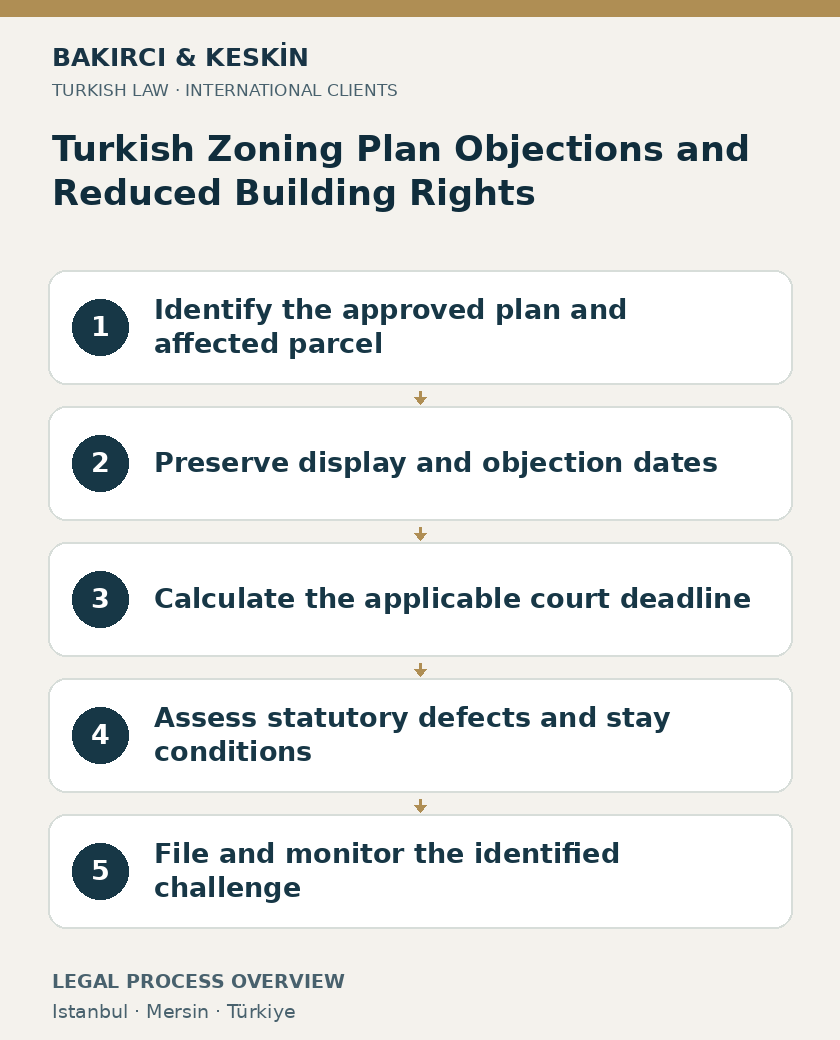
A reduction in building capacity must be traced to an identifiable administrative measure. Obtain the approval decision, the plan sheet covering the parcel, the complete plan notes and the explanatory material belonging to that version. Record the province, district, neighbourhood, block and parcel references alongside the plan approval date. A comparison between two sales brochures does not establish which legally operative provision changed. The relevant comparison is between the authenticated former planning position and the newly approved provisions affecting the same land.
Article 5 of the Zoning Law, Law No. 3194, distinguishes the master development plan, or nazım imar planı, from the implementation development plan, or uygulama imar planı. Their functions differ: the former establishes broader land-use and development decisions, while the latter supplies detailed implementation arrangements. Identify whether the dispute concerns one level, both levels, or a particular plan note. A title record establishes ownership particulars; it does not reproduce the entire public-law planning regime.
Check the authority and the procedure used for approval
Article 8(b) establishes the ordinary municipal process: the relevant municipality prepares or commissions plans within municipal boundaries, and the municipal council approves them. For the areas outside municipal and adjacent-area boundaries described by the provision, preparation and approval involve the governorate. The approval authority and the issuing body on the actual decision must therefore be identified before an objection is addressed. A property agent, contractor or land registry office cannot reconsider a planning decision merely because that person participated in the purchase.
This article concerns the ordinary Article 8 planning route. A decision adopted under a special planning regime must be assessed under its own statutory basis before the ordinary procedural timetable is used. The document heading alone is insufficient: read its legal-authority clause, approval history and annexes. In a metropolitan area, retain the decisions of each authority appearing in the approval chain. This allows the challenge to identify the actual administrative measure and the defendant authority responsible for it without treating every planning file as institutionally identical.
Obtain the complete public planning record
Article 8(b) requires plans, plan amendments and revisions to be uploaded to the electronic system established by the Ministry for recording and archiving, with a Plan Transaction Number obtained through that system. Request that number with the approval particulars. It helps distinguish a proposed revision, a version approved before objections, and a later amendment. Preserve downloaded files with the date obtained and retain the official correspondence supplying them. A screenshot of one coloured map fragment can omit the legend, scale or controlling plan note.
The same provision expressly makes development plans public and places responsibility for that openness on the relevant authorities. Municipal and administrative authorities may supply copies of all or part of a plan against the prescribed charge. Request enough of the surrounding plan to show the context of the affected parcel, rather than selecting only the line considered unfavourable. The wider material is relevant to comparing the stated land-use decision with the underlying plan hierarchy and the administrative reasons given for the amendment.
Record the one-month display and the accompanying announcements
Under Article 8(b), the ordinary approved plan is announced simultaneously for one month at the designated physical notice locations and on the relevant authority’s website. The provision also applies the approval and announcement procedures to changes in approved plans. Record the actual first and last display dates from the official announcement documents. For an owner living abroad, the statutory display is a material procedural event even though the owner did not personally visit the municipality or receive a message from the seller.
Article 8(b) additionally requires information identifying where the plan or amendment is displayed to be announced on the relevant neighbourhood head’s noticeboard during the same period. A plan amendment must also be publicised through at least two visible signs in the affected area for thirty days. These are separate statutory publicity requirements, not a substitute for obtaining the plan itself. Preserve evidence of any identified omission and its date. An allegation about defective publicity should be supported by the actual record rather than used as a reason to postpone all protective action.
Submit a specific objection during the statutory display period
Article 8(b) permits objections during the one-month display period. Identify the approved decision, the parcel, the challenged plan provision and the requested correction. Attach the plan extracts needed to explain the objection, together with the ownership or other interest documents on which the applicant relies. A technical comparison should identify exactly what changed: permitted use, building configuration, density, access or another recorded planning parameter. The objection is more useful when the requested outcome can be located on the adopted plan and connected to a stated legal defect.
For the municipal route, objections sent by the mayor’s office to the municipal council are examined and finally decided by the council within fifteen days under Article 8(b). The governorate route also contains a fifteen-day examination-and-decision requirement. Keep the submission receipt and every response. That administrative decision period must be distinguished from the judicial rules governing silence and the deadline for proceedings. An overdue response does not itself approve the owner’s requested development intensity, amend the map or suspend implementation of the challenged decision.
Calculate the court deadline from the announcement and objection history
Articles 7 and 8 of the Administrative Judicial Procedure Law, Law No. 2577, provide the ordinary sixty-day administrative-court period unless another statutory period applies and prescribe the rules for calculating time. Article 11 permits a qualifying administrative reconsideration request within the litigation period, suspends time already running and treats the request as rejected after thirty days without an answer. On rejection or deemed rejection, time resumes with the elapsed portion counted. The relevant events must therefore be listed chronologically before a final filing date is calculated.
The Council of State’s Sixth Chamber, E.2024/3544, K.2025/5268, dated 23 October 2025, applied the current thirty-day silence rule to an objection made during display. It counted that silence period from the end of display, followed by the ordinary sixty-day litigation period. Without a display-period objection, it described the ordinary sixty days as running from the day after the last display date. The majority also held that a later rejection notice and redisplay concerning other parcels did not revive the expired period. The decision contains a dissent; the majority’s thirty-day calculation should not be replaced by the dissent’s older sixty-day silence approach.
Keep the five-year outer limit separate from the ordinary filing period
Article 8(b) also states that proceedings against finalised development or subdivision plans must in any event be brought within five years of finalisation. That outer limit is not an unconditional five-year period allowing an owner to ignore the ordinary litigation deadline after announcement or an objection decision. Record finalisation separately from approval, display and notification. Those events perform different legal functions. The existence of a longer outer boundary does not establish that a particular claim filed after an applicable shorter period remains admissible.
Article 7(4) of Law No. 2577 separately permits a person affected by implementation of a regulatory measure to challenge the regulatory measure, the implementing measure, or both. It also states that the regulatory measure’s not having been annulled does not prevent annulment of an implementing measure based on it. This requires identification of a genuine implementation decision and its own procedural dates. It should not be treated as an unlimited device for reopening every expired planning challenge. The applicable outer limit and the actual relief sought remain part of the admissibility analysis.
Test the amendment against the plan hierarchy and the documented reasons
Article 8(b) requires conformity with applicable regional and environmental plan decisions. Article 8(d) also governs the relationship between planning levels, requiring lower-level plans to be brought into conformity with finalised higher-level plans within the prescribed statutory process. During the adaptation period addressed by that provision, permitting proceeds under the implementation plan in force. A higher-level change therefore needs to be analysed together with the operative lower-level plan and the statutory transition; a single newly coloured regional map does not answer every parcel-level permit question.
Under Article 2 of Law No. 2577, an annulment action examines unlawfulness in competence, form, grounds, subject matter or purpose. Structure the legal and technical assessment around the defect actually supported by the documents. A reduction in expected development profit is a consequence to document, but it does not by itself prove that one of those legal defects exists. The court reviews legality; it does not simply replace the planning authority’s judgment with the owner’s preferred design or select whichever development proposal produces the highest commercial return.
Identify the competent court and explain the affected interest
Article 2 connects an annulment action with infringement of the claimant’s interest. The application should therefore explain the relationship between the claimant, the parcel and the challenged planning measure, supported by the relevant ownership and planning documents. For an owner abroad, an organised file should use consistent parcel identifiers across translated correspondence, the title record and the plan extracts. A challenge directed at an entire extensive planning area needs an explanation of the scope of the claimant’s affected interest; the geographical breadth of the plan alone does not supply that explanation.
Article 34 of Law No. 2577 places administrative proceedings concerning application of property-related legislation, including zoning and permits, before the administrative court at the location of the immovable under its ordinary territorial rule. Territorial venue must still be distinguished from any special statutory allocation of subject-matter jurisdiction. Preserve the exact approval decision and the statute invoked by the approving body so that both questions can be checked. Living overseas does not make the owner’s foreign residence the ordinary territorial forum for challenging a Turkish parcel’s planning decision.
A lawsuit does not automatically suspend the plan
Article 27 of Law No. 2577 states that bringing an administrative case does not stop execution of the challenged administrative act. A request for a stay of execution must address the statutory conditions: manifest unlawfulness and harm that would be difficult or impossible to repair must exist together. Explain the documented legal defect and the concrete consequences of implementation separately. A general statement that the plan is financially disadvantageous does not dispense with either requirement or establish that the court has already granted protection.
The application should identify the measure for which suspension is requested and support the claimed urgency with the planning and project record. Existing permit documents, pending administrative decisions and dated site material must be distinguished from commercial forecasts. Continue monitoring the proceeding for the actual stay decision and its scope. A filing receipt, an objection receipt and a judicial stay are different documents with different legal effects. Any work undertaken on the parcel must be assessed against the authorisation actually in force, rather than an assumption that litigation has restored the former planning position.
Separate the planning challenge from existing permit and occupancy issues
Article 29 of Law No. 3194 governs commencement, completion and expiry of building permits and preserves acquired rights for construction commenced within its statutory framework. That rule requires examination of the permit and the actual construction history; it does not establish that every purchase expectation is an acquired building right. Keep the permit issue distinct from the legal challenge to a new plan. A pending application, a valid issued permit, commenced construction and a completed building each require their own factual record before the consequences of a planning amendment can be assessed.
The site’s guide to occupancy permission for foreign buyers addresses the separate permission to use a completed building. It should be read with the actual permit and planning file where both issues arise. Likewise, the property and land registry due-diligence guide provides the wider acquisition context. Neither an ownership registration nor an immigration objective resolves an administrative dispute about the planning rules governing what can lawfully be built on the land.
Prepare a reviewable file before instructing action from abroad
The completed file should allow another reviewer to reconstruct the decision and the deadline without relying on memory. Include the approval instruments, plan number, full applicable notes, authenticated map extracts, former and current planning records, display certificates, objection receipt, response and service information. Add the title particulars and a technical explanation identifying the changed provision on the correct parcel. Separate documents that establish statutory events from documents that only describe commercial expectations. This makes the requested administrative or judicial action concrete and permits the procedural timetable to be checked independently.
For the final instruction, identify the measure to be challenged, the legally supported grounds, the relief requested and any stay application. Record unresolved factual questions expressly instead of filling them with assumptions. An ordinary plan objection, a permit dispute and a compensation claim must each be classified before their procedures are selected. The immediate objective is a properly identified, timely challenge supported by the official planning record. The merits depend on the applicable legislation and established facts; neither the existence of foreign ownership nor a reduction in projected building income determines the result by itself.
Frequently asked questions
How long is an ordinary Turkish zoning plan displayed?
Article 8(b) of Law No. 3194 provides for one month of simultaneous announcement at the designated physical locations and on the relevant authority’s website. The actual display documents should be retained.
Can I object to a plan while I am abroad?
The statutory objection concerns the plan and the applicant’s affected interest. Prepare the identifiable decision, parcel documents and properly authorised submission; residence abroad does not extend the display period.
Does the municipality have fifteen days to decide an objection?
Article 8(b) gives the municipal council fifteen days to examine and decide objections referred to it. That decision requirement is distinct from the judicial deemed-rejection and litigation rules.
Is the silence period still sixty days?
Current Article 11 of Law No. 2577 uses thirty days. The Sixth Chamber’s majority in E.2024/3544, K.2025/5268 applied that current period to display-stage objections, counting from the end of display.
Does the five-year rule let me ignore the normal lawsuit deadline?
No. Article 8(b)’s five-year outer boundary must be assessed together with the ordinary applicable filing period. It is not an unconditional replacement for the shorter deadline.
Can a later implementing decision be challenged with the plan?
Article 7(4) permits a challenge to the regulatory measure, its implementing measure or both upon implementation. The actual implementing decision, applicable periods and relief must be identified.
Does filing a case restore the old plan immediately?
No. Article 27 says proceedings do not automatically suspend the challenged act. A judicial stay requires the statutory conditions and a court decision.
Which court ordinarily handles a parcel’s zoning dispute?
Article 34 ordinarily assigns property-related administrative cases to the administrative court where the immovable is situated. Any special statutory jurisdiction must also be checked.
Does a lower development value prove the new plan is unlawful?
No. Article 2 requires a legally supported defect in competence, form, grounds, subject matter or purpose. Economic effects are evidence to analyse within the legal framework.
Does a new plan automatically cancel every existing building right?
The existing permit and construction record must be assessed. Article 29 contains an acquired-rights rule for commenced construction, but it does not turn every purchase expectation into an established building right.
Official legal sources
Legal review: 28 October 2026. The official Turkish legislation controls. Record the actual display, objection and notification history before calculating the ordinary filing period and any outer limit.
Contact information
Do not include confidential documents or identity numbers in an initial message. An enquiry does not establish representation or suspend any legal deadline.
Istanbul and Mersin contact details
Bakırcı & Keskin Law Office is Mersin-based. Turkish matters are handled under the applicable jurisdiction and agreed mandate. The competent court and the scope of representation are assessed for each matter.
Istanbul — Polaris Plaza
Maslak Ahi Evran Caddesi, Polaris Plaza No:21, Floor 9, 34475 Sarıyer/İstanbul, Türkiye.Mersin — Profit İş Merkezi
İhsaniye Mahallesi, 4903. Sokak, Profit İş Merkezi No:23, Floor 3, Office 14, 33070 Akdeniz/Mersin, Türkiye.+90 552 224 43 66 · Contact details in English. An enquiry does not establish representation or suspend a legal deadline.
Istanbul Office – Polaris Plaza, Maslak / Sarıyer
Bakırcı & Keskin Hukuk Bürosu
Maslak Ahi Evran Caddesi, Polaris Plaza No:21, Kat:9, 34475 Sarıyer/İstanbul
Our physical offices in Istanbul and Mersin coordinate matters throughout Turkey, subject to jurisdiction and the local steps required for each case. Please specify your preferred office when arranging an in-person appointment.
Open the Istanbul office on Google Maps · Contact and appointments
Contact regarding a legal matter
In your first message, you may briefly state the subject, your country or city, and any relevant notification or recent procedural date. Please do not send identity numbers, medical data, or personal documents. Messaging alone does not constitute legal advice or create a lawyer–client relationship.
Discover more from Bakırcı & Keskin Hukuk Bürosu
Subscribe to get the latest posts sent to your email.