Contracts Signed After Deception or Duress in Turkey: TCO Articles 36–39
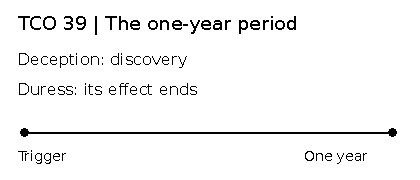
A signature does not eliminate the statutory protection against a contract induced by deception or duress. Article 36 of the Turkish Code of Obligations addresses deception, while Articles 37–38 address intimidation and its conditions. Article 39 requires timely action: the affected party is treated as having approved the contract if, within one year from discovery of the deception or the ending of the effect of intimidation, that party neither notifies the other side that it is not bound nor requests return of what it gave. The starting event, the person responsible and the remedy sought must be identified separately. A criminal complaint and a civil declaration concerning the contract are not interchangeable procedures.
Have a general question about this article? Ask anonymously
Article 36 concerns deception that led to the contract
Under Article 36 of Law No. 6098, a party who concluded a contract as a result of the other party’s deception is not bound even if the resulting mistake was not fundamental. The causal connection is essential. The file must identify the misleading conduct and explain its role in bringing about the agreement.
Start with the representations made before or during conclusion, the facts said to be untrue and the evidence establishing the difference. Preserve the original advertisement, proposal, messages, meeting record and signed agreement. A dispute cannot be adequately assessed from the later allegation that the transaction was unfair without identifying what was communicated when consent was obtained.
A later failure to perform does not by itself prove deception at formation. Breach, inaccurate performance and induced consent are different legal issues. The same facts can require examination under more than one route, but the evidence and statutory basis for each route should remain clear. The review should not label every unpaid invoice or missed delivery as fraudulent contracting.
A fundamental mistake is not an additional Article 36 requirement
Article 36 expressly states that the deceived party’s mistake need not be fundamental. That is a significant distinction from the general mistake framework. The claim still needs to establish the deception and its effect on contracting; the statutory wording does not mean that any inaccurate statement automatically defeats the agreement regardless of its relevance.
Describe the decision affected by the misleading information. Identify the term, asset, identity, authority or other fact about which the party was deceived. The point is to connect the conduct with consent, not to attach every disagreement that developed during the business relationship.
The requested consequence should also be clear. Saying that a statement was wrong, demanding performance of the existing agreement and declaring that the party is not bound are not necessarily the same legal position. A lawyer should assess the factual basis and the intended remedy before sending a notice whose wording creates avoidable uncertainty.
Third-party deception requires examination of the counterparty’s knowledge
Article 36’s second paragraph deals with deception by a third person. The affected party is not bound where, at conclusion, the contractual counterparty knew or was in a position to know of that deception. The provision therefore requires more than identifying a misleading statement by someone who was not a party to the contract.
Identify the deceiver’s role and relationship with the contracting parties. Retain the communications linking that person to the negotiations and the documents showing what the counterparty received or knew. The relevant knowledge is assessed at the time the contract was made. A later discovery by the counterparty should not automatically be substituted for that statutory time reference.
Do not assume that every intermediary is necessarily an independent third person for the legal analysis. An agent, representative or person acting in the negotiations can raise separate attribution questions. The representation and ratification guide explains why authority and consent must be examined from the actual role rather than a business-card description.
Articles 37–38 address contracts obtained through intimidation
Article 37 provides that a party who contracts as a result of intimidation by the other party or a third person is not bound. Article 38 supplies the conditions. In the affected person’s circumstances, that person must be justified in believing that a serious and imminent danger of harm threatens their own or a close person’s personality rights or property.
The assessment is therefore not limited to a threat directed at physical safety, but neither is it satisfied by ordinary commercial discomfort. Identify the threatened harm, its seriousness and proximity, the person targeted and the circumstances explaining why the fear was justified. A conclusion should be grounded in those facts rather than in the general observation that negotiations were stressful.
Preserve the exact words or conduct relied on and their context. A complete message exchange is more useful than a cropped sentence detached from the preceding discussion. Where there are witnesses, record who directly observed the event and what they can actually explain. Do not ask a witness to describe matters they learned only later as though they had personally observed them.
A threat to exercise a legal right is subject to a special test
Article 38 also addresses contracting under a threat that a right or statutory power will be exercised. Intimidation is recognised where the person making that statement obtains an excessive benefit by exploiting the other party’s difficult situation. The fact that the threatened act involves a legal right does not automatically end the inquiry.
At the same time, every notice of lawful enforcement is not automatically duress. The file must identify the asserted right or power, the difficult situation and the excessive benefit obtained through it. Those elements should be examined together. An unpopular payment demand is not, by its existence alone, proof of the specific statutory abuse.
Compare the original entitlement with the new obligation or advantage extracted in the disputed agreement. Record the timing and circumstances of the demand. This permits the legal review to distinguish ordinary assertion of a claim from the particular exploitation described by Article 38, without inventing a universal rule that any pressure invalidates a settlement.
Third-party intimidation differs from third-party deception
Article 37 expressly covers intimidation by a third person. Where the other contractual party did not know and was not in a position to know of that intimidation, the intimidated person who does not wish to remain bound must compensate the other party if equity requires it. The statute protects the ability to reject the coerced contract while addressing the innocent counterparty’s position.
This differs from Article 36’s knowledge requirement for third-party deception. A legal notice should not simply copy the third-party fraud test into a duress claim. Identify which conduct occurred and apply the corresponding provision.
The possible equitable compensation is not stated as an automatic fixed penalty. The relevant circumstances and loss must be examined. A person seeking release should therefore be advised about the complete statutory framework rather than told that invoking third-party coercion necessarily produces a cost-free exit from every transaction.
Article 39 has a one-year period with different starting events
For deception, Article 39 starts the period when the affected party learns of the deception. For intimidation, it starts when the effect of intimidation ends. The contract’s signing date is not presented as the universal starting date for both situations. The factual basis of the asserted starting event must be established.
Prepare a dated chronology of discovery or cessation. Identify the document, communication or event that revealed the deception, or the circumstances showing that the coercive effect ended. Avoid assigning a convenient date solely because it produces a longer period. Conflicting records must be considered before calculating the deadline.
The provision also applies to mistake, but that does not make every mistake a deception case. Classification remains important for the substantive requirements. Where several grounds are genuinely supported, their respective facts and discovery dates should be recorded separately rather than merged into one unsupported narrative.
The required action is not described only as filing a lawsuit
Article 39 states that the party is treated as having approved the contract if it neither notifies the other side that it is not bound nor asks for return of what it gave within the period. It is therefore inaccurate to paraphrase the provision only as a one-year deadline for every possible civil lawsuit. The text identifies the relevant acts preserving the non-binding position.
A declaration should identify the agreement, the supported ground and the legal position being asserted. Keep proof of its content, addressee and delivery. A message merely asking the other party to call back does not necessarily communicate that the contract is rejected. The appropriate channel and any related procedural step must be selected for the individual transaction.
Do not rely on continuing discussions as an assumed extension of the statutory period. A request for more evidence, informal renegotiation or a pending investigation must be assessed separately. The review should ensure that the actual Article 39 action is addressed instead of assuming that any complaint to any institution performs the same function.
Compensation and recovery are separate from the approval question
Article 39’s second paragraph states that treating a contract affected by deception or intimidation as approved does not eliminate the right to compensation. This is an express distinction between the contract’s binding position and damages. It does not mean that every damages claim succeeds automatically or remains available without regard to its own requirements.
Identify the loss claimed, the causal link and the person against whom compensation is sought. Separate return of a payment from expenses or other loss. The evidence should not treat the gross value of the transaction as necessarily identical to recoverable damage.
Where property, registered rights or a separately enforceable instrument is involved, further action can be required to obtain the practical result. A declaration concerning consent is not itself a bank transfer, cancellation of a registry entry or termination of a pending enforcement file. The remedy must match the asset and procedure involved.
Civil contract protection and criminal complaints serve different purposes
The provisions discussed here address the civil effect of impaired consent. A criminal complaint concerns a different process and its own legal elements. A party should not assume that an allegation made to police automatically returns the purchase price or supplies the declaration required by Article 39.
Where a criminal route is also considered, maintain a consistent factual chronology and identify the evidence supporting each assertion. Our foreign victim’s criminal-complaint guide explains that route. It should be used alongside, not instead of, review of the civil contract and its time-sensitive remedies.
Similarly, a served payment order or lawsuit requires its own procedural response. A person alleging coercion should provide the full document and service record promptly. The existence of a substantive objection does not itself file a defence or pause a proceeding.
Evidence for clients outside Turkey
Keep the complete signed instrument, all language versions, negotiations, advertisements, payment records and the later discovery documents. For intimidation, add the chronology of threats and the facts concerning when their effect ended. Distinguish original records from summaries prepared afterwards.
Preserve electronic material lawfully. The electronic-evidence guide addresses original records and authenticity questions. Do not access another person’s account or alter a message sequence to strengthen a claim. A complete, traceable record allows the legal issue to be assessed without creating a separate evidential problem.
Foreign execution or nationality does not itself decide the law governing consent. The international-contract guide explains the preliminary governing-law assessment. Once the relevant Turkish provisions are identified, the substantive grounds, Article 39 chronology and appropriate procedural measures can be evaluated together.
Frequently asked questions
Does signing prevent a deception claim?
No. Article 36 protects a party who contracted as a result of the other party’s deception. The conduct, causal connection and timely Article 39 action must be established.
Must deception also produce a fundamental mistake?
Article 36 expressly says the mistake need not be fundamental. That does not remove the need to establish deception that led to the contract.
What changes when an independent third person deceived me?
Under Article 36, the contractual counterparty must have known or been in a position to know of the third person’s deception when the agreement was concluded.
Is commercial pressure always duress?
No. Article 38 requires justified belief in serious and imminent harm to the affected person or a close person’s personality rights or property, assessed in the relevant circumstances.
Can threatening lawful enforcement amount to intimidation?
Article 38 recognises it where the person threatening to exercise a right or statutory power obtains an excessive benefit by exploiting the other party’s difficult situation. A lawful demand alone does not establish all those elements.
Does third-party duress require the counterparty’s knowledge?
Article 37 covers third-party intimidation even where the counterparty lacked the relevant knowledge. In that situation equitable compensation to the innocent counterparty can be required when the intimidated party rejects the contract.
When does the one-year period begin?
Article 39 uses discovery of deception or the ending of intimidation’s effect. It does not use the signing date as one universal starting point.
Must Article 39 always be described as a lawsuit deadline?
No. It addresses notification that the party is not bound or a request for return of what was given within one year. The required declaration and any court procedure must be distinguished.
Does deemed approval eliminate every compensation right?
Article 39 expressly preserves compensation rights for deception or intimidation despite deemed approval. The compensation claim still requires its own legal and evidential assessment.
Does a criminal complaint automatically undo the contract?
No. Criminal proceedings and civil contract remedies are distinct. The civil declaration, return claim and any procedural defence must be assessed separately.
Official legal sources
Turkish Code of Obligations No. 6098, Articles 36–39; official Ministry text, page 7. The English terms deception and duress are explanatory; the governing Turkish provisions control.
Istanbul and Mersin offices
Bakırcı & Keskin Law Office coordinates Turkish matters from Mersin and Istanbul. For an English-language assessment, state the contract date, discovery or cessation date and any urgent notice through the contact section. Agree a secure channel before sharing private evidence.
Istanbul — Polaris Plaza
Maslak Ahi Evran Caddesi, Polaris Plaza No:21, Floor 9, 34475 Sarıyer/İstanbul.
Mersin — Profit İş Merkezi
İhsaniye Mahallesi, 4903. Sokak, Profit İş Merkezi No:23, Floor 3, Office 14, 33070 Akdeniz/Mersin.
Call +90 552 224 43 66. General information; an enquiry does not establish representation or suspend a legal deadline.
Contact regarding a legal matter
In your first message, you may briefly state the subject, your country or city, and any relevant notification or recent procedural date. Please do not send identity numbers, medical data, or personal documents. Messaging alone does not constitute legal advice or create a lawyer–client relationship.
Discover more from Bakırcı & Keskin Hukuk Bürosu
Subscribe to get the latest posts sent to your email.