Transferring or Joining a Contract in Turkey: Consent and TCO Articles 205–206
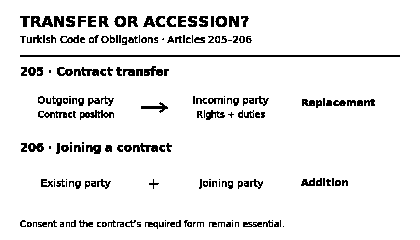
Transferring a contract in Turkey changes the person who holds the contractual position, not merely the bank account receiving payment. Article 205 of the Turkish Code of Obligations regulates an agreement transferring a party’s status together with the rights and obligations arising from the contract. Article 206 regulates a different transaction: a new person joins alongside an existing party and acquires rights and obligations with that party. Consent and the required contractual form are central to both mechanisms. A business handover should therefore identify whether it replaces a party, adds a party, assigns a receivable or transfers an individual debt before anyone starts performing under a new name.
Have a general question about this article? Ask anonymously
Identify the contractual position that is supposed to move
A contract can contain payment rights, delivery obligations, confidentiality duties, termination rights, reporting obligations and continuing service commitments. Transferring one invoice does not necessarily transfer that whole relationship. Article 205 addresses the contractual position itself: the incoming party takes the outgoing party’s place with the rights and obligations arising from the contract. The first practical task is to identify the exact agreement and the party whose position is being transferred.
Record the agreement date, parties, amendments, incorporated schedules and current performance stage. A transaction described as transferring a customer account can concern several separate supply orders, a framework agreement and an unrelated service arrangement. Listing them precisely avoids assuming that consent to one transfer covers every contract between the businesses. A commercial customer reference is useful evidence, but it is not a complete description of the legal relationship.
Article 19 requires the parties’ actual common intention to be considered when determining and interpreting a contract’s nature and content. The heading on an English document is therefore not decisive. A document called an assignment, takeover or novation must be assessed by what it actually does under the applicable law. The official Turkish Code of Obligations No. 6098 provides the starting point for that classification.
Article 205 normally involves three legal positions
The first paragraph identifies the transferor, the transferee and the party remaining in the contract. Their agreement transfers the outgoing party’s contractual status, including the associated rights and obligations, to the incoming party. The remaining party is not a stranger whose interests can simply be disregarded: it originally contracted with someone else and has an interest in who will perform the obligations and exercise contractual rights.
The clearest document structure identifies all three participants, the original agreement and the intended substitution. The remaining party’s consent should relate to that substitution rather than merely acknowledge receiving a notice. A signature confirming receipt of correspondence does not, without more, establish agreement to every legal effect stated in an attached handover document.
A contract between a seller and a buyer allocating contracts internally is consequently different from evidence that the customers or suppliers have agreed to substitution. The seller and buyer should maintain a consent register for each contract requiring action. Their acquisition agreement can allocate the risk of missing consent between themselves; that allocation does not by itself supply the remaining contractual party’s consent under Article 205.
Prior permission and subsequent approval are recognised expressly
Article 205’s second paragraph also covers an agreement between transferor and transferee based on the remaining party’s prior permission or subsequently approved by that party. All three participants therefore do not necessarily have to sign the same sheet at the same moment. What must be established is the legally relevant permission or approval and its connection with the particular transfer.
For prior permission, examine the original clause’s scope. It can identify a class of transferees, a notification process or conditions relevant to the proposed substitution. Do not treat permission limited to a named group entity as permission to transfer to any unrelated purchaser. Record the documents showing that the agreed conditions were fulfilled and retain the communication identifying the actual incoming party.
For subsequent approval, preserve the approval itself and the preceding transfer instrument. Establish what the remaining party was asked to approve, who responded and whether that person had authority. Article 205 does not make every unanswered email an approval. Where a party relies on conduct rather than express wording, the legal review must examine that conduct under the applicable declaration and form rules instead of replacing missing evidence with an assumption.
The required form follows the contract being transferred
Under Article 205’s third paragraph, the transfer’s validity depends on the form of the transferred contract. Article 206 contains the corresponding rule for accession. The form question must therefore be answered by identifying the underlying contract and any special provision governing it. There is no universal rule that every Turkish contract transfer needs a notary, and no universal rule that an ordinary email is sufficient.
Articles 12–17 distinguish statutory form, written form, signature requirements and form agreed by the parties. Review those provisions with the underlying transaction. Where a legal validity form is required, a commercial handover schedule does not dispense with it. Where the parties have agreed a particular form, the relevant clause and Article 17 also need examination.
The execution method should be selected after this analysis. A scanned signature, a secure electronic signature and an official-form transaction are not interchangeable concepts. Authentication of a foreign signature likewise does not automatically satisfy every Turkish requirement for the particular contract. Preserve the executed original or legally valid electronic record, the applicable consent and the authority documents as one completion file.
Article 206 adds a party rather than substituting one
Accession to a contract is an agreement between the joining person and the parties to an existing contract. The joining person takes a position alongside one existing party and acquires that party’s rights and obligations with it. The existing party remains in the relationship. That continuing participation is the essential difference from replacing the outgoing party through Article 205.
Article 206’s second paragraph establishes a default consequence: unless otherwise agreed, the joining person and the party alongside whom it joins are jointly and severally creditors and debtors towards the other contractual party. The rule therefore concerns both sides of the contractual position. It is incomplete to describe accession only as adding another person who can be sued for an invoice.
The agreement should specify the side being joined, any departure from the statutory default and how performance is to be administered. Payment instructions, delivery coordination and the handling of contractual notices should be consistent with the resulting legal positions. Administrative convenience should not obscure whether a party has obtained rights, undertaken duties or merely agreed to assist another participant with performance.
Compare the transaction with neighbouring legal mechanisms
| Mechanism | What changes | Main statutory reference |
|---|---|---|
| Contract transfer | An incoming person replaces a contractual party in that contractual position. | Article 205 |
| Accession to a contract | A person joins alongside an existing party and shares the contractual position. | Article 206 |
| Assignment of a receivable | The holder of a claim changes; that alone does not transfer every contractual duty. | Articles 183–194 |
| Assumption of a debt | The debt arrangement changes under the applicable internal or external assumption mechanism. | Articles 195–200 |
| Accession to a debt | An additional debtor joins an existing debt without necessarily acquiring the whole contractual position. | Article 201 |
These distinctions are useful when a purchaser takes over a trading business or a group reorganises its contracts. The intended commercial result determines which documents are needed. A person seeking only payment of assigned invoices should not assume it also obtained the right to vary delivery obligations. An incoming operator assuming a debt should not assume that the agreement automatically transferred the customer’s entire relationship.
The separate guides on assignment of receivables and debt assumption and creditor consent examine those mechanisms. They should be consulted for their own statutory conditions, not used as substitutes for the consent and form requirements of a whole-contract transfer.
Prepare the handover around obligations, not just documents
A useful completion schedule identifies performance already completed, performance still due, unpaid sums, advances, disputed invoices, outstanding notices and known complaints. The purpose is to make the transferred relationship intelligible to all participants. Merely handing over an electronic folder does not answer which invoices have been paid or which contractual time limits are already running.
Record the effective date and any conditions to completion. Deal expressly with the treatment of accrued claims, outstanding breaches and any liability or reimbursement obligations retained between transferor and transferee. Article 205’s transfer of contractual status should not be presented as a universal release of every separate liability the outgoing party has ever incurred. Separate undertakings and claims require their own analysis.
Security also deserves a separate schedule. List guarantees, suretyships, pledges, insurance arrangements and deposits, identify their grantors and beneficiaries, and check the rules governing each instrument. Articles 205–206 do not justify a blanket statement that every third-party security automatically survives unchanged. Obtain any legally required consent or replacement instrument before representing that security as available after completion.
Lease and employment transfers have special rules
Article 205 expressly reserves statutory succession and other special provisions. A general transfer clause therefore cannot be read in isolation when the agreement belongs to a specially regulated category. The special rule can determine whose consent is necessary, its form and the liabilities that remain after the transfer.
For a lease transfer, Article 323 requires the landlord’s written consent and provides that a landlord cannot withhold consent to a workplace lease transfer without just cause. The provision separately regulates the legal position of the incoming and outgoing tenants. This is not identical to subletting under Article 322. An agreement permitting somebody to use premises should not be described as a complete tenant substitution without checking the actual arrangement.
For a permanent transfer of an individual employment contract, Article 429 requires the employee’s written consent. It provides that the incoming employer takes the employer’s position with all rights and obligations and preserves the original start date for service-related rights. Transfer of an undertaking is a separate mechanism; our workplace transfer guide deals with that different issue. A general commercial template should not collapse these routes into one.
Authority, foreign documents and contractual restrictions
Confirm the legal identity of every corporate participant and the authority of the person signing for it. A shared brand, website or group owner does not make two companies the same contracting party. The document should use the correct registered names and identifying information so that invoices, notices and performance records can be matched to the resulting relationship.
Representation issues are distinct from consent. A person purporting to approve a transfer for another entity must be assessed under the relevant authority rules. The guide to unauthorised representation and ratification explains why an unverified signature cannot be treated as conclusive approval. International authority and governing-law questions also require their applicable conflict-of-laws analysis.
Read prohibitions, permitted-transfer clauses and notice provisions in the existing agreement. When wording was prepared for repeated use, the general-terms rules in Articles 20–25 can be relevant to incorporation, interpretation and content. The standard contract terms guide examines those controls. A printed permission clause should not be assumed immune from the legal rules applying to the document.
When a disputed transfer has already taken place
Preserve the complete original contract, transfer instrument, approval correspondence and performance records before asking who must now pay or deliver. Identify whether the dispute concerns absence of consent, defective form, lack of authority, the scope of what moved or breach after the handover. Different defects require different legal arguments and evidence.
Do not let the transfer dispute obscure an existing court or enforcement deadline. A request asking the parties to confirm who is responsible does not itself replace a procedural response to a served document. Record the service date and obtain the full claim or payment order. Commercial discussions and defence preparation should proceed on the basis of the actual documents, not a seller’s informal promise to resolve the situation.
Frequently asked questions
Can two businesses transfer a contract without involving the customer?
Article 205 requires the remaining party’s participation, prior permission or subsequent approval for the contractual substitution it regulates. An internal agreement allocating the contract between the businesses does not itself prove that the customer accepted the transfer.
Must all three participants sign one document?
Not invariably. Article 205 recognises prior permission and subsequent approval as well as a three-party agreement. The relevant consent and required form must still be established for the actual transaction.
Does assigning an invoice transfer the entire contract?
No. Assignment concerns the claim. Transferring the whole contractual position, including the associated rights and duties, is the different mechanism described by Article 205.
Does accession remove the original party?
No. Under Article 206 the joining person takes a position alongside an existing party. Unless otherwise agreed, they become jointly and severally creditors and debtors towards the opposite contractual party.
Is notarisation required for every contract transfer?
No universal notarisation rule appears in Article 205. The transfer must comply with the form required for the transferred contract, together with any applicable special rules and relevant agreed-form requirements.
Can prior consent in the original agreement be used?
Article 205 expressly recognises prior permission. Its scope and conditions must cover the proposed transfer. Permission for a limited class of transferees should not be treated as unrestricted consent.
Does an English heading determine whether the document is a transfer?
No. Article 19 directs attention to the parties’ actual common intention when determining the contract’s type and content. The operative rights and obligations matter more than an isolated heading.
Can a workplace lease be transferred on the general rule alone?
The special lease-transfer provision in Article 323 must be considered. It requires the landlord’s written consent and restricts refusal without just cause for workplace leases.
Can an individual employment contract be moved without written employee consent?
Article 429 requires the employee’s written consent for the permanent contractual transfer it regulates. A transfer of an undertaking follows a distinct legal framework and must be classified separately.
What should an overseas business provide for review?
Provide the original agreement, amendments, proposed transfer or accession, consent records, signatory authority and a schedule of outstanding obligations. Identify the effective date and any served proceedings before arranging a confidential document channel.
Official legal sources
Turkish Code of Obligations No. 6098, Articles 12–19, 20–25, 183–206, 322–323 and 429. The official Ministry text, page 39 sets out Articles 205–206. English explanations are explanatory translations; the Turkish statutory text governs.
Istanbul and Mersin offices
Our Mersin-based practice coordinates Turkish matters from offices in Mersin and Istanbul. For a contract-transfer review in English, identify the agreement, the intended party change and the proposed completion date through the English contact section. Agree a confidential channel before sending contracts or identity records.
Istanbul — Polaris Plaza
Maslak Ahi Evran Caddesi, Polaris Plaza No:21, Floor 9, 34475 Sarıyer/İstanbul.
Mersin — Profit İş Merkezi
İhsaniye Mahallesi, 4903. Sokak, Profit İş Merkezi No:23, Floor 3, Office 14, 33070 Akdeniz/Mersin.
Call +90 552 224 43 66. General legal information; an enquiry does not create a mandate or suspend a deadline.
Contact regarding a legal matter
In your first message, you may briefly state the subject, your country or city, and any relevant notification or recent procedural date. Please do not send identity numbers, medical data, or personal documents. Messaging alone does not constitute legal advice or create a lawyer–client relationship.
Discover more from Bakırcı & Keskin Hukuk Bürosu
Subscribe to get the latest posts sent to your email.