The Turkish Developer Changed Your Apartment: Contract Remedies for Overseas Buyers
A developer’s offer of a different apartment does not, by itself, replace the apartment it promised to deliver. Start with the legally operative contract, the exact unit description and the proposed amendment. Turkish Code of Obligations Articles 112 and 123–125 govern defective performance and default within their respective conditions. Where the transaction is a consumer prepaid housing sale, Law No. 6502 adds mandatory protections, including Article 45(2), under which a seller that fails to perform its obligations properly cannot demand the withdrawal charges addressed by that provision.
Have a general question about this article? Ask anonymously
This guide concerns an overseas buyer offered a replacement unit, a different development or substantially altered specifications. It explains how to compare the offer, preserve the original claim and separate a negotiated replacement from a legal remedy for non-performance.
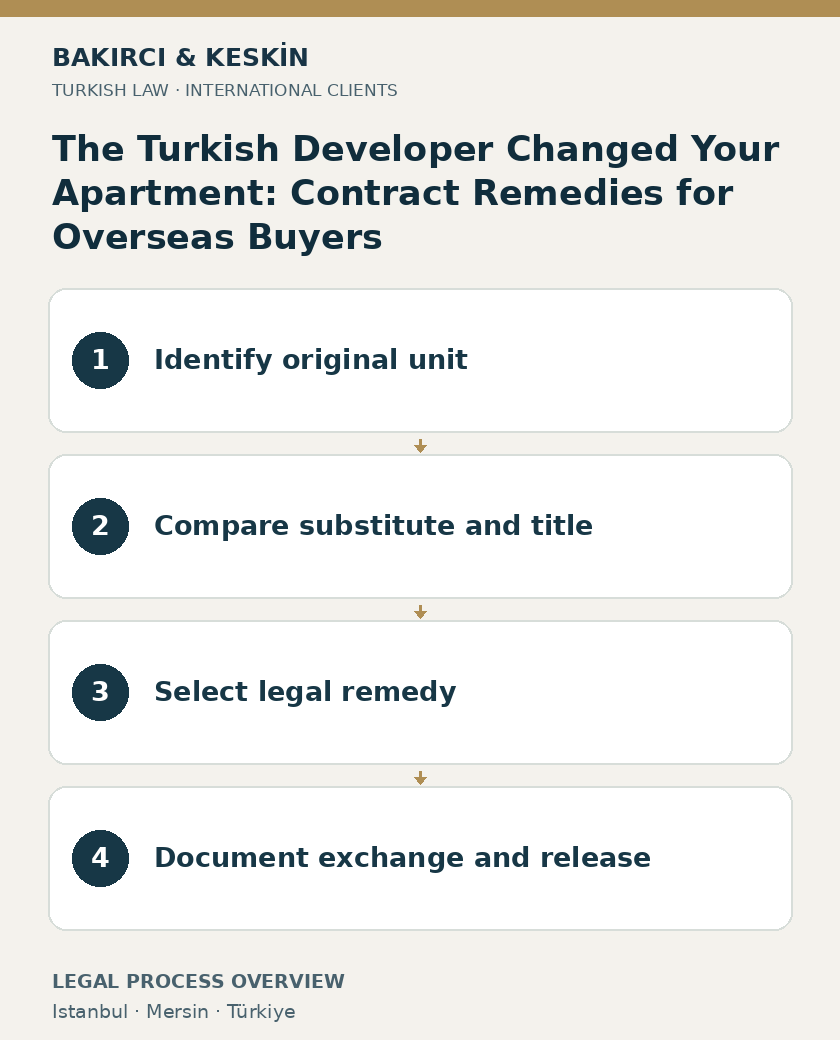
Quick summary
| Legal issue | The Turkish Developer Changed Your Apartment: Contract Remedies for Overseas Buyers |
|---|---|
| Short answer | A developer's offer of a different apartment does not, by itself, replace the apartment it promised to deliver. Start with the legally operative contract, the exact unit description and the proposed amendment. Turkish Code of Obligations Articles 112 and 123–125 govern defective performance and default within their respective conditions. Where the transaction is a consumer prepaid housing sale, Law No. 6502 adds mandatory protections, including Article 45(2), under which a seller that fails to perform its obligations properly cannot demand the withdrawal charges addressed by that provision. |
| Key legislation | Law No. 6098 — Articles 112, 123-125, 219, 237; Law No. 6502 — Articles 3, 8-11, 40-45 |
Identify the apartment that was actually promised
Begin with every signed version of the agreement, its schedules and any official sale promise. A marketing name is rarely enough to identify a Turkish apartment. Match the province, district, neighbourhood, cadastral block and parcel, building designation, floor and independent-unit number. Check whether a temporary project number was subsequently replaced by a cadastral number and retain the document connecting the two. A clerical renumbering and a transfer to a different parcel are materially different events.
List the specifications that formed part of the bargain: internal layout, stated area and measurement method, floor, orientation, parking or storage entitlement, delivery condition and agreed completion date. Preserve the plan actually supplied when the contract was made. A new brochure downloaded after the dispute began does not establish what was promised at the time of payment. If the agreement incorporates a technical specification, obtain the incorporated version, including its date and signatures.
Article 237 of the Turkish Code of Obligations makes official form central to real-estate sales and sale promises. The guide to preliminary property sale agreements explains that formation issue. Here, the task is to establish which obligation the later replacement proposal is supposed to change.
Identify the company that owes performance
The developer’s brand, landowner, construction contractor, sales intermediary and recipient bank-account holder may be different persons. Read the contracting party’s legal name and registration details. Compare those details with payment receipts and correspondence. A message from the marketing team announcing that another company will finish construction does not automatically demonstrate a transfer of the buyer’s contractual rights or a release of the original seller.
Ask for the legal document explaining any change of company, rather than accepting a new logo as the explanation. Distinguish a change in the same company’s name from a different company offering to take over the project. Record who owns the land and who has undertaken to transfer the apartment. The ability to complete construction and the legal obligation to provide title require separate examination.
When a replacement proposal introduces a new counterparty, obtain that entity’s signature and authority documents. Keep the original seller’s continuing obligations explicit. The buyer should be able to identify who owes the refund, who must deliver the replacement and which existing claim, if any, is being released. An unexplained switch of debtor creates an additional dispute before the property problem has been solved.
Check whether prepaid housing consumer protection applies
Law No. 6502 defines the consumer by the non-commercial or non-professional purpose of the transaction. Overseas residence or foreign nationality does not itself decide that classification. Examine the purchase purpose and the seller’s professional activity. A company acquiring premises for its business should not automatically be treated like an individual acquiring a holiday home.
Articles 40 and 41 of Law No. 6502 regulate prepaid housing contracts, pre-contract information and required form. Article 41 also prevents the seller from invoking the specified invalidity against the consumer and prohibits demanding payment before a valid contract has been made. Those rules matter where a developer responds to a dispute by claiming that its own informal paperwork deprived the buyer of every remedy.
Article 44 requires delivery within the promised period and imposes a maximum period of forty-eight months from the contract date. That outer limit does not rewrite an earlier contractual delivery date as forty-eight months. Identify the transaction date and any applicable transitional issue before using the rule. Special prepaid housing regulation, the actual contract and the legal character of a project variation must also be reviewed before issuing a time-sensitive notice.
Compare the replacement with the contractual apartment
Build a comparison using documents and measurements. Place the original obligation beside the replacement proposal, then identify every change. Include the parcel, legal title status, apartment area, layout, floor, permitted use, handover date, remaining instalments and additional expenses. A claim that the replacement is “better” supplies none of this information.
Use independent technical information where the difference concerns structure, area or completion. A salesperson’s statement about increased value should not replace a valuation, and an artist’s rendering should not replace an approved plan. Ask whether the replacement is presently owned by the proposed transferor and whether it is subject to mortgages, attachments or third-party rights. Apparent physical progress does not answer those registry questions.
Separate matters that can be corrected before handover from permanent changes to the asset. A missing fixture and a different floor present different practical solutions. Where the buyer’s purpose depended on a particular characteristic, preserve the correspondence showing that characteristic was communicated and agreed. The legal file should explain the significance of the difference rather than merely attaching two inconsistent sales brochures.
Read a replacement agreement as a new legal decision
A replacement document can do more than change an apartment number. It may acknowledge full performance, extend the delivery date, alter the price, settle delay claims or release the original seller. Read the operative clauses together. A heading such as “allocation update” does not restrict the effect of the text underneath it.
Identify whether the buyer is being asked to give immediate and unconditional release in return for future performance. If title transfer and delivery have not yet occurred, that timing matters. Record the promised exchange: what the seller must do, by when, and what happens if it fails. Do not rely on an oral assurance that a broad release “will not be used” after signing it.
Language also matters. Compare the Turkish and English versions and determine which version the agreement gives priority. A translator should retain the difference between a proposed allocation, an unconditional transfer obligation and an acceptance of completed performance. Preserve the draft history so the parties can distinguish a negotiated change from a provision inserted without explanation.
Distinguish a substitute offer from proper performance
Article 112 addresses a debtor’s liability for damage from non-performance or improper performance, subject to the debtor establishing absence of attributable fault. A replacement offer does not itself establish performance of the original obligation. Equally, the existence of a dispute does not remove the need to establish breach, loss and the applicable contractual relationship.
Articles 123–125 regulate remedies following default in reciprocal contracts. Article 123 provides for an appropriate period for performance; Article 124 identifies circumstances in which an additional period is unnecessary. Article 125 then separates continued performance with delay compensation from the other statutory choices. The correct route depends on the actual default and notices, not on a standard cancellation paragraph copied from another dispute.
Article 125(2) requires immediate notification when the creditor elects to give up performance and delay compensation in favour of non-performance damages or withdrawal under that provision. The timing and wording of the election therefore need attention as soon as the applicable additional period expires or an Article 124 exception applies. A general discussion about alternative apartments should not be assumed to constitute that statutory notice.
Keep a chronology showing the agreed due date, changes actually accepted, requests for performance and the seller’s responses. Record whether the original apartment remains deliverable. A developer’s unequivocal refusal, a construction delay and an invitation to consider another unit require different analysis. Do not let continued discussions obscure the date on which legal action is required.
Select the remedy before calculating the demand
The buyer must decide what relief is sought and on what legal basis. Continuing to demand the original apartment, agreeing to a documented replacement, seeking a price adjustment and withdrawing with restitution are different positions. Plead alternative relief where procedurally appropriate, but do not send mutually inconsistent final instructions without understanding their consequences.
Where consumer defective-goods rules apply, Articles 8–11 of Law No. 6502 address conformity and the consumer’s statutory choices. Where the issue is an unperformed future transfer, the default and prepaid-housing rules require separate consideration. The fact that both disputes involve an apartment does not make every remedy interchangeable.
Under Article 45(2), a prepaid housing seller that does not perform its obligations, or does not perform them properly, cannot demand the charges addressed by that withdrawal regime. This distinction matters when the developer treats its own breach as the buyer’s unexplained change of mind. The notice should identify the documented non-performance. It should not merely reproduce the seller’s description of a voluntary cancellation.
Reconcile money paid before accepting a credit
Prepare a payment schedule containing the date, currency, payer, recipient, reference and purpose of every transfer. Include cash receipts and payments made through an authorised intermediary. Identify the evidence connecting payments to this particular apartment. A total written in a settlement draft should be checked against the underlying records rather than accepted because it resembles the buyer’s recollection.
If the developer offers to “transfer the balance” to another project, explain exactly which amount is transferred and how exchange-rate differences, paid fees and accrued contractual claims are treated. Distinguish a credit against the new price from repayment into the buyer’s bank account. Neither description should conceal an additional payment obligation.
Keep separate schedules for the principal paid, documented additional loss and any contractual penalty claimed. Avoid double counting the same loss under different headings. A refund calculation must also account for money already returned and any benefit that the legal remedy requires the buyer to restore. Clear accounting makes the proposed settlement and the litigation alternatives comparable.
Preserve evidence that can be reviewed from abroad
Save complete emails, messages and attachments, including sender information and dates. Preserve the original files containing plans and sales specifications. Screenshots are useful for immediate capture, but a cropped image without its surrounding conversation may conceal whether the seller made a binding statement, offered an option or asked a question.
Record changes to the project with dated photographs and an independent technical report where needed. Keep the photographer’s identity and the location of each image. Where the site is inaccessible, document the access request and response. Do not represent a photograph from a different building as evidence of the purchased unit’s condition.
The electronic evidence guide explains preservation of messages for Turkish proceedings. For this dispute, a short chronology and comparison table should accompany the source records. They help the lawyer assess the evidence while the buyer remains overseas without pretending that a summary replaces the originals.
Check title, mortgages and the effect of existing protection
Obtain a current registry record for both the original and proposed replacement property. An annotation concerning the original parcel does not automatically protect a new parcel. Identify any step needed to establish or preserve protection when the agreement changes. The order of signatures, payments, releases and registry acts should be coordinated, because completing one step may change the buyer’s position before the others occur.
A sale promise and ownership are separate legal positions. Review the official form, annotation and the seller’s ability to transfer. Foreign acquisition restrictions also remain relevant to a substitute property. A contractual clause promising delivery cannot waive the legal restrictions governing the final acquisition.
Where there is a concrete risk of disposal or dissipation, assess appropriate court protection using the applicable conditions and evidence. Interim relief is not automatic merely because a developer has proposed another apartment. The requested measure must fit the right asserted and the identified risk. Keep security planning separate from unsupported statements that every payment is recoverable.
Make a negotiated replacement verifiable
An acceptable settlement identifies the exact replacement asset, its condition, title status, price reconciliation, delivery obligations and the parties responsible. It should state what happens to existing promises, annotations and pending claims. Any release should match the performance actually received or the agreed conditional structure.
Set objective completion evidence: the registry transaction, signed handover record, agreed technical documents and reconciliation of money. A general statement that the project is “ready” is difficult to test. If defects remain, list them and specify the agreed remedy without confusing physical handover with acceptance of every obligation.
Keep the buyer’s mandate aligned with the settlement. A representative authorised to obtain records may not have the required authority to surrender claims, accept another property or complete title-related acts. Obtain the appropriate authority before the signing appointment and check the final document against the version the buyer approved.
Prepare an instruction that allows a concrete legal review
Send the signed contract and schedules, payment ledger, original-unit identification, replacement proposal and key correspondence first. Add a one-page account of the buyer’s objective: delivery of the contracted property, an acceptable replacement or recovery of money. Identify any impending signing date, instalment deadline, court notice or threatened disposal.
Keep original records available for later use and arrange Turkish translations of the documents selected for the procedure. Do not sign a new release simply to obtain more information. The initial review should establish the enforceable obligation, the applicable consumer or general contract rules, the evidence of breach and the remedy that corresponds to the buyer’s chosen objective.
Keep the comparison attached to the final decision
Retain the completed unit comparison with the buyer’s written instructions. Identify any unresolved item expressly: a missing registry extract, unconfirmed parking entitlement, undelivered technical specification or unexplained extra charge. The decision to accept a replacement should be based on the actual information available, with outstanding conditions stated in the agreement. A salesperson’s later account of what the buyer allegedly accepted is easier to test when the reviewed documents and final instructions have been preserved together. If the proposal changes again, update the comparison and obtain the new operative document instead of treating approval of an earlier proposal as approval of every later version.
Special notice and withdrawal rule for prepaid housing project changes
Article 11 of the Regulation on Prepaid Housing Sales requires a later project change to be notified in writing or through a durable medium. A consumer who does not accept the change may withdraw within one month without a charge under the names of tax, fee, expense or compensation. Where the change arises from a legal requirement or force majeure, the regulation permits deductions by reference to Article 9(3). Check the notice, the reason for the change and the applicable transaction dates before calculating the deadline or deductions.
Frequently asked questions
Does an email offering another apartment replace my contract?
No. The legal effect depends on the operative contract, required form and an effective agreement to vary it. A unilateral offer is not proof of your acceptance.
Does a new project name mean the seller changed?
No. Check the legal entity and registry information. A brand change and a different contracting company are separate matters.
Is forty-eight months always the permitted delivery date?
No. Article 44 requires the promised contractual period to be observed and sets an outer limit. It does not automatically extend an earlier agreed date.
Can the developer call its own breach a voluntary cancellation?
The legal character depends on the facts. Article 45(2) specifically addresses failure to perform the seller’s obligations properly and the associated prohibition on charges.
Should the new unit’s value be accepted from a brochure?
No. Compare the contractual specifications, title records and appropriate technical or valuation evidence.
Does a transferred credit equal a refund?
No. A credit reduces an identified payment obligation; a refund returns money. The settlement must state which is being provided.
Will the old sale-promise annotation cover another parcel?
Do not assume so. Registry protection must be reviewed for the particular property and right.
Can I preserve my claim while discussing a replacement?
Negotiation and legal deadlines must be managed together. Review proposed acknowledgments, releases and extensions before signing.
Can an overseas buyer instruct a Turkish lawyer remotely?
The evidence can be reviewed remotely. Representation and property-related transactions require authority appropriate to the acts to be performed.
What should I send first?
Send the signed agreement, schedules, payment evidence, original unit details and complete replacement proposal, together with any imminent deadline.
Official legal sources
Turkish Code of Obligations No. 6098, Articles 112, 123–125, 219 and 237; Consumer Protection Law No. 6502, Articles 3, 8–11 and 40–45. Source review: 26 October 2026. This English explanation does not replace the operative Turkish legislation or the review of a particular agreement.
Contact information
Do not include confidential documents or identity numbers in an initial message. An enquiry does not establish representation or suspend any legal deadline.
Istanbul and Mersin contact details
Bakırcı & Keskin Law Office is Mersin-based. Turkish matters are handled under the applicable jurisdiction and agreed mandate. The competent court and the scope of representation are assessed for each matter.
Istanbul — Polaris Plaza
Maslak Ahi Evran Caddesi, Polaris Plaza No:21, Floor 9, 34475 Sarıyer/İstanbul, Türkiye.Mersin — Profit İş Merkezi
İhsaniye Mahallesi, 4903. Sokak, Profit İş Merkezi No:23, Floor 3, Office 14, 33070 Akdeniz/Mersin, Türkiye.+90 552 224 43 66 · Contact details in English. An enquiry does not establish representation or suspend a legal deadline.
Istanbul Office – Polaris Plaza, Maslak / Sarıyer
Bakırcı & Keskin Hukuk Bürosu
Maslak Ahi Evran Caddesi, Polaris Plaza No:21, Kat:9, 34475 Sarıyer/İstanbul
Our physical offices in Istanbul and Mersin coordinate matters throughout Turkey, subject to jurisdiction and the local steps required for each case. Please specify your preferred office when arranging an in-person appointment.
Open the Istanbul office on Google Maps · Contact and appointments
Contact regarding a legal matter
In your first message, you may briefly state the subject, your country or city, and any relevant notification or recent procedural date. Please do not send identity numbers, medical data, or personal documents. Messaging alone does not constitute legal advice or create a lawyer–client relationship.
Discover more from Bakırcı & Keskin Hukuk Bürosu
Subscribe to get the latest posts sent to your email.