A Missing Heir in a Turkish Estate: Representation, Protection and Distribution
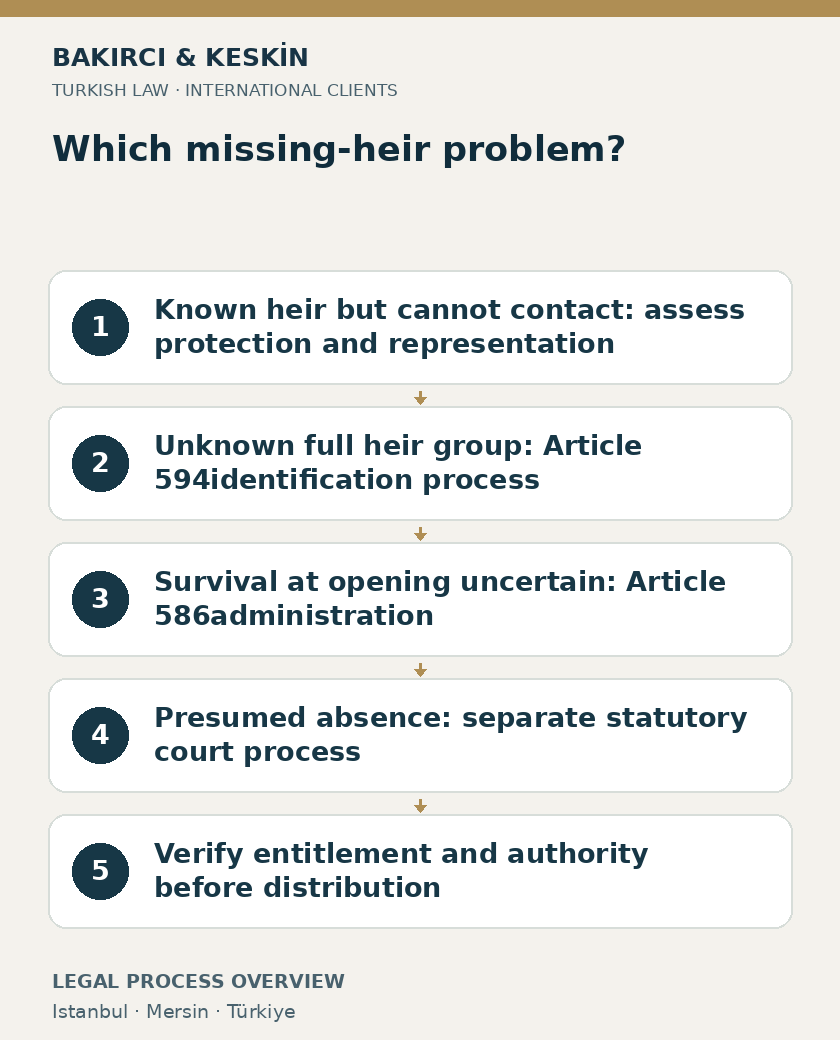
Short answer: An heir who cannot be contacted is not automatically excluded from a Turkish estate. The correct route depends on whether the person’s identity is known, whether their survival when the succession opened can be established and whether the full group of heirs is known. Civil Code Articles 427 and 589–594 provide management, inventory and protective mechanisms, while Article 586 specifically protects an absent heir whose survival at the opening of succession cannot be proved. A declaration of presumed absence or death follows separate conditions; unanswered messages and overseas residence are not substitutes for that process.
Have a general question about this article? Ask anonymously
Quick summary
| Legal issue | A Missing Heir in a Turkish Estate: Representation, Protection and Distribution |
|---|---|
| Short answer | An heir who cannot be contacted is not automatically excluded from a Turkish estate. The correct route depends on whether the person's identity is known, whether their survival when the succession opened can be established and whether the full group of heirs is known. Civil Code Articles 427 and 589–594 provide management, inventory and protective mechanisms, while Article 586 specifically protects an absent heir whose survival at the opening of succession cannot be proved. A declaration of presumed absence or death follows separate conditions; unanswered messages and overseas residence are not substitutes for that process. |
| Key legislation | Law No. 4721 — Articles 32, 33, 34, 35, 427, 580, 584, 585, 586, 588, 589, 590, 592, 593, 594, 609, 619, 640, 642; Law No. 5718 — Articles 11, 20; Law No. 6100 — Articles 223, 224 |
Different kinds of absence require different legal responses
Begin by defining what is unknown. A known heir with an unavailable current address presents a different problem from an unidentified member of the family tree. A person known to be alive but unwilling to cooperate differs from a person whose survival at the deceased’s death cannot be established. These distinctions determine which protective or procedural rules need to be used.
Record the last verified information and its source. Identify the person’s full name, previous names, date of birth, known citizenship, relationship to the deceased and last reliable contact. State separately whether there is evidence of a later death. A family belief that someone “must have died” is not an official death record or a judicial determination.
Civil Code Article 580 makes survival at the opening of succession relevant to heirship. If the missing person survived and died later, their inheritance right passes through their own succession. The estate cannot be divided correctly by deleting an unreachable name from the family tree. Establishing the chronology is part of the legal work, even when it complicates the list of interested persons.
No response is not the same as consent, rejection or loss of inheritance
The fact that an heir has not answered letters or messages does not automatically amount to consent to a sale or partition. Nor does it amount to a Turkish rejection declaration. Article 609 regulates rejection through an unconditional oral or written declaration to the Civil Court of Peace. The legal effect of silence must be derived from a specific applicable rule, not from the other heirs’ frustration.
Under Article 640, the heirs form an undivided community over estate rights until partition, subject to the statutory rules on representation and management. The available family members therefore need a lawful mechanism for dealing with the estate while the absence is addressed. They should not assume that their majority permits them to dispose of the missing person’s interest.
The community-of-heirs guide describes that ownership structure. The immediate objective in a missing-heir case is to keep the estate functional and protected without pretending that the absent person’s rights no longer exist. A court-appointed role or specific protective measure can address that practical need within its legal scope.
Protect the property and establish what the estate contains
Article 589 empowers the Civil Court of Peace to take the measures necessary to protect estate property and secure its transmission to those entitled. It identifies measures including inventory, sealing, official administration and opening of wills. The request should describe the assets and the actual need for protection, rather than merely announce that a family member cannot be found.
Article 590 includes the situation in which an heir has been untraceable for a long time and has no representative among the grounds for a protective inventory. That inventory serves preservation and documentation. It must be distinguished from the official inventory under Article 619, which has its own eligibility, timing and later acceptance consequences. Using the same English word for both procedures should not obscure their different statutory functions.
For property, identify the title, possession, rental arrangements, ongoing expenses and any concrete risk of loss or unauthorised dealing. For money and claims, preserve account and contract records through lawful channels. An application supported by an asset list and evidence of the required protective step gives the court a more precise basis for action than a general request to freeze everything indefinitely.
Article 592 addresses the need for official administration
Article 592 provides for official administration in specified circumstances, including where an heir has been absent for a long time without leaving a representative and their interests require it. It also covers uncertainty about heirship, the existence of heirs and situations in which all heirs are not known. The conditions must be matched to the actual problem; long absence and a need for protection should be explained rather than assumed.
Article 593 defines the administrator’s duties, including preparing the estate record where necessary, taking protective measures, collecting claims, paying debts and managing ongoing businesses according to the statutory framework. The role is directed towards careful management without loss of the entitled persons’ rights. It is not a private appointment allowing one relative to take whatever assets they prefer.
Obtain and read the appointment order. Identify the administrator’s authority, reporting position and the estate covered. If an executor has been appointed over the whole estate, Article 592 contains a rule concerning assignment of administration to that executor unless a significant obstacle exists. The court must therefore be informed of any will and existing officeholder rather than being asked to create overlapping arrangements on an incomplete record.
A management trustee and an estate representative have distinct roles
Article 427 provides for a management trustee in specified situations involving property without someone responsible for its management. These include a person missing for a long time whose place of residence is unknown, and an estate in which inheritance rights are not yet established or an unborn child’s interests require protection. The precise ground and property needing management should be identified.
Article 640 separately permits the Civil Court of Peace, on an heir’s request, to appoint a representative for the inheritance community until partition. This is not the same role as treating the missing heir as dead or appointing a personal substitute with unlimited authority over their rights. The appointment must be chosen for the function that needs to be performed and interpreted within the actual order.
Explain the practical task to the court: preserving an asset, handling estate litigation, managing income or addressing another defined estate need. A generic request for “a guardian for the inheritance” can conceal several different legal possibilities. Clear terminology and a precise requested function help prevent a person appointed for one purpose from being presented to a bank or registry as authorised for a different transaction.
Article 594 concerns uncertainty about whether heirs exist or who all the heirs are
Where it is unknown whether the deceased has heirs, or the full group of heirs is not known, Article 594 requires the Civil Court of Peace to make two announcements through appropriate means one month apart. The announcements call persons entitled to report their heirship within a maximum of one year from the final announcement. This is a statutory identification mechanism, not a private deadline set by relatives.
The provision should not be applied casually to a known heir simply because an email remains unanswered. Establish the nature of the uncertainty and the inquiries already made. The court needs the existing family and civil-status evidence, not an assertion that the absent person should be omitted to make a sale easier. A known address abroad should be recorded accurately and considered through the relevant procedural channels.
Article 594 also addresses the result where no one applies during the announcement period and the judge cannot identify any heir: the estate passes to the State, subject to the preserved inheritance-recovery claim. That rule is not authority to distribute an uncontactable person’s share among the available relatives after a year. Its conditions and consequence must be read together.
Article 586 specifically protects an heir whose survival cannot be proved
Article 586 applies where an heir is absent and it cannot be established whether that person was alive when the succession opened. Their inheritance share is officially administered. The statute therefore provides a holding and protection mechanism instead of requiring the family to guess whether the person survived.
The same article allows those who would take the share if the absent person had not been alive at the opening of succession to seek a declaration of presumed absence and delivery of the share, following the relevant periods and procedure. Delivery is subject to the rules concerning the estate of a person declared absent. This is a judicial route with safeguards, not an entitlement arising from lack of contact alone.
The evidence must address survival at the legally relevant date. A verified communication after that date, a death record, civil-status information or another reliable record can change the succession analysis. Preserve the full source and date of each item. An old photograph or an undated family statement should not be represented as proving the specific temporal fact the statute requires.
A declaration of presumed absence follows separate conditions and safeguards
Articles 32–35 regulate the declaration of presumed absence, or gaiplik. Article 32 requires the statutory circumstances and a strong likelihood of death. Article 33 requires at least one year after disappearance in danger of death or at least five years since the last news, and provides for a judicial call for information with a period of at least six months from the first announcement. These are not the same announcements as Article 594’s search for unknown heirs.
Articles 584–585 protect the absent person and superior claimants when estate assets are delivered. Article 584 requires security under its stated durations and rules; Article 585 regulates restitution if the absent person reappears or a superior right is established. The possibility of delivery therefore does not justify presenting the assets as permanently free of all return obligations.
Article 588 separately addresses property or an inheritance share officially administered for ten years, or the passing of the time when the person would have reached one hundred years, and a Treasury application under the stated conditions. This special route should not be confused with ordinary efforts to locate an overseas heir. The elapsed time, official administration and legally entitled applicant all matter.
Keep a lawful, dated record of efforts to establish the facts
Prepare a chronology of verified contacts, official record requests, returned correspondence and information received from competent authorities. Separate confirmed facts from leads. A social-media account with a similar name can point to an inquiry, but it does not by itself establish identity, death or address for a legal proceeding. Avoid collecting irrelevant personal information or using deceptive means to obtain records.
Foreign documents require attention to their legal function, authentication and translation. Code of Civil Procedure Articles 223–224 govern translation of foreign-language evidence and authentication of foreign official documents, subject to treaty rules. Include complete records and explain name variations or different date formats rather than silently changing them.
Where the person is a foreign national or the estate crosses borders, Law No. 5718 Articles 11 and 20 require separate consideration of presumed-absence and succession-law questions. Turkish assets do not remove every foreign-law issue. Identify which legal effect is being sought in Turkey and the provision governing that effect.
Progress towards distribution through the appropriate court-supervised route
Active litigation requires a further check of representation. Article 593 makes the official administrator the inheritance community’s representative in matters within the office. It addresses representation in proceedings against the community and authority to bring proceedings where required, while requiring the administrator to notify the heirs of litigation and enforcement. The file should identify the existing case, the estate right involved and the administrator’s authority for the action being taken. An appointment should be placed before the relevant court through the proper procedural channel.
This power must be read with the administration’s protective purpose and duration. Article 593 requires careful management until the reasons for official administration cease or partition occurs. Finding the missing person, establishing a death or resolving an uncertainty about heirship can therefore be material to the continued basis of the arrangement. Supply the new verified information to the responsible authority and obtain the necessary determination; do not assume that relatives can privately terminate a court-appointed role by sending an email.
Preserve the administrator’s account and the supporting evidence of income, necessary expenditure, collected claims and asset dealings. The person eventually entitled to receive the property needs an intelligible record of what was managed and what remains. This is particularly important where the absence has lasted for years and management has passed between different officeholders. A complete handover should distinguish the property protected, money received, obligations paid and matters still requiring a decision, without treating the management record itself as a final adjudication of disputed heirship.
Once the absence issue has been legally addressed, review the inheritance certificate, representation orders and estate record together. Verify that all relevant persons are identified and that the person signing or receiving property has authority for that act. A management appointment does not automatically settle contested heirship, and an inheritance certificate does not automatically confer power to sign for an absent person.
Partition remains governed by the applicable rules, including Article 642 and any relevant protection for interested persons. The partition guide explains the general division stage. If the missing person is located or new survival evidence emerges, the existing orders and proposed distribution must be reconsidered in light of that information through the proper process.
Bakırcı & Keskin Law Office coordinates these cases for families abroad through Istanbul and Mersin, with Mersin-based services nationwide. The practical goal is to protect the estate and enable lawful progress while preserving the absent person’s rights. Distribution should rest on verified identity, entitlement and authority, rather than the assumption that an unreachable heir can be removed from the process.
Frequently asked questions
Does an heir lose their share by failing to answer messages?
No. Lack of contact is not itself consent, rejection or a judicial determination removing heirship.
Can the other heirs appoint themselves to act for the missing person?
Informal family agreement does not establish the required authority. The appropriate representation or protective mechanism must be used.
Can the estate be inventoried while an heir is missing?
Article 590 includes a long-untraceable heir without a representative among the grounds for protective inventory.
Is that the same as official inventory under Article 619?
No. The protective inventory and the official-inventory acceptance procedure have different legal purposes and conditions.
When does Article 594 apply?
It concerns uncertainty about whether heirs exist or who all the heirs are, with court announcements under the statutory procedure.
Do relatives receive a known missing heir’s share after one year?
Article 594 does not establish that rule. Its conditions concern unidentified heirs, and its specified consequence differs from private redistribution.
What if survival at the deceased’s death cannot be proved?
Article 586 provides for official administration of the absent heir’s share and a separate judicial route subject to the presumed-absence rules.
Is presumed absence the same as an unknown-heir announcement?
No. Articles 32–35 and 594 address different matters and contain different conditions and periods.
What if the missing person reappears?
The relevant orders and rights must be reviewed. Articles 584–585 provide safeguards concerning security and return of assets in the circumstances they regulate.
What should overseas relatives provide first?
Supply the verified family chain, death records, last reliable contact information, existing court documents and a clear account of what remains unknown.
Official legal sources
- Law No. 4721 — Articles 32, 33, 34, 35, 427, 580, 584, 585, 586, 588, 589, 590, 592, 593, 594, 609, 619, 640, 642
- Law No. 5718 — Articles 11, 20
- Law No. 6100 — Articles 223, 224
The official Turkish legislation controls. The applicable rules and procedural steps must be assessed against the facts of the individual estate.
Contact information
Do not include confidential documents or identity numbers in an initial message. An enquiry does not establish representation or suspend any legal deadline.
Istanbul and Mersin contact details
Bakırcı & Keskin Law Office is Mersin-based. Turkish matters are handled under the applicable jurisdiction and agreed mandate. The competent court and the scope of representation are assessed for each matter.
Istanbul — Polaris Plaza
Maslak Ahi Evran Caddesi, Polaris Plaza No:21, Floor 9, 34475 Sarıyer/İstanbul, Türkiye.Mersin — Profit İş Merkezi
İhsaniye Mahallesi, 4903. Sokak, Profit İş Merkezi No:23, Floor 3, Office 14, 33070 Akdeniz/Mersin, Türkiye.+90 552 224 43 66 · Contact details in English. An enquiry does not establish representation or suspend a legal deadline.
Istanbul Office – Polaris Plaza, Maslak / Sarıyer
Bakırcı & Keskin Hukuk Bürosu
Maslak Ahi Evran Caddesi, Polaris Plaza No:21, Kat:9, 34475 Sarıyer/İstanbul
Our physical offices in Istanbul and Mersin coordinate matters throughout Turkey, subject to jurisdiction and the local steps required for each case. Please specify your preferred office when arranging an in-person appointment.
Open the Istanbul office on Google Maps · Contact and appointments
Contact regarding a legal matter
In your first message, you may briefly state the subject, your country or city, and any relevant notification or recent procedural date. Please do not send identity numbers, medical data, or personal documents. Messaging alone does not constitute legal advice or create a lawyer–client relationship.
Discover more from Bakırcı & Keskin Hukuk Bürosu
Subscribe to get the latest posts sent to your email.