Ankara EKAP Tender Upload Failed When an E-Signature Certificate Expired: Platform Evidence, Bidder Error and Complaint Routes
Direct legal answer
An expired qualified e-signature certificate does not by itself establish unlawful tender exclusion. First verify the certificate’s validity and signing time, then determine whether EKAP received a compliant electronic offer. For tenders announced from 1 August 2025 apply the new electronic procurement regulation, not the repealed older instrument. Where Law 4734 applies, any administrative complaint must satisfy its particular prerequisites and short deadlines.
Have a general question about this article? Ask anonymously
Legal provisions and practical evidence
| Question | Relevant law | Proof to secure |
|---|---|---|
| Signing and qualified certificate | Law No. 5070, Arts 3–5 | Certificate issuer, validity interval, signing receipt |
| Bidder account and transmission | Law No. 4734 and current e-procurement regulation | Corporate ID, EKAP activity logs |
| Procurement regulatory change | 2025 effective electronic procurement framework | Notice date, applicable current template |
| Complaint and objection route | Law No. 4734, Arts 54–56 | Decision, legal trigger, complaint receipt |
| Evidence and privacy | Electronic signature and data-security requirements | Immutable logs, restricted access, chain of custody |
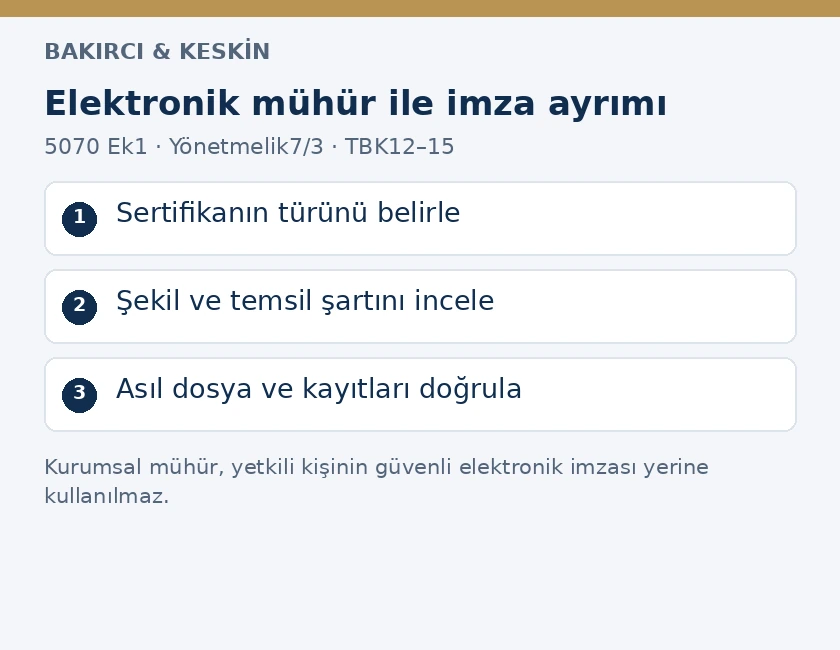
The factual question comes before the complaint
A foreign-owned bidder preparing an Ankara procurement file may describe the event as an unfair electronic tender exclusion. That conclusion is premature. The first question is whether the bidder transmitted a legally effective electronic offer at all. An expired certificate, a local computer malfunction, an expired platform authority, a server-side rejection and a failure to finish uploading are different events. The legal response depends on the exact one. Preserve the submission screen, the certificate warning, the date, the tender identifier and the user account before anyone attempts a second upload. A draft price quotation in a computer folder does not establish that the contracting authority received a timely electronic tender. Equally, a generic failure screen does not prove the bidder caused the technical defect. Each explanation must be tested against original records.
Check which procurement framework governed the notice
For procurements announced from 1 August 2025, the Regulation on Public Procurement Conducted in Electronic Environment changed how many public procurement steps operate through EKAP. The Public Procurement Authority published an official implementation notice on 10 July 2025 and explained that the earlier Electronic Tender Implementation Regulation was repealed. The tender date, notice date and any transitional provisions therefore matter before citing an article from an old manual. Obtain the actual tender documents and the current forms linked to that procurement, not a template downloaded during an earlier bid. Distinguish a procurement under Law No. 4734 from a transaction under a specific statutory exception: procedural objections cannot simply be borrowed from the ordinary framework whenever the word tender appears.
Identify the legal bidder and the electronic actor
The person holding a signature certificate is not necessarily the company that submits the offer. Establish the bidder’s registered legal name, tax identification, commercial register status and appointed signatories. Compare the corporation’s account in EKAP with the identity shown in the e-signature certificate and the person who made the attempted submission. For a branch, subsidiary or joint venture, the relationship between an individual user and the relevant tendering entity should be documented. An expatriate manager may have general corporate authority but lack a properly completed platform authorisation. Conversely, a user authorised in the platform may present a certificate that has expired. A complaint built on the wrong corporate entity can obscure an otherwise testable technical event.
Distinguish certificate expiry from certificate revocation
Under Electronic Signature Law No. 5070, the security and legal significance of an electronic signature depend on the qualifying requirements. A certificate that has reached the end of its validity interval is not the same as a certificate revoked earlier, and neither is the same as an incorrectly entered token password. Obtain the issuer’s validation information covering the exact attempted signing time. Preserve the certificate serial number, subject, issuer, valid-from and valid-to fields and any status response the signing application displayed. Do not publish the private key, password or token PIN as supposed evidence. Keep a screenshot of the public certificate details and secure technical diagnostics only, with access restricted to persons who need them.
Verify the signature creation time independently
The client computer’s clock may be wrong even if the user claims that the signing attempt occurred five minutes before the deadline. Compare local time with EKAP server timestamps, the signing utility’s event record, network connection history and any trusted timestamp available. A photograph of the taskbar clock is supporting context, not definitive proof of when a server accepted a signed document. Check the time zone, daylight-saving configuration and whether a remote workstation was used. Preserve the original export before adjusting device clocks or reinstalling drivers. If clock evidence conflicts, explain that conflict instead of silently converting every record to Ankara time. The legal analysis should identify the event for which the tender rules treat the submission as effective.
Separate creating a file from transmitting a bid
Procurement staff sometimes confuse four stages: generating a draft, entering the participation information, signing the electronic offer and transmitting the completed package. Each can leave a different type of trace. A local PDF or XML saved at 14:55 proves only that a file existed then unless its provenance and later platform receipt can be shown. An EKAP receipt or authoritative platform transaction record can be more significant. Obtain the transaction identifiers and exact messages from the bidder interface rather than accepting a recollection that the upload appeared successful. Identify whether the platform displayed a success confirmation, an unresolved validation error or an automatically generated incomplete draft. The presence of a bid in a staff member’s shared folder does not prove delivery to the procuring authority.
Preserve the original EKAP incident artefacts
Create a documentary package containing the tender ID, bidder account, device and browser versions, signing utility, certificate issuer and serial number, error codes, screen captures and full submission chronology. A single screenshot cropped to show only a red error banner may omit the final warning that the certificate expired. Save complete and unaltered exports where authorised. Do not run intrusive scanning against EKAP or attempt to access server logs without permission. Request identified platform logs through the legally available administrative channel. Technical records should include a source, extraction time and custodian. A later expert must be able to distinguish screenshots, authenticated system records and statements written after the tender closed.
Review the e-signature service provider record
The certificate service provider may be able to confirm the status of the qualified certificate, whether a renewal request was processed and when any replacement certificate became usable. Ask for a verification statement limited to the relevant dates and certificate identifier, not access to a user’s private cryptographic material. Check whether procurement personnel mistakenly believed that paying a renewal invoice automatically extended the cryptographic validity of the old certificate. If a replacement credential was issued but never installed or authorised in EKAP, those are separate issues. A provider’s general service-status web page may give context but cannot by itself establish what happened to a particular certificate at the attempted signing time.
Examine the 2025 electronic procurement transition
The new electronic procurement regime should be read with the actual procurement’s announcement and invitation dates. The 2025 Public Procurement Authority statement described updated electronic forms, signature-based processes and platform authorisation options. As a result, an older instruction referring only to the former tender interface can mislead staff about what must be signed, which fields are mandatory and how a legal-person user is authorised. Preserve the version of the applicable tender form and the instruction displayed in the account at the time. The fact that the underlying 4734 law has not been repealed does not mean every procedural detail from a superseded implementing regulation remains valid. Identify the specific governing rule before characterising a submission failure as a breach.
Do not infer a general right to extend the deadline
A bidder whose staff member discovers certificate expiry shortly before closing may ask for an extension. There is no general principle that a personal certificate problem entitles that bidder to extra time after all competitors have submitted. Check the tender documents and any applicable lawful amendment, postponement or system-failure procedure. If a platform-wide malfunction is alleged, gather official incident notifications and evidence that the same service problem affected users independent of the complaining bidder’s equipment. Do not equate one laptop’s error with a nationwide outage. Fair and equal treatment must be assessed against the lawful mechanism for bids and the actual technical record. Promising that a late offer will be accepted would be misleading.
Differentiate procurement authority conduct from bidder conduct
The procuring authority, EKAP platform operator, certificate issuer, bidder and the bidder’s external consultant perform different tasks. A legal claim should identify an act or omission by the entity against which relief is sought. A local employee who forgot to renew a token may create an internal corporate-control issue; it does not automatically establish unlawful conduct by a public authority. If the platform prevented a validly signed and otherwise timely submission due to an attributable defect, that may require different evidence and legal reasoning. The complaint cannot assume platform responsibility based solely on its visibility to the user. Obtain technical records in a form that permits independent testing of both competing explanations.
Apply 5070 without exaggerating electronic signature equivalence
Law No. 5070 provides the framework for secure electronic signatures, including basic definitions and their legal consequences. Article 5 recognises the legal effect of a secure electronic signature within its statutory scope. That does not turn an expired qualified certificate into a valid signature or prove a tender was transmitted. The examiner must check whether the specific digital signature fulfilled the legal and technical criteria at the moment it was made, and whether the procurement system accepted the resulting package. The certificate provider’s status data, signed container and platform receipt each answer a different question. Do not infer from a document showing an electronic signature icon that the entire submission complied with the procurement rules.
Distinguish administrative notification from platform alerts
The bidder may receive an EKAP notification about rejection or a procurement decision. That official notification should not be confused with the platform’s local signing error or an email from an IT help desk. Save the official notification text, recorded delivery and associated procurement decision as separate exhibits. Complaint periods under the relevant procurement procedure may be short and may run from legally specified events. Starting a calendar from the employee’s first phone call, a consultancy email or a public news item is risky. Record all possible trigger dates and take a cautious approach to deadlines. The organisation should ask who has authority to receive and act upon electronic procurement notices during staff absence or turnover.
Identify the proper complaint route under 4734
Where Law No. 4734 applies, Articles 54–56 provide the framework for complaint to the contracting authority and subsequent objection to the Public Procurement Authority. Article 55 includes short statutory periods whose length depends on the applicable procurement procedure and triggering event. A complaint should identify the disputed act, the complainant, relevant tender and legal reasons, with available evidence. It is not enough to send a general support email asking why the platform failed. The decision on admissibility, standing and merits is governed by the actual statutory and implementing rules, not by the bidder’s nationality. For exceptional procurement categories, check whether the standard 4734 complaint route is applicable before using it.
Preserve proof of complaint submission
Prepare the complaint within the applicable procedure and retain the platform receipt or other legally recognised proof of transmission. Save the exact version filed, all annexes, the person who signed, and any reference numbers. A draft complaint prepared before the deadline is not necessarily a filed complaint. If the authority requests clarification, preserve both the question and the response with their timestamps. Do not rely only on a screenshot showing a submission button was clicked; seek evidence the system actually accepted the complaint. Track the follow-on objection procedure separately from the initial complaint because the stages have different addressees and timing consequences. Counsel should verify the latest law and procurement-specific status before choosing the remedy.
Assess whether the requested relief is legally possible
The bidder may want the contract awarded to it, the tender cancelled, a lawful review of the exclusion or a new submission window. These are not interchangeable outcomes. A court or procurement authority cannot simply reconstruct an unsubmitted offer from a private price file and treat it as timely without a lawful basis. The petition should request the measure authorised by the governing framework and explain how the proven defect affected the process. An objection may be rejected even if a technical inconvenience is undisputed. A successful procedural challenge does not itself prove the bidder would have won the procurement. Avoid financial projections that assume award of the tender when eligibility and comparative bid evaluation have not occurred.
Use technical expert questions that can be answered
A focused technical examination can ask whether the bidder’s qualified certificate was valid at the attempted signing time, whether a signing operation occurred, which error code was returned, whether EKAP accepted any bid transaction and whether a server-side incident affected the relevant window. Request original system clock and time-zone information. Distinguish forensic findings from legal conclusions: an expert can often determine that a certificate was expired, but should not be asked to decide whether all complaint requirements were satisfied. Preserve software versions and the hash of any signed file. If the platform does not release raw logs to the bidder, explain the legal basis for a narrowly targeted request through competent authorities rather than demanding uncontrolled access to procurement infrastructure.
Protect private keys and commercial secrets
A procurement file may contain price schedules, technical designs, shareholder records and authentication credentials. A legal evidence request should not distribute the certificate private key or token password. Redact unrelated bids and confidential customer data where proportionate. Store original electronic records in a restricted evidence repository and create redacted working copies for administrative complaints. Every transfer should identify the custodian and destination. If a screenshot includes another employee’s personal identifier or phone number, consider whether it is needed for the dispute. Security controls are especially important because a system failure can tempt frustrated staff to export entire workstation profiles. Preserve the proof that matters without creating a second confidentiality incident.
Handle a foreign parent and Turkish subsidiary accurately
A foreign parent corporation may pay the costs of an Ankara tender while the bid is made by its Turkish subsidiary or branch. The claimant must be the entity with the relevant legal interest under the procurement rules. Obtain registry extracts and authorised-signatory documentation rather than describing the group as one legal person. Translate company names consistently and identify any transliteration differences between the certificate and the bidder account. If a foreign executive signs through a qualified certificate, verify the platform authorisation and the applicable technical requirements; citizenship alone does not decide whether a signing attempt was valid. The foreign investor’s financial interest in the outcome is not a substitute for checking the formal tendering entity.
Do not confuse a token failure with procurement discrimination
A staff report may describe a certificate problem as discriminatory treatment of a foreign company. Such a serious conclusion requires an identifiable differential rule or practice and supporting evidence. Compare the procurement’s stated requirements, what the platform actually did and how those requirements were applied. If every participant had to use a valid qualified electronic signature, a bidder’s inability to sign with an expired certificate may not show discrimination. Conversely, a genuinely unequal technical or administrative treatment should be described with specific transactions, persons, dates and records. Legal arguments are stronger when the alleged unlawfulness is separated from frustration over a missed commercial opportunity. Do not attribute intent to an authority without proof.
Build a reliable financial-loss record
Unsuccessful bidders may have incurred bid preparation, translation and engineering expenses. A missed procurement can also lead to speculative lost-profit allegations. Record actual invoices, time sheets and third-party fees, and distinguish costs incurred regardless of the contested event from extra expenditure caused by it. The procurement complaint procedure is not automatically a damages proceeding, and its possible relief is governed by the relevant law. Do not calculate compensation simply as the full contract price or expected profit of a hypothetical winning bid. Any later damages analysis needs the correct respondent, legal basis, causal link and a properly evidenced loss calculation. Keep insurance and consultancy agreements separately so the same expenditure is not claimed twice.
Illustrative chronology: a certificate expired the previous night
Consider a foreign-controlled engineering company that opened an EKAP tender on Monday. Its authorised user’s qualified certificate expired on Sunday evening. The bid package was prepared two hours before the Monday deadline, but the signing utility refused to sign it. The company’s own IT team obtained a replacement certificate after the deadline. The record establishes a certificate validity problem; it does not by itself establish a platform failure. The practical task is to preserve expiry data, upload logs and the tender’s procedural status, then evaluate whether any lawful remedy exists. The example does not promise that the bid can be reinstated, and no administrative board decision is invented to make it seem otherwise.
Illustrative chronology: valid signature but no acceptance receipt
Consider a different bidder whose certificate remained valid throughout the submission window. The local signing utility reported success, but the platform never displayed an acceptance reference and later showed no completed tender. The claimant needs to determine whether a network interruption, browser session timeout, mandatory-field omission or platform error prevented delivery. Preserve the signed container, submission transaction traces, account history and contemporaneous support report. A valid signature shows something about the signed file, not necessarily that EKAP received it. The company should not claim automatic acceptance solely because the cryptographic signature validated. The difference between signing and delivering is central to an accurate complaint.
A 24-hour preservation and escalation protocol
In the first response window, stop staff from erasing browser data or reinstalling signature utilities on the relevant device until the records have been preserved. Secure the tender documents, certificate status proof and available EKAP transaction history. Assign a lawyer to identify complaint deadlines, an IT custodian to extract records and a corporate officer to confirm the proper bidder and authorised signatory. Check whether a formal decision has already been notified. Do not delay necessary corporate cybersecurity response, but document each intervention and why it was required. Draft a concise evidence request directed at the appropriate administrator, specifying exact times and tender references. The request should preserve useful facts without alleging a deliberate system failure prematurely.
Avoid outdated templates from before August 2025
One frequent error is to copy an objection that quotes the former Electronic Tender Implementation Regulation as though it remains the operative instrument for a procurement announced in late 2026. The Public Procurement Authority’s 2025 announcement made the change explicit. Start with the current law, current regulation, the announcement date and the electronic forms in the particular tender. Retired terminology such as a former data-entry form may be inappropriate. The difference matters because an otherwise careful factual complaint can lose clarity when it refers to obsolete fields or procedures. A document archive should retain historic versions for evidentiary purposes but clearly label them as historical, not current law.
Separate legal facts from vendor service promises
A signature software supplier may advertise uninterrupted support or send a renewal reminder. Those commercial statements may matter in a separate service relationship, but they are not automatically binding on the public procurement authority. If the provider failed to deliver a promised renewal on time, obtain the service contract and support history; analyse that issue separately from the admissibility of the tender. The authority’s decision remains governed by the procurement framework. A company may need to investigate multiple relationships without merging them into one accusation. Assign each alleged breach to the entity that actually undertook that duty. This prevents the evidentiary file from becoming a collection of complaints with no clear legal respondent.
How to communicate a reasoned legal position
A strong written submission states the tender ID, affected bidder, relevant decision or failure, chronology, evidence and precise legal proposition. Explain which facts remain uncertain and identify narrowly defined records that could resolve them. Avoid declaring that an expired signature is ‘as good as valid’ or that a platform malfunction must have occurred because a deadline was missed. If a regulation is quoted, use the currently applicable text and relevant notice date. Keep a short executive summary followed by a technical chronology and separate legal grounds. This structure is useful to corporate counsel abroad as well as Turkish administrators, and it avoids the appearance of keyword-driven advocacy without substantive analysis.
Official sources and Mersin practice coordination
The main current official sources are Public Procurement Law No. 4734, Electronic Signature Law No. 5070, the Regulation on Public Procurement Conducted in Electronic Environment effective from 1 August 2025, and the Public Procurement Authority’s implementing materials. The 10 July 2025 announcement expressly describes the regulatory transition. Relevant site materials separately discuss a bid guarantee naming the wrong entity and the general preparation of bids; those issues should not be merged with certificate expiry. Bakırcı & Keskin Hukuk Bürosu is described in this CITY60 guide as having a physical office in Mersin. An Ankara procurement is the location of the illustrated legal issue, not a representation that the firm has an Ankara branch. This article is educational and cannot predict any complaint result.
Official legislation and related guides
Official sources
- Public Procurement Authority: 10 July 2025 regulatory transition
- Public Procurement Authority: updated EKAP user guides
- Information and Communication Technologies Authority: e-signature FAQ
- Ministry of Justice official legislation portal (4734 and 5070 text lookup)
Related material on this site
12 frequently asked questions
Can an expired qualified certificate be used to submit an EKAP bid?
A certificate’s validity at the signing time must be checked; an expired credential is not automatically legally effective.
Does a saved tender file prove the bid was submitted?
No. Establish an accepted electronic submission and supporting platform record, not only a locally saved draft.
Did the electronic procurement rules change in 2025?
Yes. The relevant regulation took effect on 1 August 2025 and replaced the earlier Electronic Tender Implementation Regulation.
Does a personal certificate error entitle the bidder to extra time?
Not automatically. The tender and current legal rules govern any extension or system-failure procedure.
Which statute governs secure electronic signatures?
Electronic Signature Law No. 5070 governs definitions, legal effect and related requirements.
Can a bidder demand EKAP server logs?
A focused lawful request may seek relevant records, subject to the competent authority’s powers and security requirements.
How should the failed signing time be verified?
Compare certificate status, client and server timestamps, transaction IDs and trustworthy contemporaneous records.
Where does a complaint go in a 4734 procurement?
The applicable complaint and objection route under Articles 54–56 must be checked against the tender and its deadlines.
Can a foreign parent complain for its Turkish subsidiary?
The legal bidder and party with standing must be identified; parent ownership alone does not resolve standing.
Does valid signing prove the offer reached EKAP?
No. Cryptographic signing and successful platform delivery are distinct factual events.
Must the bidder share the token password to prove the error?
No. Preserve validation records and technical diagnostics without revealing private keys or PINs.
Does this article identify an Ankara physical office?
No. It discusses an Ankara procurement while identifying the firm’s physical office for this guide in Mersin.
Istanbul Office – Polaris Plaza, Maslak / Sarıyer
Bakırcı & Keskin Hukuk Bürosu
Maslak Ahi Evran Caddesi, Polaris Plaza No:21, Kat:9, 34475 Sarıyer/İstanbul
Our physical offices in Istanbul and Mersin coordinate matters throughout Turkey, subject to jurisdiction and the local steps required for each case. Please specify your preferred office when arranging an in-person appointment.
Open the Istanbul office on Google Maps · Contact and appointments
Contact regarding a legal matter
In your first message, you may briefly state the subject, your country or city, and any relevant notification or recent procedural date. Please do not send identity numbers, medical data, or personal documents. Messaging alone does not constitute legal advice or create a lawyer–client relationship.
Discover more from Bakırcı & Keskin Hukuk Bürosu
Subscribe to get the latest posts sent to your email.
