Lost Original Turkish Promissory Note: Payment Prohibition, Court Notices and Cancellation Under TCC 757–765
A lost Turkish promissory note creates two immediate problems: the creditor no longer controls the paper embodying the right, and the maker needs protection against payment to the wrong person. The solution is not simply to print a scan or ask the maker to pay the same amount again. Turkish commercial law provides a court procedure for payment protection, production notices and cancellation of the missing instrument.
Have a general question about this article? Ask anonymously
Direct answer
TCC Article 778(1)(ı) applies the cancellation provisions in Articles 757–765 to promissory notes. The person entitled under Article 651 can seek the appropriate relief. Article 757 provides a payment-prohibition route before the commercial court at the payment place or holder’s domicile. If the possessor is known, Articles 758 and 763 direct the applicant towards a return action. If the possessor is unknown, the statutory notice and cancellation process applies. Losing the original does not, by itself, extinguish the claim.
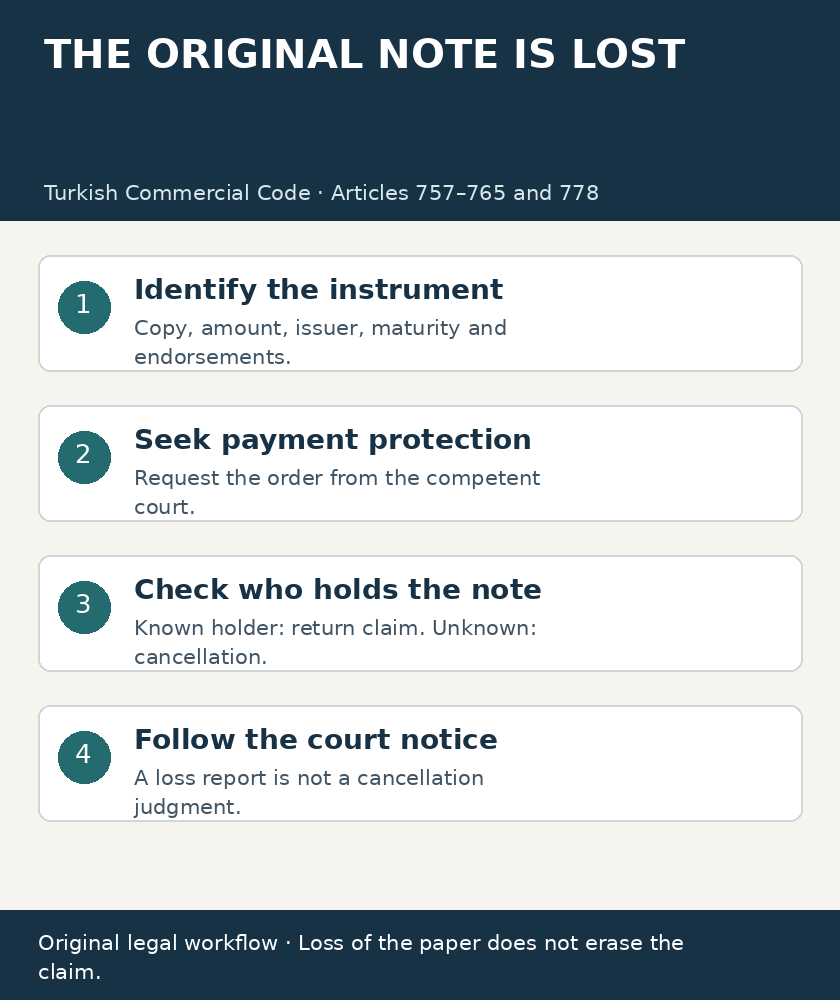
Quick summary
| Issue | Statutory rule |
|---|---|
| Who can seek cancellation? | The person entitled to the instrument when it was lost or the loss became apparent, under Article 651. |
| Where is payment protection requested? | The commercial court identified by Article 757, subject to the international aspects of the actual note. |
| What if the possessor is known? | The court gives an appropriate period for a return action. |
| What if the possessor is unknown? | The applicant must provide credible loss evidence and the instrument’s copy or essential contents. |
| How long is the production period? | Ordinarily at least three months and at most one year, with the specific Article 761 exception. |
| How many statutory announcements? | Three, in the gazette referred to by Article 35, under Article 762. |
| Does cancellation itself order payment of the debt? | No. The cancellation effect must be distinguished from a judgment deciding and ordering payment of a monetary claim. |
1. Understand why the original matters
TCC Article 645 describes negotiable instruments as documents whose embodied rights cannot ordinarily be asserted or transferred separately from the instrument. Article 646 links the debtor’s payment obligation to delivery of the paper and regulates discharge through payment to the person entitled according to its nature. The missing original is therefore more than a lost administrative record.
A scan can identify the note and support the application, but it is not automatically the legal equivalent of possessing the original. The special enforcement procedure also has its own original-document requirement in Article 167 of the Enforcement and Bankruptcy Law. A creditor should not assume that an ordinary photocopy can simply be substituted at every procedural stage.
At the same time, destruction or loss of the paper does not itself establish that the maker’s debt has been paid, released or extinguished. Articles 651 and 652 provide the cancellation framework precisely because rights need protection when the instrument is missing. Keep the instrument claim, the underlying transaction and the court’s cancellation function separate throughout the file.
2. Identify the person entitled to seek cancellation
Article 651(2) identifies the relevant applicant as the person entitled to the instrument when it was lost or when the loss became apparent. The application should explain that entitlement, not merely state that the paper was previously stored in the applicant’s office. The payee, an endorsee, a person holding for collection and a company employee physically carrying the note can occupy different legal positions.
Trace the instrument’s history. Identify its maker, payee, endorsements, delivery and any collection arrangement. Include copies showing both sides and allonges where available. A party whose name does not appear on the front of the note must still explain the legal basis of the claimed right. Conversely, being the maker does not alone establish entitlement to cancel a document simply to avoid an asserted debt.
For a foreign corporate applicant, establish who may instruct Turkish counsel and provide the company’s representation documents. These are separate from the documents establishing ownership or another relevant right in the note. Our foreign-company authority guide explains how to organise that part of the litigation file.
3. Choose the court and request payment protection
Article 757 allows the person who involuntarily lost possession to request a payment prohibition from the commercial court at the payment place or the holder’s domicile. The provision is applied to a promissory note through Article 778, with the adaptations required by the nature of a bono and the maker’s position under Article 779.
The application should identify the specific note and the person whose payment is to be restrained. A generic request concerning every instrument in a business relationship risks failing to identify the subject of protection. Provide the amount, currency, maker, payee, issue date, maturity, payment place and any available identifying number, while clearly identifying any missing information rather than inventing it.
Article 757(2) also addresses a deposit when maturity arrives: the court’s order permits the relevant deposit and specifies its place. A letter asking the maker not to pay is not the same thing as a judicial prohibition. Counsel should obtain and check the actual order, its scope and the communication needed to make the measure effective in the file.
4. Prove both the instrument and the loss
Under Article 759(2), the applicant must provide evidence making it credible that the instrument was lost while in their possession, and must submit a copy or information about its essential contents. A complete scan is useful, but the statute also addresses the absence of a copy by allowing the essential contents to be supplied. That does not remove the need for a credible account of the applicant’s entitlement and the loss.
Prepare a chronology showing receipt of the original, custody, any transfer for collection, the last confirmed possession and discovery of the loss. Retain delivery receipts, collection instructions, dispatch records, correspondence, internal custody records and any contemporaneous report of theft or damage. Explain which documents concern the original rather than a copy held for accounting purposes.
A police report may support the factual account where appropriate, but it does not replace the commercial court’s cancellation procedure. An internal incident report likewise does not by itself cancel the instrument. The court must assess the statutory application and supporting evidence; the applicant should not present an administrative record as though it were already a judicial decision removing the paper’s effect.
5. Use the return-action route when the possessor is known
Article 758 deals with the situation in which the person holding the instrument is known. The court gives the applicant an appropriate period to bring an action for its return. If that action is not brought within the period, the payment prohibition is lifted. The deadline must therefore be taken from the court’s actual order rather than assumed to be a universal number of days.
Identify the possessor with usable information and explain the basis for claiming return. A dispute about which person owns or is entitled to hold the note is not resolved merely by obtaining an uncontested declaration that the applicant misplaced it. The return claim gives the known possessor the opportunity to assert their own position.
Article 686 also matters where a later holder claims rights through the endorsement chain: the statute contains protection for the qualified holder, subject to its bad-faith and gross-negligence conditions. The loss allegation does not automatically establish a right to recover the paper from every person who later holds it. Evidence of acquisition and entitlement must be examined separately from the fact that the applicant originally lost possession.
6. Follow the production period and the statutory announcements
Where the possessor is unknown and the applicant’s account is found credible, Article 760 provides for a public invitation to produce the instrument within the specified period, with a warning that it will otherwise be cancelled. This process protects persons who may hold the paper; it is not an optional publicity step that can be replaced by an email to the maker.
Article 761 ordinarily fixes a production period of at least three months and at most one year. For a matured instrument, the period runs from the first announcement. For an instrument not yet due, it runs from maturity. Paragraph (2) provides a specific exception where limitation on a matured instrument would occur before three months have passed: the court is not bound by the three-month minimum in that situation.
Article 762 requires three announcements in the gazette referred to by Article 35 and permits additional suitable publication measures in special circumstances. Keep copies and publication dates in the case file. The order, the first announcement and maturity must be read together when calculating the production period. Do not state a fixed completion date for the entire case merely because three announcements are required.
7. Respond promptly if someone produces the original
Article 763 addresses production of the missing instrument to the court. The court gives the applicant an appropriate period to bring a return action. Failure to do so results in the instrument being returned to the person who produced it and the payment prohibition being lifted. The application therefore requires active monitoring after the announcements, not only at the initial filing.
When the original appears, compare it with the available copy and the essential contents previously supplied. Record any differences without treating every discrepancy as established forgery. The opposing possessor’s claimed endorsement or acquisition history should be obtained and assessed. The court’s direction must then be followed through the appropriate contested procedure.
Finding the original in the applicant’s own custody also requires the court to be informed. Do not ignore an existing payment order or leave the file resting on an outdated loss allegation. Counsel should address the correct procedural conclusion and the treatment of any protective measure or deposit. Recovery of the paper and settlement of the underlying debt are still different events.
8. Understand what the cancellation judgment does and does not decide
Article 764 provides for cancellation if the instrument is not produced within the prescribed period. Article 652 states the general effect: the entitled person can assert the right without the instrument or request issuance of a new one, subject to the special rules governing the particular security. Article 764(2), read with Articles 778 and 779, preserves the relevant instrument claim against the maker.
This does not turn the cancellation judgment into a money judgment deciding every defence and ordering the maker to pay the amount stated by the applicant. A dispute about payment, signature, authority or the existence of the obligation may still require the proper merits procedure. The instrument’s cancellation and adjudication of the monetary claim must not be described as the same legal act.
The route for enforcing the resulting right must also be chosen correctly. A photocopy is not transformed into an original by describing it as cancelled, and the requirements of a particular enforcement route remain relevant. Our guide to debt collection in Turkey from abroad explains the broader distinction between a claim, a judgment and the relevant collection procedure.
9. Address security, deposits and independent time limits
Article 765 permits the court, before cancellation, to require the relevant deposit and payment against sufficient security. The security protects the interests of a person who acquired the instrument in good faith. The article also addresses return of security when the instrument is cancelled or the rights arising from it otherwise cease. It does not prescribe one universal cash percentage for every case.
Read the actual order to establish the required security, recipient, deposit place and conditions. A private assurance given by the applicant is not automatically the security required by the court. The maker should likewise not assume that an informal promise to reimburse any future claimant removes the legal risk of making payment without the prescribed safeguards.
The production period is not the same as every limitation or recourse period connected with the note. Article 749 and the other provisions referred to by Article 778 distinguish claims and signatories. Preservation of any claim against the maker, endorser or another obligated person requires its own assessment. The cancellation timetable should not be treated as a general extension of all other statutory periods.
10. Organise the application while living or trading abroad
Provide Turkish counsel with the available copy, the custody chronology, evidence of entitlement and the payment details. If a foreign company is involved, include the representation records. Foreign-language documents relied upon in civil proceedings require translation under HMK Article 223; authentication of foreign official records is assessed under Article 224 and applicable treaties.
The place of payment is particularly important in an international instrument. TCC Article 775 provides that the measures to be taken when a bill is lost or stolen are governed by the law of the payment place, and Article 778 extends the relevant conflicts framework to promissory notes. A Turkish maker or Turkish-language form does not eliminate the need to identify the payment place and the international procedural position.
Keep the underlying account evidence separate from the cancellation file. Payment and return documentation remains important if the dispute is settled, as explained in our receipt and return-of-note guide. Where the paper was originally incomplete and the entries themselves are contested, the blank-note completion guide addresses a different legal problem; it should not be substituted for the loss procedure.
Frequently asked questions
Does losing a Turkish promissory note erase the debt?
No. The loss and cancellation framework protects the relevant right; it does not itself establish payment or release of the debt.
Who can request cancellation?
Article 651 identifies the person entitled to the instrument when it was lost or the loss became apparent.
Which court can prohibit payment?
Article 757 identifies the commercial court at the payment place or holder’s domicile; the note’s international aspects must also be assessed.
Can an application be made without a copy?
Article 759 allows the essential contents to be supplied, but credible evidence of entitlement and loss is still required.
What happens if the person holding the note is known?
Under Article 758, the court gives an appropriate period for a return action. Missing it can result in lifting the payment prohibition.
Is the production period always exactly three months?
No. Article 761 ordinarily provides at least three months and at most one year, with a specified limitation-related exception and different starting points.
How many announcements are required?
Article 762 requires three announcements in the gazette referred to by Article 35. The court can order additional suitable measures.
Does a police loss report cancel the note?
No. It can support the factual account where relevant, but cancellation requires the prescribed court procedure.
Is a cancellation judgment automatically a payment judgment?
No. Cancelling the missing instrument and deciding a contested monetary claim are different judicial functions.
Must an overseas creditor travel for every procedural step?
Initial preparation and instructions can be handled remotely. A valid power of attorney and any case-specific personal or original-document requirement must still be addressed.
Türkiye-wide case management and Mersin practice
Bakırcı & Keskin Law Office assists clients abroad with Turkish legal matters from its Mersin office. For a missing-note file, the priority is to identify the instrument and entitlement, obtain the correct protective order, follow every court-set period and preserve the separate monetary claim. Mersin-related matters and files elsewhere in Türkiye are assessed by reference to their actual payment place, competent court and documentary record.
Updated: 29 October 2026. The article provides general legal information and does not replace examination of the actual note, court orders and relevant international connections.
Istanbul Office – Polaris Plaza, Maslak / Sarıyer
Bakırcı & Keskin Hukuk Bürosu
Maslak Ahi Evran Caddesi, Polaris Plaza No:21, Kat:9, 34475 Sarıyer/İstanbul
Our physical offices in Istanbul and Mersin coordinate matters throughout Turkey, subject to jurisdiction and the local steps required for each case. Please specify your preferred office when arranging an in-person appointment.
Open the Istanbul office on Google Maps · Contact and appointments
Contact regarding a legal matter
In your first message, you may briefly state the subject, your country or city, and any relevant notification or recent procedural date. Please do not send identity numbers, medical data, or personal documents. Messaging alone does not constitute legal advice or create a lawyer–client relationship.
Discover more from Bakırcı & Keskin Hukuk Bürosu
Subscribe to get the latest posts sent to your email.
