Lost or Stolen Belongings at a Turkish Hotel: Notice, Valuables and TCO 576–578
A Turkish hotel cannot eliminate its statutory responsibility for guests’ belongings merely by displaying a “not responsible for valuables” notice. Article 576 of the Turkish Code of Obligations regulates loss, damage and theft of property brought by guests; Article 577 treats valuables and substantial sums separately; Article 578 requires the guest to notify the operator as soon as the loss is discovered. The familiar three-times-daily-accommodation-fee limit is not a universal ceiling: it applies under Article 576 only where no fault is attributable to the operator or its employees. The property’s category, custody record and evidence of fault must therefore be examined before calculating a claim.
Have a general question about this article? Ask anonymously
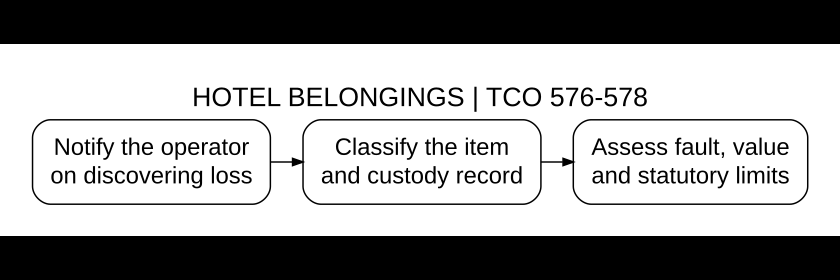
Notify the operator when the loss is discovered
Article 578 makes prompt notification a central requirement. A guest who does not tell the operator as soon as the damage is learned loses the right to claim under the provision. The first practical task is therefore to communicate the discovery to the operator and preserve a reliable record of that communication, not to wait until the holiday ends to assemble a perfect valuation.
State the room or booking reference, the item, when it was last known to be present and when its loss or damage was discovered. Ask for a record of the report and keep your own copy. The statute does not prescribe a universal number of days in which any complaint is automatically timely; replacing its discovery-based wording with an invented seven-day or thirty-day rule would be misleading.
A complaint sent only to a booking intermediary should not be assumed to notify the operator itself. Identify who received the report and in what capacity. Communications with an insurer, police or a travel agency can have their own purpose, but the Article 578 notice must be addressed as a separate legal requirement.
Identify the accommodation operator and the relevant stay
Article 576 covers operators of places such as hotels, motels, guesthouses and holiday villages. Establish the business that operated the accommodation during the relevant stay. The name of a building, an online brand or a payment intermediary does not necessarily identify the legal person responsible for operating it.
Keep the reservation, check-in record, invoice and payment documents. Record the stay dates, room and people occupying it. A property claim must connect the belongings and the incident with the accommodation relationship; a booking confirmation alone does not prove which items were brought into the premises.
The official provisions are Law No. 6098, Articles 576–578. This guide concerns belongings, not compensation for bodily injury. Our hotel accident and injury guide addresses that different subject. A bag lost during air carriage also raises a separate framework, discussed in the airline baggage guide.
Article 576 starts with responsibility for guest property
The operator is responsible for destruction, damage or theft of belongings brought by guests. The statutory starting point should not be replaced with a blanket assertion that a guest must always prove a named employee stole the item. The law contains its own responsibility and defence structure.
The guest must nevertheless identify the property and the loss relied on. Preserve receipts, photographs, serial numbers, repair assessments and other records that support ownership or possession, presence during the stay and condition. An unsupported list prepared after departure should not be treated as conclusive proof of every item and value.
Distinguish destruction, physical damage and disappearance. A damaged item that remains available can be inspected; a missing item requires a record of where it was last seen and the circumstances of discovery. The claim should explain the actual event without presenting suspicion as a verified accusation against a particular person.
The operator’s statutory defences need proof
Article 576 permits the operator to escape responsibility by proving that the damage arose from fault attributable to the guest, a visitor, a person accompanying or serving the guest, from force majeure, or from the nature of the property. The provision identifies grounds of defence; a general denial of responsibility does not itself establish one.
Read the operator’s explanation against the actual event. A statement that the hotel employs trustworthy staff is not proof that the guest caused the loss. Equally, the guest’s account should disclose the involvement of visitors or companions and any known condition of the item rather than omit facts relevant to the statutory defence.
The mere fact that an unidentified third person may have been involved does not automatically prove force majeure. The defence asserted must be connected with supporting facts. Avoid converting an incomplete investigation into either an automatic admission by the hotel or an automatic release from the statutory framework.
The three-times fee limit is conditional, not automatic
Where no fault can be attributed to the operator or its employees, Article 576 limits responsibility for each guest to three times the daily accommodation fee. The article does not say that every hotel-property claim is always capped at that amount regardless of conduct or the special valuables rules.
Establish the relevant daily accommodation fee from the booking and invoice. A package can contain meals, transfers or other services, so the gross amount paid for an entire holiday should not automatically be treated as one daily accommodation charge. The basis used in the calculation needs a documentary explanation.
The maximum is not an automatic award. The loss, its value and the applicable responsibility must still be established. Nor should the absence of the no-fault ceiling be represented as a guarantee that every amount demanded will be recovered. The calculation must remain tied to the proven loss and the legal category of the property.
Valuables and substantial sums are governed by Article 577
Article 577 separately addresses valuable items, substantial amounts of money and negotiable instruments. Where they were not left with the operator for safekeeping, the operator is responsible only where the operator or its employees were at fault. This is different from simply repeating the ordinary-property rule for every object in a room.
Identify the item, its value and how it was kept. The statute does not establish a single published monetary threshold that automatically classifies every possession as valuable or every cash sum as substantial. The legal assessment must address the actual property and circumstances rather than invent a universal currency figure.
Keep ordinary travel belongings and items requiring the separate valuables analysis distinct in the inventory. A laptop, jewellery, documents and cash should not be combined under one generic description if their classification or custody differs. Each item’s position can affect the applicable rule and evidence required.
Acceptance or refusal of safekeeping changes the valuables analysis
Article 577 states that where the operator accepted valuables for safekeeping or refused to accept them, the operator is responsible for their full value. A record of the offer, acceptance or refusal is therefore important. A hotel should not answer a documented refusal merely by pointing to a general instruction that guests are responsible for their own property.
For accepted property, retain the deposit receipt, item description, declared value and return arrangements. Establish who received it for the operator and where the record was kept. A receipt identifying only a sealed envelope has a different evidential content from an inventory of its contents; preserve the material supporting what was actually entrusted.
For refused property, record when and how safekeeping was requested and the response. Do not assume that the presence or absence of a room safe automatically proves that the operator accepted or refused custody of the particular valuables. The relevant act must be established from the actual service and communications.
Some property necessarily kept with the guest follows the ordinary rule
Article 577 also states that items, money and similar property which the guest must keep personally are governed by the responsibility rule applicable to the guest’s other belongings. This qualification prevents the valuables paragraph from being applied mechanically without considering the item’s use during the stay.
The review should explain why a particular item falls within that description. A general preference to keep an object close is not necessarily a complete explanation of the statutory category. Equally, every item with an appreciable value should not automatically be treated as something the guest was required to surrender for custody.
Document the item’s purpose and the circumstances of its presence. The point is to select the appropriate statutory rule, not to rewrite the facts after a loss. A carefully classified inventory helps both the guest and operator identify the real dispute instead of arguing over all belongings as one undifferentiated group.
Disclaimers cannot remove the statutory protection
Under Article 578, an operator does not escape responsibility by announcing in any manner that it assumes no such responsibility or that responsibility depends on a condition not stated in the Code. A wall notice, website sentence or printed statement must therefore be assessed against the statutory protection, not treated as decisive merely because it was visible.
Preserve the disclaimer relied on, including where it appeared and its wording. A legal response should identify the actual exclusion or additional condition. The existence of an invalid attempt to exclude responsibility does not remove the guest’s own obligations to identify the loss and notify the operator promptly.
Our liability-exclusion guide explains broader contractual controls. The hotel-specific rule in Article 578 should be addressed directly rather than buried in a general debate over standard terms.
Preserve records without creating a second legal problem
Ask the operator to preserve relevant incident, access and security records for the identified time and location. Such a request documents the need to avoid loss of evidence; it is not an unrestricted right to receive footage showing every other guest. Access to records and personal information must follow the applicable legal procedure.
Keep photographs of damage, the immediate report, replies and any inventory completed with staff. Preserve original files and complete exchanges. Do not alter timestamps, manufacture receipts or access another person’s account in an attempt to strengthen a claim. The electronic-evidence guide explains the importance of traceable records.
If an item is repaired, replaced or disposed of, keep the assessment and available evidence of its earlier condition. A replacement purchase can be relevant to expenditure, but it does not automatically establish the lost item’s age, condition or recoverable value. Separate evidence of the incident from evidence of the amount claimed.
Police reports, insurance and civil compensation are separate routes
A suspected theft can require a criminal complaint, while the civil claim against the operator concerns the statutory accommodation relationship. Reporting the event to police does not itself establish the operator’s liability or transfer compensation to the guest. It should also not be assumed to replace direct notification under Article 578.
Our criminal-complaint guide for foreign clients explains that separate procedure. Give a factual account and distinguish what was observed from what is suspected. Naming a person as responsible requires evidence, not simply dissatisfaction with the hotel’s response.
An insurance notification has its own policy requirements. Keep records of any insurer’s payment, hotel reimbursement and remaining loss so that the account does not seek double recovery. The policy’s coverage and the civil claim’s legal basis must each be checked; neither automatically resolves the other.
A settlement should identify the loss it resolves
A hotel may offer a payment, replacement, room credit or other proposed resolution. Record what is offered and whether it is intended as a full settlement or a payment towards a disputed claim. A voucher is not the same as cleared compensation, and acceptance should not be described as payment before its terms are understood.
Read release language before signing. An acknowledgement that one damaged item was reimbursed should not inadvertently resolve unrelated property or injury matters unless that is the intended agreement. Conversely, a document expressly settling a defined loss must be retained with the proof of performance.
For an overseas guest, practical preparation should include the original currency values, translations, contact details and any authority needed for representation. A departure flight does not determine the civil forum or replace the need to preserve the Article 578 notification record. Any formal procedural document must be reviewed on its own terms and service date.
Frequently asked questions
When should I report missing belongings to the hotel?
Article 578 requires notification to the operator as soon as the guest learns of the loss. Preserve the report and delivery record rather than waiting until departure.
Does a no-liability sign defeat the claim?
No. Article 578 prevents the operator from escaping statutory responsibility through such announcements or additional conditions not stated in the Code.
Is compensation always limited to three nights’ charges?
No. Article 576 uses three times the daily accommodation fee per guest only where no fault is attributable to the operator or its employees. The valuables rules must also be checked.
What must the operator prove to rely on a statutory defence?
Article 576 identifies attributable fault of the guest or specified associated persons, force majeure and the nature of the property. The asserted cause must be supported by evidence.
What if valuables were not deposited for safekeeping?
Article 577 generally requires fault of the operator or its employees for that valuables category. Its separate rule for items the guest must keep personally also needs consideration.
What if the hotel refused to accept valuables?
Article 577 provides full-value responsibility where the operator accepted or refused the valuables for safekeeping. Establish the item, request and actual response.
Does using a room safe prove a custody deposit?
Not automatically. The actual custody arrangement and communications must be examined rather than equating the existence of a safe with acceptance of a specific item by the operator.
Does a police complaint replace notice to the hotel?
It should not be assumed to do so. Criminal reporting and Article 578 notification to the operator serve different purposes and must be addressed separately.
Is the statutory maximum an automatic award?
No. The property, loss, value and applicable responsibility must be established. A ceiling limits a qualifying claim; it does not itself prove the amount due.
What documents should an overseas guest retain?
Keep the booking and invoice, immediate report, property evidence, custody receipt or refusal, replies, valuation records and details of insurance or settlement payments.
Official legal sources
Turkish Code of Obligations No. 6098, Articles 576–578; official Ministry text, page 115. This English explanation is not an official translation; the Turkish statute governs.
Ask about a hotel property claim
State the accommodation, discovery date, item category and when the operator was notified. Do not include identity numbers or sensitive documents in the initial enquiry.
Istanbul and Mersin offices
Bakırcı & Keskin Law Office coordinates Turkish matters from its Istanbul and Mersin offices. Arrange a confidential channel for booking, incident and property records.
Istanbul — Polaris Plaza
Maslak Ahi Evran Caddesi, Polaris Plaza No:21, Floor 9, 34475 Sarıyer/İstanbul. Istanbul office directions.
Mersin — Profit İş Merkezi
İhsaniye Mahallesi, 4903. Sokak, Profit İş Merkezi No:23, Floor 3, Office 14, 33070 Akdeniz/Mersin. Mersin office directions.
Call +90 552 224 43 66. General information; an enquiry does not establish representation or suspend a deadline.
Contact regarding a legal matter
In your first message, you may briefly state the subject, your country or city, and any relevant notification or recent procedural date. Please do not send identity numbers, medical data, or personal documents. Messaging alone does not constitute legal advice or create a lawyer–client relationship.
Discover more from Bakırcı & Keskin Hukuk Bürosu
Subscribe to get the latest posts sent to your email.