Commercial Signing Authority in Turkey: Representatives, Limits and TCO Articles 547–554
A job title does not establish the full scope of a person’s authority to bind a Turkish business. Articles 547–554 of the Turkish Code of Obligations distinguish a commercial representative with broad statutory powers from a commercial authorised person with authority over ordinary business transactions and from sales staff with defined functions. Those differences determine whether a person can undertake bill-of-exchange obligations, borrow, transfer real estate, receive payment or accept a defect notice. Registration also matters: an internal restriction is not necessarily effective against a good-faith counterparty, and removing an employee from the payroll does not itself complete the registry steps for ending commercial representation.
Have a general question about this article? Ask anonymously
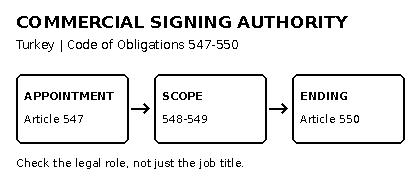
Three legal roles that an English title can conceal
The statutory term ticari temsilci denotes the commercial representative regulated by Article 547. Article 551 addresses the narrower role of ticari vekil. Article 552 concerns certain personnel in wholesale, semi-wholesale and retail businesses. Translating all three simply as agent obscures their different powers. The appointment and transaction must be classified before concluding that the signature binds the enterprise.
A director acting as a company organ is another legal category. This guide does not replace the company-specific rules on management and representation. Our limited-company management guide addresses that separate subject. Likewise, an independent commercial agency agreement and its portfolio-compensation rules are not identical to appointing a commercial representative within this framework.
Use the exact legal identity of the enterprise and the signatory. A branch name, a group brand and a registered company name are not interchangeable. The appointment should be traced to the person or corporate body competent to confer it. A corporate email address helps identify a communication, but it is not a substitute for the legal source and scope of authority.
Article 547: appointment can be express or implied
Article 547 of the Turkish Code of Obligations No. 6098 defines a commercial representative as a person expressly or impliedly authorised by the enterprise owner to manage the commercial enterprise and represent the owner, under the trade name, in transactions relating to it. The law therefore recognises more than appointments contained in a document bearing a particular English heading.
However, implied authority must be established from the facts. Identify the activities entrusted to the individual, the owner’s communications and the relevant transaction history. A person’s own claim to have unrestricted authority is different from evidence that the enterprise owner conferred commercial representation. The legal question cannot be answered by selecting a convenient title from a signature block.
The owner must register the appointment in the trade registry. Article 547 also states that the owner’s responsibility for the representative’s acts does not depend on registration having occurred. Failure to register is therefore not, by itself, a complete defence that every act of an otherwise appointed commercial representative is ineffective. Appointment evidence and registry compliance should be examined separately.
Article 548: broad powers towards good-faith third parties
Against good-faith third parties, Article 548 treats the commercial representative as authorised to undertake negotiable-instrument obligations in the owner’s name and to carry out transactions falling within the enterprise’s purpose. The protected third-party position is part of the rule. It should not be omitted when explaining the relationship between statutory authority and internal instructions.
The enterprise’s purpose remains relevant. A review should identify the business concerned and how the transaction relates to it. A contract for a different group company is not automatically within the representative’s appointment simply because the companies share shareholders. The legal entity or enterprise whose trade name is used must correspond to the obligation being undertaken.
For a bill or other negotiable instrument, retain the original and the signature-capacity record. Authority to make the undertaking and the instrument’s own validity are different questions. Article 548 is not a universal answer to missing formal requirements, defective signatures or disputes about the identity of the person on whose behalf the instrument was issued.
Real-estate transfers and encumbrances require express authority
The second paragraph of Article 548 excludes transferring immovable property or burdening it with a right unless the representative is expressly authorised. Broad commercial appointment alone must not be presented as sufficient for those acts. Review the precise authority relating to the property and the proposed transaction.
Check whether the document addresses transfer, creation of the relevant right, or only negotiations and administrative follow-up. These are not equivalent acts. The authority document must also be assessed alongside the form and registration requirements of the property transaction itself. Proving authority does not dispense with the separate formalities necessary to complete a transfer.
For overseas owners or foreign companies, keep the original appointment, corporate authority records and any authentication or translation material together. The applicable foreign-document requirements depend on the actual document and route. Do not assume that translating an unrestricted management letter necessarily creates the express property-disposal authority required by Article 548.
Article 549: branch and joint-signature restrictions
Article 549 permits commercial representation to be restricted to a branch’s affairs or made subject to joint signatures by several people. Under the joint-signature arrangement, a signature by one representative without the others does not bind the owner, subject to the article’s protection of good-faith third parties where the restriction was not registered. The registration condition is essential to a complete statement of the rule.
Those two restrictions have no effect against good-faith third parties unless registered. Other restrictions cannot be asserted against good-faith third parties even when registered. An internal transaction-value ceiling must therefore not be equated with the branch or joint-signature restrictions expressly recognised by the provision.
This distinction is important for both sides. A business owner should not rely only on an internal approval chart to manage external exposure. A counterparty should not ignore a properly registered joint-signature requirement merely because the person negotiating the deal has previously handled routine communications. The appointment category, registry record and transaction date must be read together.
Internal breach and external contractual effect are different questions
An internal instruction can remain relevant to the relationship between owner and representative even where Article 549 prevents reliance on it against a protected third party. Whether the enterprise is bound externally and whether the representative breached duties internally are distinct issues. A coherent assessment addresses both rather than treating one answer as resolving the other.
Preserve the instruction, evidence of communication to the representative, the executed transaction and any evidence concerning the counterparty’s knowledge. Avoid describing the counterparty as acting in good or bad faith solely because the transaction exceeded a private financial threshold. The facts supporting that characterisation must be identified.
A company investigating an internal breach should keep its investigation separate from unverified external assertions that the contract never existed. That separation protects the accuracy of its response. The dispute can concern contractual responsibility, internal loss allocation and the authority record at the same time, but each proposition requires its own evidence.
Article 551: ordinary commercial authority is narrower
A ticari vekil is authorised to manage the enterprise or conduct some of its affairs without receiving commercial-representative authority. Article 551 extends this role to the enterprise’s customary transactions. It then identifies acts that require express authorisation: borrowing money or equivalent things, making negotiable-instrument undertakings, bringing proceedings and conducting existing proceedings.
Do not import Article 548’s broader negotiable-instrument power into an Article 551 appointment. The difference is express in the statutory scheme. A person permitted to negotiate ordinary purchases is not thereby shown to have the separate authority required to borrow or sign a bill on behalf of the owner.
The reference to litigation authority does not replace procedural rules governing representation in court. Identify both the substantive authority to act and the person legally entitled to conduct the proceeding. The documents needed to approve a lawsuit and those needed for a lawyer to appear in it serve related but different functions.
Article 552: sales staff, notices and collection of money
For personnel in wholesale, semi-wholesale and retail businesses, Article 552 specifies authority over customary sales, invoices for authorised transactions and certain notices or declarations about ordinary business obligations. This includes receiving defect notifications concerning goods delivered in customary transactions. The statutory conditions include the absence of a contrary written announcement displayed where customers can readily see and read it within the business.
Payment collection has an additional restriction. Without written authority, such personnel cannot demand or receive sales proceeds outside the premises or, where cashiers have been appointed, inside the premises. When entitled to receive the price, they are also entitled to mark invoices paid or issue receipts. Invoice-signing authority should not be mistaken for unrestricted authority to collect money anywhere.
Before paying an employee who requests funds through a different channel, verify the actual authority and recipient. Keep the request, invoice, collection authorisation and receipt. Our payment-receipt guide addresses evidence after payment; it does not replace the prior question whether payment was made to someone authorised to receive it.
Ending authority requires more than an internal dismissal
Article 550 requires termination of commercial-representative authority to be registered even where the original grant was never registered. Until termination is registered and announced, the authority retains its validity for good-faith third parties. An internal termination letter and completion of these publicity steps are therefore different events.
Article 554 permits the owner to revoke the powers of commercial representatives, commercial authorised persons and other business assistants at any time, while preserving rights arising from employment, mandate, partnership or similar underlying agreements. Revocation is not automatically a finding that no wage, fee, expense or contractual claim remains.
Maintain a dated close-out record covering revocation, communication, registry filing and announcement where applicable, recovery of authority documents and pending transactions. Do not backdate that record. A transaction signed between internal revocation and external publicity needs analysis under the relevant third-party protection rather than an assumption that every date has the same legal effect.
The owner’s death and prohibited competition
Article 554 expressly states that the enterprise owner’s death or loss of legal capacity does not end these assistants’ powers. This provision concerns the owner and must not be rewritten as an unrestricted proposition that every event affecting every participant leaves authority intact. Estate and business-continuity documents should be reviewed with the actual appointment.
Article 553 separately restricts the specified business assistants who manage all the enterprise’s affairs or serve its owner from undertaking the same kind of business for themselves or third parties without permission. It covers direct and indirect conduct. The provision addresses the protected business relationship; it is not the same as a post-employment non-compete clause.
For breach, Article 553 provides damages or the specified alternative of treating the competing business as undertaken for the owner and obtaining the remuneration or assignment of the resulting claim, while preserving rights under the underlying relationship. The remedy must be selected and supported by the competing-transaction evidence rather than assumed from the fact that a former employee has found another job.
Documents for an international signing-authority review
Obtain the appointment, relevant registry records, corporate approvals, signature documents and complete contract. Add any express powers for the particular transaction and every restriction or revocation relied on. Dates matter: a current registry extract alone does not establish the record at the time an earlier contract was signed.
Keep the source document beside its translation and use the Turkish role consistently. Our cross-border representative-authority guide explains the preliminary applicable-law question. The unauthorised-representation guide addresses ratification when the necessary authority is absent. Neither issue should be resolved solely by the signatory’s nationality.
The practical conclusion should identify the legal role, relevant transaction, scope, restriction and effective termination date. Where proceedings have already been served, include the full claim and service record. An authority investigation does not itself suspend the procedural response required in that case.
Frequently asked questions
Does a manager title prove full signing authority?
No. Identify whether the person acts as a company organ, commercial representative, commercial authorised person or another assistant. The applicable appointment and statutory powers differ.
Must a commercial representative be registered?
Article 547 requires registration, but the owner’s responsibility for the acts of an appointed representative does not depend on registration having occurred.
Can a commercial representative sell real estate without express authority?
Article 548 requires express authority to transfer immovable property or encumber it with a right. General commercial appointment does not alone satisfy that requirement.
Does an internal spending limit always bind the supplier?
No. Article 549 distinguishes registrable branch and joint-signature restrictions from other limitations that cannot be asserted against good-faith third parties even if registered.
Can an ordinary commercial authorised person borrow automatically?
No. Article 551 requires express authority for borrowing, negotiable-instrument undertakings and the specified litigation acts.
Can sales staff collect the price outside the business premises?
Article 552 requires written authority for collection outside the premises and for collection inside where cashiers have been appointed. Check the actual collection authorisation.
Is dismissing a commercial representative sufficient registry notice?
No. Article 550 requires registration and announcement of termination and protects good-faith third parties before those steps are completed.
Does revocation eliminate all employment or mandate claims?
No. Article 554 reserves rights arising from the underlying employment, mandate, partnership or similar agreement while allowing revocation of authority.
Does the enterprise owner’s death automatically end these powers?
Article 554 states that the owner’s death or loss of legal capacity does not end the powers of the commercial representatives and other assistants it covers.
Which records should an overseas business obtain?
Obtain the appointment, transaction-date registry records, signature documents, express powers, restrictions, revocation records and full contract. Keep translations with their originals.
Official sources and scope
Law No. 6098, Articles 547–554. The official Ministry text, pages 109–111 contains these provisions. English explanations are not an official translation; the Turkish statutory text governs.
Ask about a business signature
State the signatory’s role, transaction date and the authority question. Do not include confidential agreements or identity numbers in the initial enquiry.
Istanbul and Mersin offices
Bakırcı & Keskin Law Office is Mersin-based, working throughout Türkiye with an Istanbul and Mersin focus. Arrange a confidential document channel before sending appointment or transaction records.
Istanbul — Polaris Plaza
Maslak Ahi Evran Caddesi, Polaris Plaza No:21, Floor 9, 34475 Sarıyer/İstanbul. Istanbul office directions.
Mersin — Profit İş Merkezi
İhsaniye Mahallesi, 4903. Sokak, Profit İş Merkezi No:23, Floor 3, Office 14, 33070 Akdeniz/Mersin. Mersin office directions.
Call +90 552 224 43 66. An enquiry does not establish representation or suspend a legal deadline.
Contact regarding a legal matter
In your first message, you may briefly state the subject, your country or city, and any relevant notification or recent procedural date. Please do not send identity numbers, medical data, or personal documents. Messaging alone does not constitute legal advice or create a lawyer–client relationship.
Discover more from Bakırcı & Keskin Hukuk Bürosu
Subscribe to get the latest posts sent to your email.