Joining Another Shareholder’s Exit from a Turkish Limited Company: Article 639 and the One-Month Period
Short answer
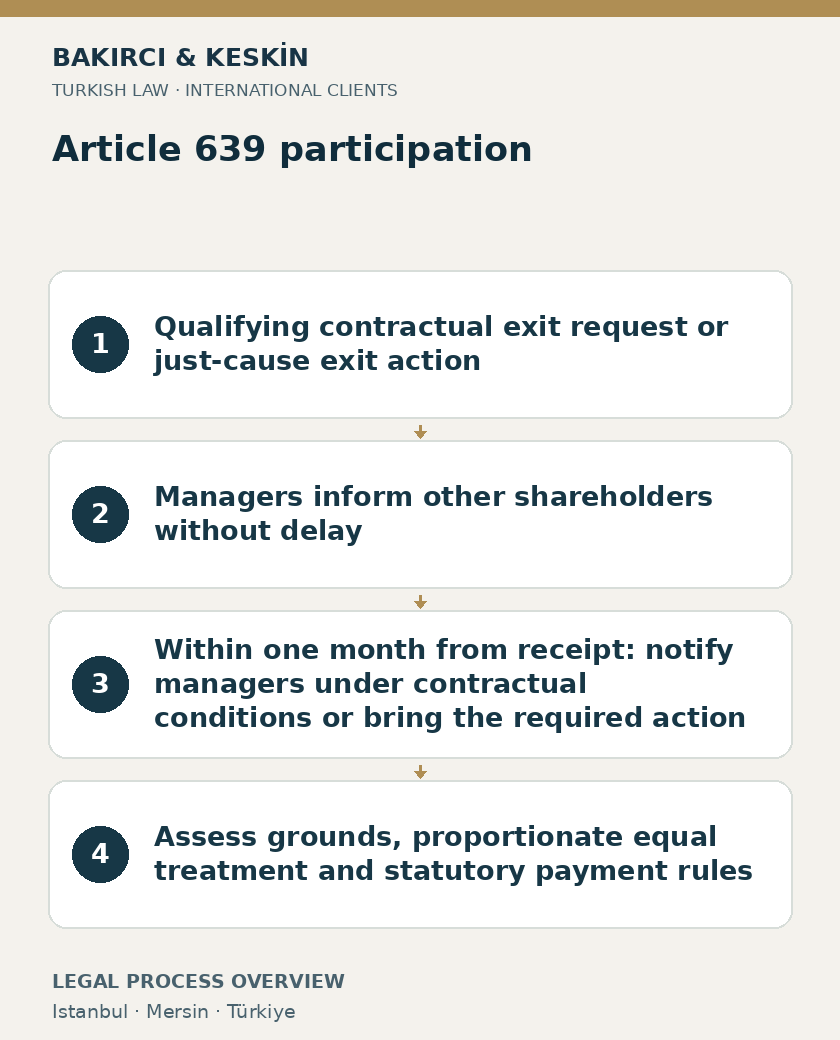
Article 639 of the Turkish Commercial Code gives other shareholders a specific opportunity to join a shareholder’s exit from a Turkish limited company. Managers must notify them without delay when a shareholder requests exit under the company agreement or brings an action for exit for just cause. Each recipient has one month from receiving the information to use the relevant statutory route. The contractual route requires the specified ground to apply to that shareholder; the litigation route requires an action. Expulsion is expressly excluded from Article 639.
Have a general question about this article? Ask anonymously
Quick summary
| Legal issue | Joining Another Shareholder's Exit from a Turkish Limited Company: Article 639 and the One-Month Period |
|---|---|
| Short answer | Article 639 of the Turkish Commercial Code gives other shareholders a specific opportunity to join a shareholder's exit from a Turkish limited company. Managers must notify them without delay when a shareholder requests exit under the company agreement or brings an action for exit for just cause. Each recipient has one month from receiving the information to use the relevant statutory route. The contractual route requires the specified ground to apply to that shareholder; the litigation route requires an action. Expulsion is expressly excluded from Article 639. |
| Key legislation | Commercial Code No. 6102; Civil Procedure Code No. 6100 |
Article 639 begins with another shareholder’s qualifying exit step
The provision concerns a Turkish limited company, or limited şirket. It applies when a shareholder requests exit based on a provision of the company agreement or files an action seeking exit for just cause. The triggering event must be identified from the actual document: the contractual exit request or the filed court claim. A discussion about selling shares, an expression of dissatisfaction or a proposal to negotiate a departure should not automatically be treated as that statutory event.
Article 638 of the Turkish Commercial Code No. 6102 supplies the underlying contractual and judicial exit routes. Article 639 addresses the position of the other shareholders once one of those routes has been used. The general guide to leaving a limited company for just cause explains the original exit claim. Participation requires a separate examination of the recipient shareholder’s entitlement and timely action.
The first practical task is to obtain the company agreement, the original exit document and the relevant dates. Without them, an investor cannot reliably distinguish a contractual notice to managers from a pending judicial exit case. That distinction determines what the joining shareholder must do.
Managers must inform the other shareholders without delay
Article 639(1) places the notification duty on the manager or managers. Once the qualifying exit request or action exists, they must inform the other shareholders without delay. The obligation is directed to the company’s management, rather than leaving every shareholder to discover the proceeding independently. A manager should therefore keep a record of the triggering document, the shareholders notified, the information sent and delivery.
The notice needs to permit an informed assessment of participation. Its substance should identify the company, departing shareholder and route used, and make the relevant request or court details available. A vague message saying that a shareholder is unhappy does not explain the legal step that has activated Article 639. Accurate information also helps prevent disputes about whether the recipient understood which opportunity was being communicated.
Article 639 does not prescribe the same express notarial notification rule found in Article 640 for an expulsion decision. The absence of that wording should not be confused with an absence of proof requirements. Both management and the recipient should preserve reliable evidence of what was communicated and when it arrived. A notice dispute should be resolved from the complete communications, not from the date written on a document alone.
The one-month period runs from receipt of the information
Article 639(2) gives each other shareholder one month from the date the information reaches that shareholder. It is not expressed as thirty days. Nor does the text make every shareholder’s period begin automatically on the date the first action was filed. The relevant receipt event must be identified separately for each participant, particularly where notices reach shareholders on different dates.
Preserve the envelope, delivery confirmation, electronic communication and attachments. Identify whether the message reached the shareholder or an authorised recipient and what information it contained. Where the legal sufficiency or timing of notice is disputed, the file needs a defensible chronology. An overseas shareholder should obtain advice on the earliest relevant communication instead of assuming that a later translation or internal discussion starts a new period.
The one-month opportunity should be treated as urgent. The shareholder needs time within it to identify the route, review the grounds, arrange authority and take the required step. Requesting more documents or negotiating with management does not itself constitute participation. Those activities should be coordinated with the statutory action rather than allowed to replace it.
The contractual route requires the ground to apply to the joining shareholder
Article 639(2)(a) permits participation by notifying the managers where the just cause provided in the company agreement also applies to the joining shareholder. The contractual wording is therefore central. Read the actual exit clause and establish the facts that bring the recipient within it. Another shareholder’s successful reliance on the clause does not by itself establish that the same condition is satisfied for everyone.
The participation notice should identify the clause, the original exit request, the joining shareholder’s interest and the reason the contractual ground applies. It should communicate an exercise of the participation right rather than merely request a valuation or express interest in a future sale. Keep the final sent version and delivery evidence so that the content and timing can be demonstrated.
Related documents require careful separation. A private shareholders’ agreement can contain contractual commitments, but Article 639 specifically refers to the company agreement. The relevant instrument and its legal effect must be established before treating a provision in another document as the statutory trigger. Any dispute over the clause, ground or effective participation needs its own legal assessment.
Keep the operative version of the company agreement together with the amendments relevant to the exit clause. A historic incorporation copy does not establish that the wording remained unchanged when the original shareholder exercised the right. The joining shareholder’s assessment should identify the clause being invoked, the document containing it and the evidence of the relevant amendment history. This also allows the managers’ response to be tested against the same contractual text used in the participation notice.
The judicial route requires the shareholder to bring an action
Article 639(2)(b) allows a shareholder to join an exit action based on just cause through an action that the shareholder brings. The wording requires a judicial step. A letter to the managers, an email to the original claimant or attendance at a hearing is not a substitute for the required claim. The joining shareholder should obtain the existing case details and prepare an independent statement of the relief sought.
Procedural handling must be addressed with the court. Article 166 of the Code of Civil Procedure No. 6100 regulates consolidation of connected cases and defines connection through similar grounds or a decision’s effect on another case. Article 639’s participation mechanism should be implemented through the appropriate filing and procedural request; it should not be described as automatic addition of a name to another person’s case.
The petition should identify the original proceeding, receipt of the information, the participation basis and the shareholder’s own requested exit. Article 119 requires the facts, evidence and requested relief to be stated. Preserve the court filing and payment records. A draft petition sent for review before the deadline does not establish that an action was brought.
Joining shareholders must present the facts supporting their own position
The right to participate does not remove the need to establish the relevant statutory conditions. Article 190 of the Civil Procedure Code places the burden of proof, absent a special rule, on the party deriving a favourable legal consequence from the alleged fact. Article 194 requires concrete facts and identification of the evidence supporting them. The joining shareholder should therefore explain how the relied-on events affect that shareholder’s continued participation in the company.
Common records can be relevant to several claimants without making their claims identical. Minutes, company correspondence, financial records and prior information requests should be organised by the fact each proves. Distinguish matters personally experienced from information obtained through another shareholder. An allegation repeated in several petitions does not become stronger merely through repetition.
Article 614 provides limited-company shareholders with information and inspection rights. The shareholder information rights guide explains the management, general assembly and judicial stages. A targeted records request can support preparation, but its timetable should not be mistaken for an extension of Article 639’s one-month opportunity.
Equal treatment is proportionate to the capital shares
Article 639(3) requires all departing shareholders to be treated equally in proportion to their capital shares. The rule does not prescribe the same cash amount for every person regardless of the size of the interest. The participation file should therefore identify each person’s capital share accurately and make the treatment of the departing interests transparent.
Valuation materials and settlement proposals should be reviewed against that statutory requirement. The company should explain the legal and financial basis of the treatment offered to each departing shareholder. Distinctions in the underlying rights or transaction terms require examination; the existence of several departures is not permission to select unexplained preferences between participants.
Equal treatment also does not mean that one shareholder can conduct another’s claim without authority. Each person must give valid instructions and address the relevant participation conditions. Joint preparation of company evidence can be useful, while decisions concerning settlement, requested relief and acceptance of a payment arrangement remain matters requiring the authority of the affected shareholder.
Participation does not remove the statutory valuation and payment rules
Article 641(1) gives a departing shareholder a right to an exit payment corresponding to the real value of the capital interest. Article 641(2) permits the company agreement to regulate the payment differently for an exit right provided by that agreement. The applicable exit basis and contractual text must therefore be identified before fixing the valuation demand. Nominal capital is not stated as the universal measure.
Article 642 separately regulates maturity of the payment. It identifies available equity, transferability of the departing person’s shares and capital reduction under the relevant rules as the statutory circumstances for maturity upon departure. A recognised entitlement to a value should not be represented as an unconditional right to immediate cash regardless of those provisions.
Under Article 642(3), the unpaid portion forms a claim against the company ranking after all creditors, with the provision linking maturity to determination of available equity in the annual report. Joining shareholders should therefore examine both valuation and payment capacity. A settlement should state what is agreed about the amount, legal payment basis and actual performance, rather than treating a valuation report as a receipt.
Assess shareholder status and interim protection during the case
Article 638(2) permits the court, on request during the action, to freeze some or all rights and obligations arising from the claimant’s membership or take other measures securing that shareholder’s position. The statute requires a judicial decision. Bringing or joining the action should not be treated as an automatic suspension of every shareholder obligation.
The request should identify the particular right or obligation, the concrete reason protection is needed and the measure sought. A joining shareholder cannot assume that an order concerning another claimant automatically extends to everyone. Obtain and read the operative wording of any existing order before deciding whether a further request is necessary.
Company communications should continue to be monitored while the exit claim is pending. Meeting notices, information requests and financial statements can affect the evidence and ongoing relationship. Keep litigation developments separate from the steps needed to implement a departure, update corporate records and address the resulting payment once the legal basis is established.
Expulsion is expressly outside Article 639
Article 639(4) states that the provision does not apply where a shareholder is expelled under the company agreement or for just cause. The distinction is explicit: another person’s expulsion does not open the same participation route. Article 640 regulates expulsion and its challenge mechanism, including its own three-month period following notarial notification of the expulsion decision.
A company dissolution claim is also a different proceeding. Article 636(3) permits dissolution for just cause and allows specified alternative solutions. The presence of a possible shareholder departure within that framework does not justify assuming that every procedural step is an Article 638 exit action. Read the petition and requested relief before applying Article 639.
A negotiated share transfer has its own legal requirements as well. These distinctions protect the shareholder from choosing the wrong deadline and the company from treating unrelated events as interchangeable. The title used in informal correspondence is less useful than the operative request, resolution or court claim.
Coordinate foreign instructions within the participation timetable
Article 639’s wording does not create a separate longer period for shareholders abroad. Overseas residence makes document collection and authority preparation more important. Confirm the recipient’s identity, current shareholding and the person authorised to instruct Turkish counsel. For a corporate shareholder, the foreign entity’s internal authority and representative documents must be established.
Foreign powers of attorney and corporate records require an appropriate authentication and Turkish translation review. The foreign document guide explains that preparation. These steps should begin promptly after notice; they should not be assumed to stop the one-month period while documents travel or internal approvals are obtained.
Keep one coherent record of trigger, timing, grounds and relief
The core file should connect the original exit request or action, management’s notification, receipt evidence, the company agreement, shareholding records and the participation act. Add the facts and documents supporting the joining shareholder’s grounds and any request for interim protection. This allows the legal route and the timing to be checked together.
After filing or notification, obtain confirmation of the procedural position and review subsequent orders and correspondence. Article 639 provides a defined opportunity to participate; the outcome still depends on the applicable grounds, evidence and financial rules. A complete record makes those issues capable of being assessed without confusing participation with a completed exit.
Frequently asked questions
When must managers tell me that another shareholder is leaving?
Article 639(1) requires notification without delay when a shareholder requests exit under the company agreement or files an exit action for just cause. The actual request or court claim should be identified. Informal discussion of a possible departure is not automatically the same triggering event.
Is the participation period thirty days?
The statute states one month from the date the information reaches the shareholder. It should not be rewritten as a universal thirty-day period. The receipt evidence and the applicable calculation must be reviewed for the actual communication and required participation step.
Does the period run from the first shareholder’s filing date?
Article 639(2) refers to the date the information reaches the other shareholder. The original filing date and each recipient’s receipt date are different facts. Both should be recorded, with reliable evidence showing what notice the recipient received.
Can I join a contractual exit by notifying managers?
Article 639(2)(a) provides that route where the just cause specified in the company agreement also applies to you. The notice should clearly exercise participation and identify the clause and relevant facts. Another shareholder’s reliance on the clause does not automatically establish your own entitlement.
Is an email to the original claimant enough to join an exit lawsuit?
No. Article 639(2)(b) refers to an action brought by the joining shareholder. The appropriate court filing and procedural handling are required. Informal agreement with the original claimant does not itself establish that the statutory judicial step occurred.
Do all departing shareholders receive the same amount?
Article 639(3) requires equal treatment in proportion to their capital shares. It does not require equal cash amounts irrespective of share size. Articles 641 and 642 separately govern valuation and payment maturity, and the applicable contractual exit terms must also be examined.
Can I use Article 639 because another shareholder was expelled?
Article 639(4) expressly excludes expulsion under the company agreement or for just cause. Expulsion and voluntary or judicial exit have different statutory routes. The resolution or claim must be classified correctly before selecting the applicable remedy and deadline.
Does joining the case suspend my shareholder obligations?
Suspension is not automatic. Article 638(2) allows the court, on request, to freeze specified membership rights or obligations or order other protective measures. Read any existing order carefully and seek protection addressing your own position where legally justified.
Does living abroad give me more time?
Article 639 does not prescribe a longer participation period for overseas shareholders. Authority documents, translation and instructions should be organised promptly. Their preparation should not be assumed to suspend the statutory period.
Does a successful exit mean immediate payment of the full valuation?
Valuation entitlement and payment maturity are separate. Article 642 sets the relevant payment conditions and addresses the unpaid portion’s subordinated position. The file must establish the real-value claim and the legal basis for the payment sought at that stage.
Official legal sources
- Commercial Code No. 6102 — Articles 614, 636(3), 638, 639(1)-(4), 640, 641, 642
- Civil Procedure Code No. 6100 — Articles 119, 166, 190, 194
The official Turkish legislation controls. The governing law, deadlines and procedural requirements must be assessed for the individual case.
Contact information
Do not include confidential documents or identity numbers in an initial message. An enquiry does not establish representation or suspend any legal deadline.
Istanbul and Mersin contact details
Bakırcı & Keskin Law Office is Mersin-based. Turkish matters are handled under the applicable jurisdiction and agreed mandate. The competent court and the scope of representation are assessed for each matter.
Istanbul — Polaris Plaza
Maslak Ahi Evran Caddesi, Polaris Plaza No:21, Floor 9, 34475 Sarıyer/İstanbul, Türkiye.Mersin — Profit İş Merkezi
İhsaniye Mahallesi, 4903. Sokak, Profit İş Merkezi No:23, Floor 3, Office 14, 33070 Akdeniz/Mersin, Türkiye.+90 552 224 43 66 · Contact details in English. An enquiry does not establish representation or suspend a legal deadline.
Istanbul Office – Polaris Plaza, Maslak / Sarıyer
Bakırcı & Keskin Hukuk Bürosu
Maslak Ahi Evran Caddesi, Polaris Plaza No:21, Kat:9, 34475 Sarıyer/İstanbul
Our physical offices in Istanbul and Mersin coordinate matters throughout Turkey, subject to jurisdiction and the local steps required for each case. Please specify your preferred office when arranging an in-person appointment.
Open the Istanbul office on Google Maps · Contact and appointments
Contact regarding a legal matter
In your first message, you may briefly state the subject, your country or city, and any relevant notification or recent procedural date. Please do not send identity numbers, medical data, or personal documents. Messaging alone does not constitute legal advice or create a lawyer–client relationship.
Discover more from Bakırcı & Keskin Hukuk Bürosu
Subscribe to get the latest posts sent to your email.