Turkish Residence Refusal Sent While You Are Abroad: Service and the Lawsuit Clock
Short answer: For an ordinary Turkish residence-refusal challenge, the filing period must be calculated from the legally relevant notification, not assumed from the decision’s date or a portal update. Law No. 6458 Articles 25 and 100, Service Law rules and Administrative Procedure Law Articles 7–8 must be read together. Service on a representative, UETS’s fifth-day rule and actual knowledge after irregular service can materially affect the chronology.
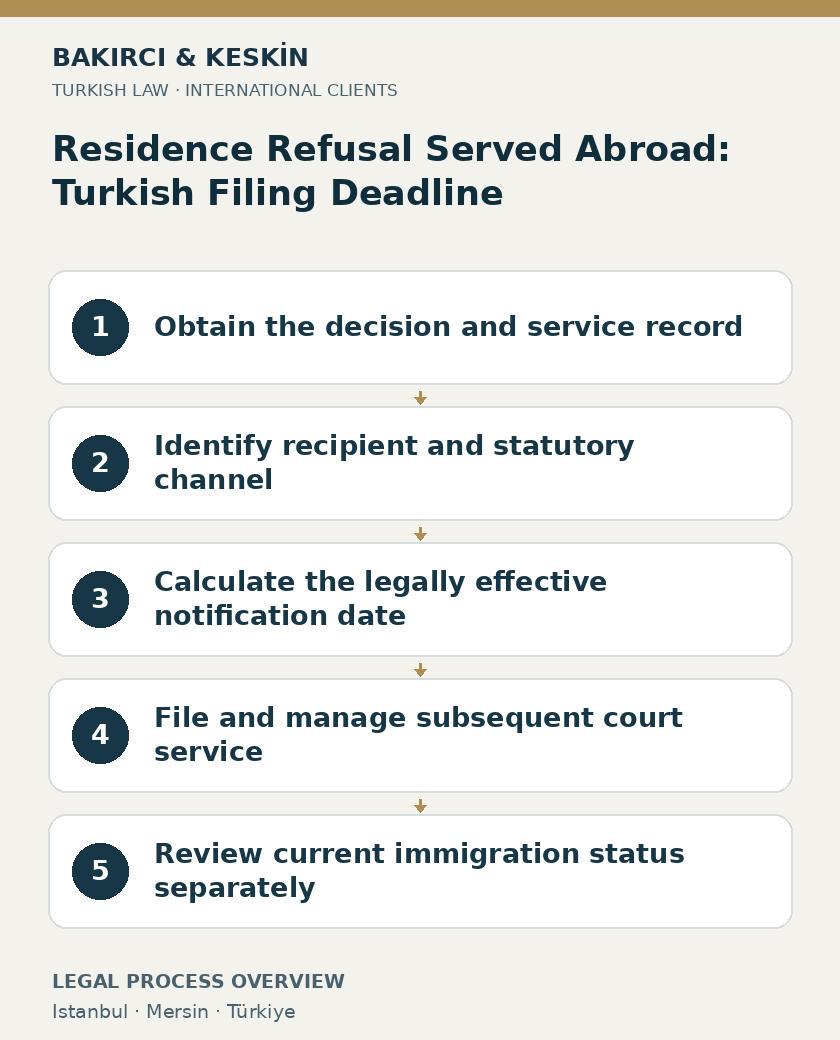
Quick summary
| Legal issue | Turkish Residence Refusal Sent While You Are Abroad: Service and the Lawsuit Clock |
|---|---|
| Short answer | For an ordinary Turkish residence-refusal challenge, the filing period must be calculated from the legally relevant notification, not assumed from the decision’s date or a portal update. Law No. 6458 Articles 25 and 100, Service Law rules and Administrative Procedure Law Articles 7–8 must be read together. Service on a representative, UETS’s fifth-day rule and actual knowledge after irregular service can materially affect the chronology. |
| Key legislation | Law No. 6458 — Articles 25, 31(7), 100; Law No. 7201 — Articles 7/a, 11, 25, 32; Law No. 2577 — Articles 7, 8, 11, 26(3), 27 |
Obtain the decision before calculating its challenge period
A residence refusal, cancellation or non-renewal must be identified from the actual administrative decision. Obtain the full document, its reference, issuing authority, reasons and attachments. A message from an intermediary saying that the application failed may alert the applicant to a problem, but it does not provide the complete legal record needed to assess the act and its notification.
Keep the date of the decision separate from the notification date. The authority can sign a decision on one day and communicate it through a legally relevant route later. A portal status can also change on a different date. The judicial period must be linked to the statutory notification rule and actual evidence, not automatically to whichever date first appears in the file.
The residence-refusal guide explains the merits of an ordinary challenge. The present issue is narrower: establishing the legally effective communication and the resulting procedural calendar when the applicant is abroad. That analysis requires the service record as well as the refusal itself.
Articles 25 and 100 connect residence notification to the Service Law
Law No. 6458 Article 25 regulates domestic residence refusal, cancellation and non-renewal and their notification. It provides for notification to the foreigner, legal representative or lawyer and requires information explaining effective use of remedies and the associated rights and obligations. The contents and recipient of the actual notification therefore require examination.
Article 100 states that notifications under Law No. 6458 are made under Service Law No. 7201, with implementing rules taking account of foreign status and relevant special circumstances. An applicant should not assume that every message from an authority has the same procedural character. Identify the legal route used and the documents proving completion of that route.
An omission or mistake in remedy information must be brought to counsel’s attention, but should not be treated as an automatic permission to wait indefinitely. Preserve the notification as received and obtain an assessment of its legal effect. The appropriate response depends on the actual defect and procedural record, not merely on the applicant’s understandable uncertainty about Turkish legal terminology.
Service on a representative can matter before the client reads the decision
Service Law Article 11 generally provides for service on the representative in matters conducted through one. It also addresses multiple representatives: service on one is sufficient, and where several are served the first service date is the operative date under the provision. Read this with the residence-specific rule and the actual representation recorded in the file.
Obtain the power of attorney, appointment record and service evidence relevant to the matter. A person described socially as the applicant’s consultant is not necessarily the legally authorised representative. Equally, an applicant cannot assume that the period waits for personal reading if a legally effective notification has already occurred through the proper representative.
Agree how decisions will be reported promptly while the applicant is abroad. Preserve the official service record separately from the later email forwarding it to the client. The forwarding date is useful communication evidence, but should not be substituted for the legal notification date without analysis. Changes of lawyer or authority should also be reflected accurately in the procedural file.
UETS service has a specific five-day deemed-notification rule
Article 7/a requires electronic service for the categories it lists, including lawyers registered with a bar. It also provides for persons outside those categories who obtain an electronic-service address on request. The statutory process operates through the National Electronic Notification System, UETS. A general email address or ordinary messaging application should not be treated as the same system merely because a document was received electronically.
Under Article 7/a, electronic notification is deemed made at the end of the fifth day following the date it reaches the recipient’s electronic address. Preserve the UETS delivery and notification records. The date an alert appeared on a telephone or the date the recipient chose to open the message should not automatically replace the statutory deemed-service calculation.
The article provides for other service methods where electronic service cannot be performed for a compulsory reason. The actual file must therefore identify which route was used and why. Do not assume that every notification is invalid because it was not electronic, or valid because a screenshot resembles an electronic notice. The system record and applicable legal category are the relevant starting points.
Foreign residence does not by itself invalidate service
Article 25 of the Service Law addresses notification in a foreign country through the competent authority there, with the treaty and local-law framework stated in the provision. Establish the applicant’s actual overseas address and the legal route applicable to the intended recipient. The country, nationality, representation and relevant service mechanism can affect the process; a general statement that the applicant was outside Turkey does not resolve it.
Preserve evidence of address changes and the information supplied to the administration or court. An old address in a file can require examination of the specific service rules and events. It does not justify an unsupported conclusion that nothing legally effective could have occurred, particularly where a representative or electronic-service address was also relevant.
Where documents were sent abroad, obtain the request, transmission and completion records available through the lawful process. Identify the person served, location, method and completion date. A tracking page showing that an envelope crossed a border does not necessarily establish every element of legal notification. The court record should support the date on which the challenge period is calculated.
Article 32 makes actual knowledge relevant to irregular notification
Article 32 provides that notification made contrary to procedure is nevertheless valid if the recipient has learned of it, and treats the date declared by the recipient as the notification date within its framework. A defect allegation therefore requires attention to actual knowledge as well as the delivery irregularity. The applicant should state the truthful chronology and preserve the material explaining it.
Do not assume that identifying an error in the envelope or address eliminates every deadline. Obtain the decision and seek prompt advice once it becomes known. A message, forwarded document or file inspection can be relevant to the knowledge inquiry, even where it is not itself the ordinary formal-service route. Its exact content and circumstances should be preserved rather than dismissed as informal.
Equally, the applicant should not invent a later knowledge date to obtain a preferred timetable. The record must remain consistent across the administrative request, court pleading and correspondence. The legal effect of the actual facts is for assessment under the applicable rules. Accurate dates are more useful than a categorical assertion that defective notification can never have consequences.
Calculate the ordinary lawsuit period from the legally relevant event
Administrative Procedure Law Article 7 provides an ordinary sixty-day period for administrative-court actions where no special period is prescribed. In administrative disputes, it runs from the day following written notification. The residence decision and any separate immigration act must be classified correctly before applying that general period.
Article 8 provides that holidays are included, while a final day falling on a holiday extends to the end of the following working day. It also contains a specific rule for periods under that law ending during the judicial recess. Those provisions should be applied to the actual calendar and legal period rather than converting every stated number into working days.
Prepare a dated calculation showing the notification mechanism, effective service date, first day and any legally applicable adjustment. Where several possible dates appear, identify their different functions and resolve the legal issue promptly. A disputed service question should not become a reason to postpone all action until the latest date the applicant hopes a court might accept.
An administrative reconsideration request does not simply reset the clock
Article 11 of Law No. 2577 allows the specified pre-action request to a superior authority, or the issuing authority where none exists, within the judicial period. The application stops the running period under the provision. It must concern the act and relief described by that article; an informal enquiry asking whether the file can be checked again should not automatically be assumed to have the same effect.
The request is deemed rejected after thirty days without a response. Upon rejection or deemed rejection, the judicial period resumes and the time that elapsed before the request is counted. The applicant does not automatically receive a new full sixty days. Preserve the original service, reconsideration application and response dates in the same calculation.
If a lawyer has already filed a case, or a later administrative act is issued, the procedural position requires fresh analysis. A duplicate letter should not be treated as a way to restart an expired period. The court must receive an accurate chronology of the act actually challenged and the steps taken in relation to it.
Short-term residence litigation has a separate address-failure rule
Law No. 6458 Article 31(7) contains special procedural rules for the short-term residence refusal and cancellation challenges it specifies. It treats the file as complete after the defence is submitted or its period expires, leaves a hearing to the court’s discretion and modifies the period applicable where notification cannot be made to the claimant’s stated address.
Administrative Procedure Law Article 26(3) ordinarily provides for removal of the file from processing until a new address is given, with any stay becoming ineffective. Its ordinary one-year period for providing a new address and requesting renewed processing runs from removal of the file from processing. Article 31(7) substitutes two months in the short-term residence cases it covers. If the required renewed-processing request with a new address is not made within the applicable period, the court declares the action not brought. This court-file maintenance rule does not replace the initial sixty-day filing analysis.
Keep the court address and representation information accurate throughout the case. An applicant who filed on time can still face procedural consequences if later notification fails and the statutory steps are not taken. Monitor the actual court orders and seek renewed processing within the applicable framework where required. Filing the original petition does not end the need to manage service.
Transition for older cases: Provisional Article 3 of Law No. 6458 applies the Article 31 changes introduced by Law No. 7533, Articles 35 and 38 to lawsuits filed after that amendment took effect on 30 November 2024. An earlier lawsuit needs its applicable procedural version checked; the two-month substitution should not be copied automatically into every historical file.
A service dispute and the right to remain are separate questions
A timely lawsuit does not itself issue a residence permit. Article 27 of Law No. 2577 states the general rule that bringing an administrative case does not suspend the challenged act. Identify the applicant’s current lawful-stay basis and any protective order actually granted. The fact that the service date is disputed does not establish a new immigration status.
The renewal guide explains the statutory application-document position under Article 24. That basis must be established from the actual completed renewal procedure and document. A refusal notification, pending judicial challenge and a separate application can have different consequences and should be recorded separately.
Provide counsel with every immigration decision received, including any act separate from the residence refusal. Do not assume that challenging one decision automatically covers another. Travel and work plans should be assessed against the actual authorisations and procedural position, so the response to a notification problem does not rest on an inaccurate account of current status.
Preserve a notification bundle that can be independently checked
The bundle should contain the full decision, envelope or delivery report, electronic-service evidence where applicable, representation documents and the chronology of actual knowledge. Add address records and any submitted update relevant to the disputed service. Label the decision date, dispatch date, delivery date and legally asserted notification date separately.
Where a family member or adviser forwarded the document, preserve the original forwarding message and the attachment as received. Explain who first obtained it and through what route. A later summary prepared for litigation should not erase the original communication record. The court needs evidence of the actual events rather than an account reconstructed only around the desired deadline.
For foreign documents, retain complete originals and arrange the legally appropriate translation or authentication for their use. The purpose is to establish the relevant address, authority or delivery fact accurately. A translated explanation should not silently change dates or names to match the Turkish file; differences must be explained by the underlying evidence.
Respond to the decision while resolving any service objection
The challenge should address both the notification issue and the actual refusal grounds where relevant. An argument about service is not a substitute for explaining why the administrative act is unlawful. The lawyer needs the application evidence and the authority’s reasons as well as the delivery record, so procedural and substantive arguments can be presented coherently.
Keep proof of the court filing and any interim request or decision. Report what has actually occurred: preparation, submission, registration, service and judicial action are different steps. The applicant abroad should receive the operative documents and an explanation of the next legal event requiring attention, especially if another notification arrives during the case.
A reliable deadline analysis rests on the right document, proper recipient, legally applicable service route and truthful chronology. Residence abroad adds practical complexity but does not replace those statutory questions. Resolving them promptly allows the applicant to challenge the actual refusal without relying on either an assumed automatic invalidity or an unverified date.
Frequently asked questions
Does the refusal date printed on the decision always start the lawsuit period?
No. Identify the legally relevant notification under the applicable rules.
Who can receive residence notification?
Article 25 names the foreigner, legal representative or lawyer; the actual representation and Service Law framework must be examined.
Can service on my lawyer matter before I read the message?
Yes. Article 11 governs represented matters and the actual legally effective service record must be checked.
When is UETS service deemed completed?
Article 7/a specifies the end of the fifth day following delivery to the recipient’s electronic address.
Is an ordinary email automatically UETS service?
No. Identify the actual statutory channel and preserve the message; it may still be relevant to other knowledge questions.
Does being abroad make every Turkish notification invalid?
No. The actual address, representation, electronic-service and overseas-service rules must be applied.
What does irregular notification mean for time limits?
Article 32 makes actual knowledge relevant. State the truthful knowledge chronology and obtain prompt legal assessment.
Does an Article 11 request create a fresh sixty days?
No. The remaining judicial period resumes with earlier elapsed time counted under the provision.
Why is the court address important after filing?
In the specified short-term residence cases, Article 31(7) substitutes two months for Article 26(3)’s ordinary period. After removal from processing, provide a new address and request renewed processing within that period; otherwise the court declares the action not brought.
Does a lawsuit automatically permit continued stay?
No. Current residence status and any protective order must be assessed separately from the court filing.
Official legal sources
- Law No. 6458 — Articles 25, 31(7), 100
- Law No. 7201 — Articles 7/a, 11, 25, 32
- Law No. 2577 — Articles 7, 8, 11, 26(3), 27
Legal review: 28 October 2026. The official Turkish legislation controls. Establish the proper recipient, service method and truthful knowledge chronology before calculating the filing period.
Contact information
Do not include confidential documents or identity numbers in an initial message. An enquiry does not establish representation or suspend any legal deadline.
Istanbul and Mersin contact details
Bakırcı & Keskin Law Office is Mersin-based. Turkish matters are handled under the applicable jurisdiction and agreed mandate. The competent court and the scope of representation are assessed for each matter.
Istanbul — Polaris Plaza
Maslak Ahi Evran Caddesi, Polaris Plaza No:21, Floor 9, 34475 Sarıyer/İstanbul, Türkiye.Mersin — Profit İş Merkezi
İhsaniye Mahallesi, 4903. Sokak, Profit İş Merkezi No:23, Floor 3, Office 14, 33070 Akdeniz/Mersin, Türkiye.+90 552 224 43 66 · Contact details in English. An enquiry does not establish representation or suspend a legal deadline.
Istanbul Office – Polaris Plaza, Maslak / Sarıyer
Bakırcı & Keskin Hukuk Bürosu
Maslak Ahi Evran Caddesi, Polaris Plaza No:21, Kat:9, 34475 Sarıyer/İstanbul
Our physical offices in Istanbul and Mersin coordinate matters throughout Turkey, subject to jurisdiction and the local steps required for each case. Please specify your preferred office when arranging an in-person appointment.
Open the Istanbul office on Google Maps · Contact and appointments
Contact regarding a legal matter
In your first message, you may briefly state the subject, your country or city, and any relevant notification or recent procedural date. Please do not send identity numbers, medical data, or personal documents. Messaging alone does not constitute legal advice or create a lawyer–client relationship.
Discover more from Bakırcı & Keskin Hukuk Bürosu
Subscribe to get the latest posts sent to your email.