Private Loan Repayment in Turkey: Interest and the Six-Week Rule Under TCO 386–392
A private loan without an agreed repayment date is not automatically repayable on the same day the lender first asks for it. Article 392 of the Turkish Code of Obligations provides a six-week period from the first request where the parties agreed neither a repayment day, a notice period nor maturity immediately upon demand. Articles 386–391 address the loan’s nature, interest, initial delivery and the borrower’s inability to pay. These rules must be distinguished from proof of the loan, default interest and the procedure for collecting an unpaid balance. A clear repayment file starts with what the borrower actually promised.
Have a general question about this article? Ask anonymously
Article 386 defines a loan by the obligation to return an equivalent
Under Law No. 6098, Article 386, the lender undertakes to transfer money or a consumable thing and the borrower undertakes to return something of the same nature and quantity. The Turkish term is tüketim ödüncü. It describes the legal form of the loan, not a conclusion that every such transaction is a regulated consumer-credit agreement.
The obligation to return an equivalent distinguishes this arrangement from a gift or a payment for goods. It also differs from lending an identified item for use and return of that same item. A bank record proves a money movement; the agreement and surrounding evidence must establish why the recipient was required to repay it.
Identify the actual lender and borrower. A transfer sent through a relative’s account or received by a company associated with the intended borrower requires explanation. Family relationship, common ownership or a shared director does not automatically combine separate people into one debtor. The repayment undertaking must be linked to the person against whom the claim is made.
Write down the agreed repayment arrangement before calculating a due date
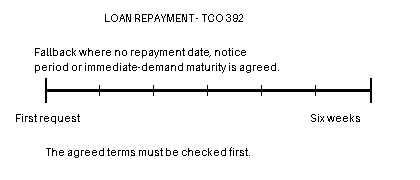
The agreement can provide a specified repayment day, an agreed notice period or maturity upon demand. Article 392’s fallback applies when those arrangements have not been agreed. The correct first step is therefore to examine the actual terms, including a later valid amendment, rather than add six weeks to every private-loan demand automatically.
Keep the original agreement, messages about repayment and any instalment schedule. Distinguish an accepted change from an unaccepted proposal. A request for more time does not necessarily establish that the lender agreed to a new maturity. Equally, a genuine extension should not be ignored simply because it was communicated after the initial transfer.
The wording must identify the obligation affected. An agreement concerning one instalment does not necessarily postpone the entire outstanding balance. A plan for payment after a particular event needs interpretation of that event and its legal significance. An informal description that the borrower will pay when able should not be converted into a precise calendar date without examining what was actually agreed.
Article 392’s six-week rule is a fallback, not a universal grace period
Where no specified repayment day, notice period or immediate-demand maturity was agreed, the borrower is not obliged to return the loan until six weeks have passed from the first request. The period protects the borrower against an unsupported assumption of immediate maturity. It is not six weeks from the original date the money was advanced.
The first request must be established from the records. Identify who made it, the repayment sought and the communication to the borrower. A draft demand saved on the lender’s computer is not proof that a request was made to the borrower. Preserve the message, letter or other communication and the available evidence of delivery.
The rule also does not provide every borrower with another six weeks after an already agreed fixed repayment date. Where the parties made one of the arrangements identified in Article 392, apply that arrangement and the relevant law. Replacing an agreed maturity with the fallback would reverse the statutory sequence.
A demand should make clear whether it is the first repayment request under Article 392, a reminder of an existing due obligation or a step concerning default. Those functions can interact, but they should not be treated as identical without analysis. The document’s legal role must be stated consistently with the timeline used in a later claim.
Maturity and debtor default are separate questions
Article 117 generally links default on a due debt to the creditor’s notice, while providing circumstances in which an additional notice is unnecessary, including the passing of an agreed performance day. Establishing that the loan has become repayable and establishing the start of default are therefore related but distinct tasks.
A repayment schedule should separately record the contract date, advance date, agreed maturity or first request, any applicable notice period and subsequent default-related communications. This prevents interest from being calculated from a date selected only because it is the earliest entry in the file.
A borrower should likewise not assume that every notice defect means the principal never has to be repaid. The existence of the repayment obligation, its maturity and the consequences of delay require separate answers. A defensible response identifies which point is disputed and the evidence supporting that dispute.
Interest differs between non-commercial and commercial loans
Article 387 states that interest cannot be demanded in a non-commercial loan unless the parties agreed it. For a commercial loan, interest can be demanded even without an express agreement. The transaction’s legal classification therefore matters before the lender adds ordinary interest to the principal.
The distinction concerns the interest attached to the loan arrangement. It should not be used to erase the separate question of default interest after the borrower falls into default. An interest-free loan during its agreed term and the legal consequences of late repayment are not automatically the same issue.
For agreed interest, retain the wording specifying the rate, period and payment mechanism. An amount added later to a private spreadsheet is not proof of an earlier interest agreement. A demand should distinguish principal, ordinary interest, default interest and any other claimed amount, with a legal basis for each.
Articles 387–388 do not provide a general authorisation to conduct a lending business or resolve every regulatory issue arising from an interest-bearing arrangement. The transaction must be reviewed under the rules applicable to its participants and activity. A civil-law interest provision is not a substitute for that separate assessment.
Article 388 addresses the rate, annual payment and compounding
Where interest is due but its rate has not been determined, Article 388 states that the rate ordinarily applicable to that type of loan at the time and place of borrowing applies as a rule. It also provides that the determined interest is payable annually unless the contract states otherwise. The reference point is not simply whatever percentage the lender currently prefers.
The provision prohibits agreeing that interest will be added to principal and that further interest will run on the combined amount. A calculation should therefore not silently capitalise unpaid interest under the general loan rule. Any special commercial or other statutory regime must be identified separately before a different treatment is asserted.
This guide does not supply one interest percentage for every private, commercial or foreign-currency loan. The applicable legal framework, date, currency and valid agreement must be established for the actual calculation. A schedule is useful when it states those inputs explicitly and permits the arithmetic to be checked, rather than presenting one unsupported accumulated figure.
Article 389’s six months does not describe every repayment claim
Article 389 concerns the borrower’s claim for delivery of the loan subject and the lender’s claim that the subject be accepted. Those claims become time-barred six months after the other party falls into default concerning that delivery or acceptance. This is a rule about the initial performance of the lending arrangement.
It should not be restated as a rule that every lender has only six months to recover money already advanced. Nor should the six-month period be confused with Article 392’s six weeks for repayment maturity in the specified fallback situation. The claims and starting events are different.
The lender’s later repayment claim needs its own limitation analysis under the applicable provisions. Identify the claim, maturity, any acknowledgement, proceedings and other relevant events. A deadline cannot be calculated reliably from the statutory number alone without first determining which obligation the article regulates.
| Rule | What it addresses | Starting point |
|---|---|---|
| Article 389: six months | Claims for initial delivery or acceptance of the loan subject | The other party’s default concerning that performance |
| Article 392: six weeks | Repayment where the specified alternative repayment terms were not agreed | The first repayment request |
| Agreed repayment term | The parties’ established maturity arrangement | The date or notice mechanism actually agreed |
Article 390 permits withholding an unadvanced loan in specified circumstances
If the borrower falls into inability to pay after the loan agreement was concluded, Article 390 permits the lender to refrain from delivering the loan subject. The lender has the same right on later learning that the borrower’s inability to pay already existed before conclusion. The provision therefore requires attention to both the financial condition and when it became known.
This is not a general right to withdraw from any promise to lend because the lender changes its mind. Identify the borrower’s inability to pay and the evidence supporting it. A disputed rumour or a problem affecting an unrelated company should not automatically be treated as the statutory condition.
The rule also concerns delivery of the loan subject. It should not be presented as automatically accelerating every amount that has already been advanced. Repayment maturity and any contractual acceleration require their own legal basis. The agreement, advance schedule and financial evidence must be read together.
Goods or securities supplied instead of the agreed money have a valuation rule
Article 391 addresses a lender supplying negotiable instruments or commercial goods in place of the money agreed. The debt amount is calculated at their exchange or market value at the time and place of delivery. A contrary agreement is invalid under the provision.
The practical review needs to identify what was actually delivered, when and where it was delivered, and the evidence of the relevant value. A face amount printed on a document or a price selected in advance does not automatically reproduce the statutory valuation. Keep the transfer and valuation records separate from the contractual description of the promised money.
Do not treat this provision as permission to substitute any goods for cash without considering the parties’ actual arrangement. Article 391 explains the valuation of the situation it regulates; the contract’s formation, performance and other applicable requirements remain relevant. The repayment calculation should use a legally supported principal rather than an inflated nominal figure.
Foreign-currency advances require a separate currency analysis
Record the currency agreed, the amount sent and the amount actually received. An international transfer can involve conversion and charges. The borrower may acknowledge a repayment obligation in a currency different from the bank’s settlement entry; the legal significance must be assessed from the agreement rather than inferred from one banking document.
Our foreign-currency debt guide addresses Article 99, conversion and payment allocation. The present article addresses the loan contract and repayment maturity. The six-week rule does not decide which currency or exchange-date option can be used in a demand.
Applicable currency restrictions, tax questions and the governing law of a cross-border arrangement also require their own assessment. Neither a foreign passport nor an overseas bank account should be used as an automatic answer. Preserve the original figures so the legal analysis does not depend on a conversion assumption hidden in a spreadsheet.
Keep the loan evidence and the outstanding balance traceable
The core record contains the repayment agreement, the actual advance, the agreed maturity or first demand, and all repayments. A message acknowledging receipt and a message acknowledging a repayable balance have different content. Keep the surrounding exchange so that a conditional proposal is not mistaken for an unconditional admission.
Partial payments must be reconciled accurately. The allocation guide explains why a payment does not automatically reduce principal in the way one party prefers. A record of money received should not be omitted merely because the parties dispute its legal allocation.
When the loan is repaid, address the receipt and any original debt instrument. The paid-debt documentation guide explains Articles 103–105. Giving a new note is not the same as actual repayment, and the novation guide explains why another instrument does not automatically extinguish the earlier debt.
Choose the recovery route only after the debt is legally ready
A repayment demand should identify the lender, borrower, advance, maturity basis and remaining amount. A claim begun on an assumed due date can encounter a problem that a clear chronology would have exposed. Review any later amendment or first-request requirement before describing the borrower as already obliged to pay immediately.
The procedural route also depends on the documents and transaction. The enforcement guide for overseas clients addresses that separate stage. Establishing a valid debt and recovering money from available assets are distinct questions; a forceful demand does not guarantee collection.
For a borrower who has been served with a claim or payment order, preserve the complete document and service record. Negotiating an extension does not itself file the required response. The loan’s merits, maturity, interest and the procedural deadline should be assessed together without allowing one issue to obscure the others.
Frequently asked questions
Is a loan without a repayment date payable immediately on demand?
Article 392 provides six weeks from the first request where no repayment day, notice period or immediate-demand maturity was agreed. Check the actual terms before applying that fallback.
Does every private borrower receive six extra weeks after an agreed due date?
No. The six-week rule is not a universal grace period. An established repayment date or other arrangement identified by Article 392 must be considered first.
Can ordinary interest be charged on every non-commercial loan?
Article 387 requires agreement for ordinary interest on a non-commercial loan. Default interest after the borrower falls into default is a separate legal question.
What does Article 388 say when an applicable interest rate was not fixed?
It refers, as a rule, to the rate applicable to that type of loan at the time and place of borrowing. The applicable legal regime and any mandatory controls still require examination.
Can unpaid interest simply be added to principal under the general loan rule?
Article 388 prohibits agreeing to capitalise interest and charge further interest on the combined sum. A different treatment requires identification of an applicable special statutory rule, not merely a spreadsheet setting.
Does Article 389 give every lender only six months to recover an advance?
No. It addresses initial delivery and acceptance claims, running from the other party’s relevant default. A repayment claim for money already advanced requires a different limitation analysis.
Can a lender refuse delivery when the borrower becomes unable to pay?
Article 390 permits withholding in the circumstances it identifies, including later discovery of pre-existing inability to pay. The financial condition and chronology must be established.
How are goods supplied instead of the agreed cash valued?
Article 391 uses their exchange or market value at delivery time and place. A contrary valuation agreement is invalid under that provision.
Does a transfer alone establish that the recipient borrowed the money?
The transfer must be connected to an obligation to repay. Article 386 defines the loan by the promised transfer and return of an equivalent, not by banking movement alone.
What should an overseas lender provide for review?
Provide the repayment agreement, advance and repayment records, maturity terms, first demand and delivery evidence, interest terms and any served proceedings. Keep currencies and legal identities explicit.
Official legal sources
Turkish Code of Obligations No. 6098, Articles 117 and 386–392. The official Ministry text, pages 76–77 contains the loan provisions. This is an explanatory English guide, not an official translation.
Ask about a private loan repayment
State when the money was advanced, what repayment terms were agreed and whether a demand or proceeding has been served. Do not include identity numbers or confidential account records in this first message.
Istanbul and Mersin offices
Bakırcı & Keskin Law Office is Mersin-based and coordinates Turkish matters from Mersin and Istanbul. Arrange a confidential channel before sending loan agreements and financial records.
Istanbul — Polaris Plaza
Maslak Ahi Evran Caddesi, Polaris Plaza No:21, Floor 9, 34475 Sarıyer/İstanbul. Istanbul office directions.
Mersin — Profit İş Merkezi
İhsaniye Mahallesi, 4903. Sokak, Profit İş Merkezi No:23, Floor 3, Office 14, 33070 Akdeniz/Mersin. Mersin office directions.
Call +90 552 224 43 66. General information; an enquiry does not establish representation or suspend a deadline.
Contact regarding a legal matter
In your first message, you may briefly state the subject, your country or city, and any relevant notification or recent procedural date. Please do not send identity numbers, medical data, or personal documents. Messaging alone does not constitute legal advice or create a lawyer–client relationship.
Discover more from Bakırcı & Keskin Hukuk Bürosu
Subscribe to get the latest posts sent to your email.