No Decision on a Turkish Residence Application: Administrative Silence and Article 10
Short answer: A delayed Turkish residence file requires separate checks of application completion, the ninety-day assessment rule and the general administrative-silence procedure. Article 10 of Law No. 2577 provides a thirty-day deemed-rejection framework for qualifying requests, with distinct rules for non-final and late answers. It does not deem a permit approved. Identify the actual request, any special response period and the relevant notification before calculating the judicial deadline.
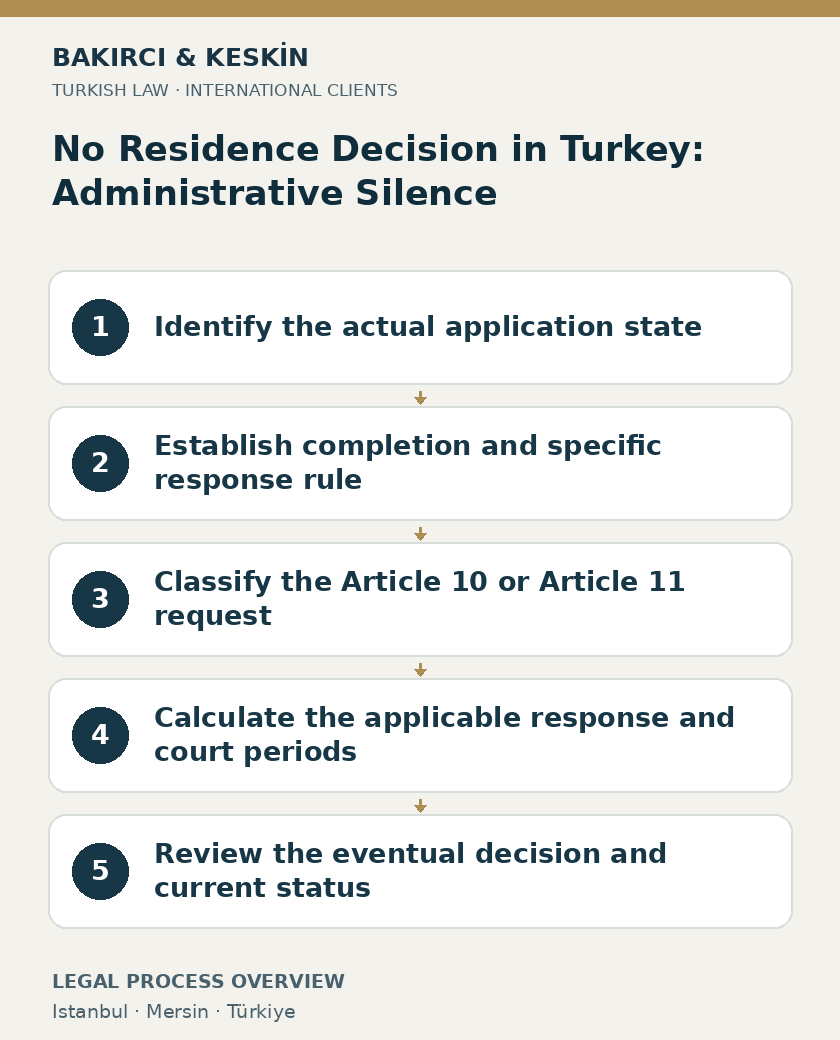
Quick summary
| Legal issue | No Decision on a Turkish Residence Application: Administrative Silence and Article 10 |
|---|---|
| Short answer | A delayed Turkish residence file requires separate checks of application completion, the ninety-day assessment rule and the general administrative-silence procedure. Article 10 of Law No. 2577 provides a thirty-day deemed-rejection framework for qualifying requests, with distinct rules for non-final and late answers. It does not deem a permit approved. Identify the actual request, any special response period and the relevant notification before calculating the judicial deadline. |
| Key legislation | Law No. 6458 — Articles 21, 24, 25; Foreigners and International Protection Implementation Regulation — Articles 21(8)–(9), 22(1)–(2); Law No. 2577 — Articles 2, 7, 10, 11, 27 |
First establish whether an application is pending at all
An unanswered residence matter can involve an incomplete online form, a completed application awaiting assessment, an outstanding document request, a file removed from processing or a decision that has not reached the applicant. Those are different legal states. Obtain the official application reference, submission records, application document and every communication from the competent authority before describing the situation as administrative silence.
The relevant question is what administrative act has been requested and what response exists. A customer-service enquiry asking for general information is different from a formal request for a decision on an identified application. Preserve the exact contents and receipt of any request relied on. The legal response must be directed to the actual file rather than to a status label in a private tracking service.
The residence-renewal guide explains the filing and pending-application framework. This article concerns the additional question of how an unanswered request can be assessed for judicial review. It does not treat the passage of time as approval of a residence permit or assume that every incomplete application has entered the assessment stage.
The residence-assessment period must be read from the immigration rules
Law No. 6458 Article 21 states a maximum ninety-day period for concluding applications in its framework. Article 22(2) of the Implementation Regulation specifies that the ninety-day period begins when the information and documents have been delivered completely to the competent authority. It also provides for informing the foreigner where the period is extended.
The completion date is therefore material. Identify what was submitted initially, what further material was required and when the competent authority received it. A date on which an online account was opened is not automatically the complete-document date. Nor should the file be described as incomplete merely because a private intermediary believes an additional document might eventually be useful.
Keep the statutory assessment period distinct from the general administrative-silence mechanism. A proper analysis considers the specific immigration provision and the procedural request actually made. Do not replace the ninety-day assessment rule with an assumed thirty-day permit-approval deadline, and do not infer that a missed assessment period itself creates the residence status requested.
A missing-document request can change the factual chronology
Law No. 6458 Article 21(3) allows evaluation to be postponed until missing information and documents are completed and requires notification of what is missing. Regulation Article 22(1) provides that the application is removed from processing if the requested information and documents are not completed within thirty days from notification. That thirty-day rule concerns completion of the file; it is not the same rule as deemed rejection under administrative-procedure law.
Obtain the deficiency request and its notification record. List each item requested, the response supplied and evidence of delivery. A statement that the documents were sent should be supported by the actual submission record. Where the applicant disputes that an item was missing or that the request was properly communicated, preserve the evidence supporting that position.
If the file was removed from processing, the legal issue is no longer adequately described as an authority that has said nothing. Identify the resulting act and the applicable challenge. Repeatedly sending the original application without addressing a notified closure can leave the real decision unchallenged. The response must follow the documented procedural state.
Article 10 concerns a request for an act or action capable of judicial review
Administrative Procedure Law No. 2577 Article 10 permits interested persons to apply to administrative authorities for an act or action concerning them that can be the subject of administrative proceedings. A request should identify the applicant, file, decision sought and relevant legal basis. It should be delivered to the competent authority in a manner that establishes its contents and receipt.
The request should explain the existing application and the absence of the act sought. Attach or identify the application record, completion evidence and previous responses. Avoid treating a generic request for help as though it necessarily invokes the same legal issue. The court must be able to determine what the authority was asked to do and whether the procedural conditions for review exist.
The specific immigration assessment period and the Article 10 request must be analysed together. Their different functions do not authorise an applicant to ignore an applicable special period. Before calculating a deemed-rejection date, establish the legal character of the request and whether a special rule governs the response time in that situation.
The general deemed-rejection rule is thirty days
Under Article 10’s general rule, a request is deemed rejected if no answer is given within thirty days. The interested person can then sue within the applicable judicial filing period from the end of those thirty days. Article 7 supplies the ordinary sixty-day administrative-court period where no special period is prescribed. These rules create a judicial-review route; they do not deem the requested permit granted.
A deadline record must identify the request received, the date of receipt, the response rule applied and the resulting judicial period. An adviser should not calculate from the date a draft was prepared or an intermediary promised to lodge it. Retain the receipt or other legally reliable submission evidence. The validity of the chronology depends on the actual administrative request.
Where the interaction with the residence-specific assessment period is material, resolve it before making a filing-date conclusion. The ninety-day assessment rule, a thirty-day deficiency deadline and Article 10’s general silence rule refer to different events and purposes. Combining their numbers into a single informal waiting period does not establish the legally correct deadline.
A non-final answer within thirty days triggers a separate choice
Article 10 expressly addresses an answer given within the thirty-day period that is not final. The applicant may treat it as rejection and sue, or wait for a definitive answer. In the latter case, the judicial filing period does not run during the permitted wait. The statute nevertheless limits that waiting period to four months from the application date.
Preserve the response and examine what it actually says. A definitive refusal and an acknowledgement that assessment continues are not interchangeable. The applicant should not describe a clear refusal as non-final merely to postpone the lawsuit. Equally, a request for additional assessment should be evaluated for its real legal content rather than its subject line alone.
The four-month limit runs from the application, not automatically from the later acknowledgement. Record that outer date and obtain a legal assessment of the judicial period that follows the relevant event. The option to wait is not indefinite. Continuing correspondence should not be assumed to reset the statutory maximum whenever an official sends another progress message.
A later answer has a specific statutory effect in stated circumstances
Article 10 also addresses an answer from the competent authority after the thirty-day period where no action was brought or the action was rejected as out of time. In those stated circumstances, the provision allows an action within sixty days from notification of the answer. The text should be applied to the actual procedural history, including any earlier case.
Identify the later document and the act it communicates. A substantive response and a generic acknowledgement of an old enquiry can raise different questions. The claimant should not assume that any message received years later automatically creates a new opportunity to litigate every earlier decision. Establish the relationship between the original request, the later answer and the relief now sought.
Where a case is already pending, provide the later response to the lawyer and assess its procedural consequences promptly. The late-answer sentence is framed for the circumstances it names; it should not be quoted as though it supplies one universal timetable regardless of an existing lawsuit. Keep the administrative and court records synchronised as the situation develops.
A request to reconsider an existing refusal falls under a different framework
Article 11 concerns a request, before filing suit and within the judicial period, for removal, withdrawal or amendment of an existing administrative act, or a new act, made to the superior authority or the issuing authority if no superior exists. Such an application stops the running judicial period under the provision. It is distinct from treating an unanswered request for an initial act under Article 10.
Article 11 deems the request rejected after thirty days without an answer. On rejection or deemed rejection, the judicial period resumes, with the time that elapsed before the application counted. The applicant does not automatically receive a fresh full sixty days. A calculation must retain the original notification date and the days already used before the reconsideration request.
The residence-refusal guide concerns a notified adverse decision. Obtain that decision before deciding which procedural article applies. A repeated application should not be used to conceal that a refusal was already served or to assume that its challenge period starts again whenever the same request is sent.
Pending residence status is a separate statutory question
Law No. 6458 Article 24 provides that renewal applicants receive an application document and can reside in Turkey with it until a decision, even if the previous permit has expired, within the statutory renewal framework. Regulation Article 21 also addresses the application document and its stated rights. The applicant’s actual document and completed procedure must be checked rather than inferred from an unfinished online screen.
A lawsuit concerning silence does not itself issue a residence card. Administrative Procedure Law Article 27 states the general rule that bringing an administrative action does not suspend the challenged act. The current basis for lawful stay and any need for interim judicial protection must therefore be assessed separately from the fact that a court-file number exists.
Travel, work authorisation and any separately notified immigration decision also require their own analysis. Do not use an unresolved residence application as evidence of every other permission. Tell the lawyer about planned travel and all decisions received so the procedural strategy reflects the actual status instead of an assumption that delay preserves every right indefinitely.
Ask for judicial review of the actual administrative problem
Article 2 of Law No. 2577 defines the administrative action types and confines judicial authority to legality review. The court does not simply replace the administration by issuing a permit because the applicant requests one. The pleading must identify the legally reviewable act or deemed refusal, the defect alleged and the appropriate judicial result.
The evidence should show the completed application, applicable legal basis, relevant response period and the administrative history. If the authority’s silence prevents a reasoned response to a specific eligibility issue, explain that problem accurately. Do not invent a refusal ground that the administration has not stated or treat speculation about security checks as an established fact.
Any request for a stay must satisfy Article 27’s conditions, including the combined requirements of manifest unlawfulness and harm that would be difficult or impossible to remedy, within the provision’s framework. Describe the individual harm and legal defect with evidence. A request for protection and an order granting it remain different procedural events.
Maintain a single evidence file while living abroad
Keep complete copies of the application, passport and relevant permits, application document, deficiency requests, responses, receipts and authority communications. Label each item by its date and legal function. Preserve the full message and attachment rather than a cropped status screen. This allows the decision date, notification date and document-completion date to be distinguished.
Agree who receives communications and who can respond within a stated period. A representative should report a new document request or decision promptly and provide the actual record. The applicant should update genuine changes through the applicable procedure instead of continuing to rely on obsolete address or passport details. Accurate contact information matters throughout the file.
A status report should identify what remains unknown and which request is intended to resolve it. An official receipt establishes submission; it does not establish approval. A request for information establishes an enquiry; it does not establish that the authority adopted the requested act. Reporting those distinctions prevents administrative delay from being described as a completed legal result.
A response ends one uncertainty but can begin a new procedural period
When a response arrives, read the full decision and notification. Identify whether the permit was granted, the application refused, the file removed from processing or further information required. Match the response to the request and preserve its legally relevant delivery date. The applicant’s next step should address that outcome rather than continue pursuing a generic complaint about delay.
If the matter reaches judgment, obtain the operative decision and assess the authority’s implementation duty under the applicable rules. A successful challenge and the issue of a residence document are distinct events that must be verified. The file should record the administrative action taken in response to the judgment and any remaining disagreement.
The useful legal approach is to keep the clocks separate: complete-document assessment, missing-document response, general deemed rejection, a permitted non-final-answer wait and the judicial filing period. Each belongs to a particular statutory event. Applying them to verified documents provides a reviewable route through a delayed residence matter without treating silence as consent.
Frequently asked questions
Does ninety days without a decision mean my permit was granted?
No. The assessment period does not create approval by silence.
When does the regulatory ninety-day period begin?
Regulation Article 22(2) refers to complete delivery of the information and documents to the competent authority.
What is the missing-document period?
Article 22(1) provides thirty days from notification to complete the requested material before removal from processing under that rule.
What does Article 10’s thirty-day rule do?
It provides a general deemed-rejection mechanism for the qualifying administrative request, subject to the correct legal classification and applicable special rules.
Can I wait forever after a non-final reply?
No. Article 10 limits the stated waiting option to four months from the application date.
Does every late message restart a lawsuit period?
No automatic conclusion follows. Article 10’s later-answer provision has stated conditions and the actual document and procedural history must be examined.
Does an Article 11 reconsideration request give a fresh sixty days?
No. The period resumes on rejection or deemed rejection with the time previously elapsed counted.
Does a court filing itself grant lawful residence?
No. The current immigration basis and any applicable application document or protective order must be assessed separately.
Which dates should I retain?
Keep submission, complete-document delivery, deficiency notice, response, notification and court-filing dates as separate events.
What should I do when an answer finally arrives?
Read the decision and service record promptly, identify the act actually taken and calculate the applicable next step from that verified outcome.
Official legal sources
- Law No. 6458 — Articles 21, 24, 25
- Foreigners and International Protection Implementation Regulation — Articles 21(8)–(9), 22(1)–(2)
- Law No. 2577 — Articles 2, 7, 10, 11, 27
Legal review: 28 October 2026. The official Turkish legislation controls. Classification, notification dates and the correct procedural route must be checked against the actual documents.
Contact information
Do not include confidential documents or identity numbers in an initial message. An enquiry does not establish representation or suspend any legal deadline.
Istanbul and Mersin contact details
Bakırcı & Keskin Law Office is Mersin-based. Turkish matters are handled under the applicable jurisdiction and agreed mandate. The competent court and the scope of representation are assessed for each matter.
Istanbul — Polaris Plaza
Maslak Ahi Evran Caddesi, Polaris Plaza No:21, Floor 9, 34475 Sarıyer/İstanbul, Türkiye.Mersin — Profit İş Merkezi
İhsaniye Mahallesi, 4903. Sokak, Profit İş Merkezi No:23, Floor 3, Office 14, 33070 Akdeniz/Mersin, Türkiye.+90 552 224 43 66 · Contact details in English. An enquiry does not establish representation or suspend a legal deadline.
Istanbul Office – Polaris Plaza, Maslak / Sarıyer
Bakırcı & Keskin Hukuk Bürosu
Maslak Ahi Evran Caddesi, Polaris Plaza No:21, Kat:9, 34475 Sarıyer/İstanbul
Our physical offices in Istanbul and Mersin coordinate matters throughout Turkey, subject to jurisdiction and the local steps required for each case. Please specify your preferred office when arranging an in-person appointment.
Open the Istanbul office on Google Maps · Contact and appointments
Contact regarding a legal matter
In your first message, you may briefly state the subject, your country or city, and any relevant notification or recent procedural date. Please do not send identity numbers, medical data, or personal documents. Messaging alone does not constitute legal advice or create a lawyer–client relationship.
Discover more from Bakırcı & Keskin Hukuk Bürosu
Subscribe to get the latest posts sent to your email.