A Turkish Rental Property Is Sold After Attachment: The Tenant and Article 135
Short answer: Article 135 provides a specific possession route after an attachment-based enforcement sale. The occupant’s position depends in particular on whether occupation rests on a contract officially documented as preceding the attachment. Where the statutory conditions are met, the eviction order allows fifteen days after service. The general enforcement-complaint period and the absence of automatic suspension require separate attention; an auction, title registration and delivery of possession are distinct events.
Have a general question about this article? Ask anonymously
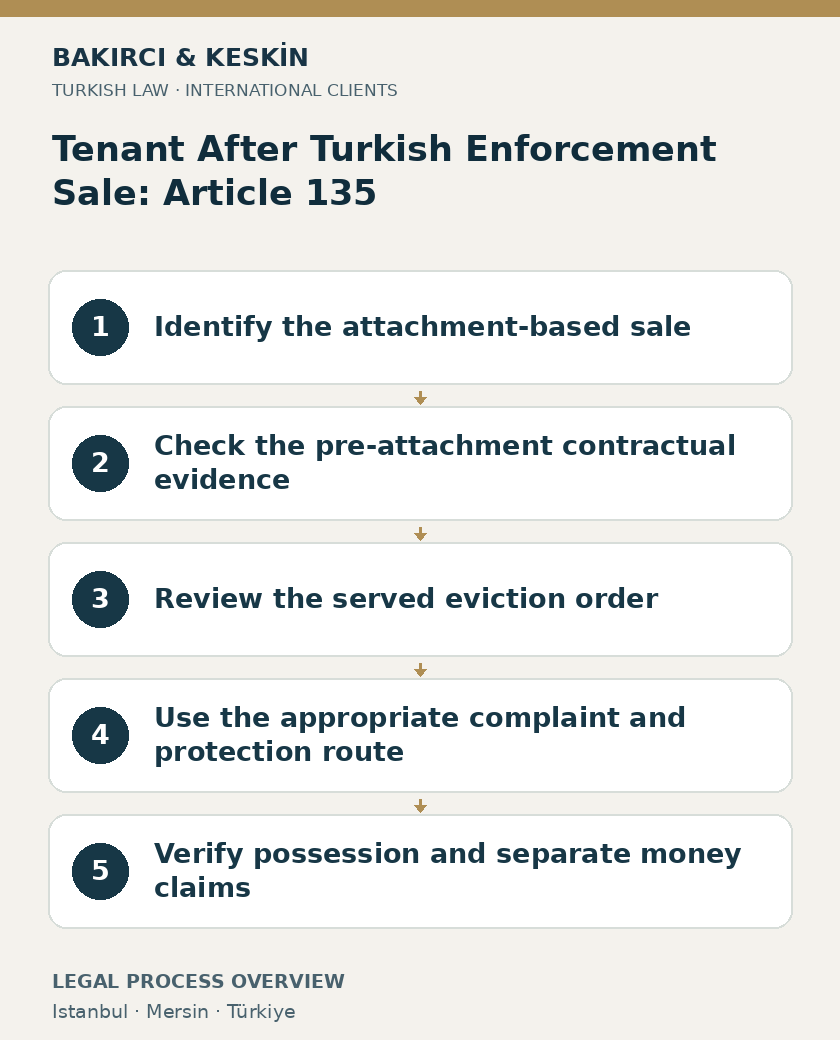
Quick summary
| Legal issue | A Turkish Rental Property Is Sold After Attachment: The Tenant and Article 135 |
|---|---|
| Short answer | Article 135 provides a specific possession route after an attachment-based enforcement sale. The occupant’s position depends in particular on whether occupation rests on a contract officially documented as preceding the attachment. Where the statutory conditions are met, the eviction order allows fifteen days after service. The general enforcement-complaint period and the absence of automatic suspension require separate attention; an auction, title registration and delivery of possession are distinct events. |
| Key legislation | Law No. 2004 — Articles 16, 22, 135; Law No. 6098 — Articles 310; Law No. 6325 — Articles 18/B |
Identify an attachment-based enforcement sale before applying the rule
A tenant’s position after a compulsory sale cannot be determined from the word “auction” alone. Establish the enforcement file, the legal basis of the sale, the attachment affecting the property, the buyer and the relevant decisions. This article addresses the attachment-based framework described in Enforcement and Bankruptcy Law Article 135. A mortgage-realisation sale or another special procedure requires its own connected statutory analysis.
Obtain the auction and payment records and the current title information. Article 135 addresses the registry communication after the property has been awarded and the price paid, with the Article 134 timing framework observed. An accepted bid, payment of the price, title registration and delivery of vacant possession are different events. Neither buyer nor occupant should assume that all four occurred together.
The ordinary tenanted-property purchase guide provides the consensual-sale background. A compulsory enforcement sale introduces the specific possession mechanism in Article 135. The buyer’s rights and the occupant’s evidence must therefore be examined within that mechanism rather than inferred from a private sale checklist.
The ordinary landlord-substitution rule does not answer the whole enforcement question
Code of Obligations Article 310 states that the new owner becomes a party to the lease where the premises change hands after the contract is made, subject to the reserved expropriation rules. That general lease provision must be read with the special enforcement-sale framework relevant to the actual transaction. It should not be quoted in isolation as proof that Article 135 can never apply.
The occupant should identify the lease relied on and the date and evidence of its creation. The buyer should identify the enforcement procedure and the attachment chronology. The legal issue is not simply whether somebody is paying rent today. Article 135 asks a specific question about the contractual basis and official documentation of occupation before attachment.
A contract’s validity between landlord and tenant and its ability to satisfy the Article 135 evidential condition are distinct matters. A private lease can raise contractual rights without automatically establishing the statutory protection against the enforcement purchaser’s possession route. The analysis must avoid turning an evidential requirement for one procedure into an unsupported statement that every private rental agreement is invalid.
Article 135 focuses on a contract officially evidenced as preceding attachment
Article 135 provides for the specified eviction order where the property is occupied by the debtor or by others who do not rely on a contract documented by an official instrument as having been made before attachment. Identify both the contractual basis and the official evidence of its timing. A document dated before the auction is not necessarily a document establishing a contract before the attachment.
Obtain the entire instrument and any official record relied on. Determine what it proves: the contract’s execution, a signature, an address, a payment or another fact. A later certification should not be assumed to establish every earlier event asserted in a privately dated paper. The legal assessment must connect the official material to the particular contractual basis and the relevant pre-attachment date.
Do not reduce the inquiry to the physical appearance of a stamp. Identify the issuing authority, date, parties and legal function of the document. Where the evidence consists of several connected records, explain the connection. The enforcement authority and reviewing court need to assess the statutory condition from the documents actually available, rather than from the occupant’s description of them as official.
The attachment date must be established from the enforcement record
Create a chronology containing the lease, the official evidence relied on, the relevant attachment, auction, payment, registration and any eviction order. Each date should be supported by the corresponding record. A family’s recollection of when the owner first fell into debt does not establish the attachment date. Nor does the date the tenant learned of the sale replace the statutory event.
Where several attachments or other encumbrances appear, identify the one relevant to the sale and legal argument. The file may contain records of a mortgage, an attachment and a later enforcement annotation that perform different functions. Do not select the earliest or latest date merely because it favours one side. The legal basis of the sale and the connection of each entry must be examined.
The lease history can also contain amendments, extensions or a change of tenant. Preserve them rather than supplying only the oldest paper bearing the property’s address. The person currently occupying must establish the contractual basis actually relied on. An earlier arrangement involving a different person should not automatically be treated as proof of the present occupant’s protected position.
The statutory eviction order gives fifteen days from service
Where Article 135’s conditions are met, an eviction order is served on the debtor or occupant requiring departure within fifteen days. The article provides for compulsory removal and delivery to the buyer if the property is not vacated within that period. This is a specific enforcement step. A buyer’s private request to leave is not the statutory order, and an advertisement stating “vacant possession” does not establish that the procedure has been completed.
Obtain the complete order and its service record. Check the property, addressee, enforcement file and date relevant to the period. The occupant should not postpone review until the final day merely because the order allows fifteen days for departure. A challenge to the enforcement act raises a different procedural time question and does not necessarily use the same period.
The buyer should also verify the actual order and service before making commitments based on immediate possession. The enforcement office carries out the statutory process. Article 135 is not authority for the buyer to remove belongings personally or bypass the required official step. The intended possession outcome must be pursued and evidenced through the applicable procedure.
The complaint period and the departure period are different
Article 16 provides the general complaint route to the enforcement court for enforcement-office acts alleged to be contrary to law or unsuitable to the circumstances, with a seven-day period from learning of the act. It separately addresses failure to fulfil a right or unjustified delay. The legal basis and timing of a challenge to an Article 135 step must be assessed under the applicable complaint framework.
Do not treat the fifteen-day departure period as a guaranteed fifteen-day period for every court challenge. Preserve the date the act became known and any service record. The complaint should identify the challenged act, the contractual and official-document evidence relied on and the correction requested. A general letter to the buyer may not perform the required judicial function.
Article 22 states that a complaint does not stop enforcement unless the enforcement court orders otherwise. The occupant must therefore distinguish filing a challenge from obtaining an order affecting implementation. If immediate protection is sought, the application should identify the concrete enforcement step and the legal basis for the requested direction. The court’s actual decision, rather than the applicant’s intention, determines whether execution is stopped.
A later buyer from the auction purchaser can use the stated mechanism
The final sentence of Article 135’s second paragraph addresses a further transfer. After the property is registered in the auction buyer’s name, a person who purchases it from that buyer before eviction has taken place also has the right to seek eviction under that paragraph. The sequence stated by the statute must be established from the title and possession records.
The later buyer should obtain the enforcement-sale documents and confirm whether an eviction process is already underway. A fresh purchase agreement does not erase the need to prove the relevant acquisition chain and procedural status. The request must connect the current buyer to the statutory entitlement rather than simply attach a title copy without explaining the earlier enforcement sale.
For the occupant, the identity of the person now requesting possession should be checked against the records. A change in purchaser does not by itself answer whether the Article 135 contractual exception applies. The substantive documentary issue and the applicant’s entitlement to invoke the mechanism are separate questions, each requiring an accurate account.
Evidence of occupation must be assessed for the fact it proves
Rent payments, utility records, address registrations and communications can be relevant to the factual account. Their importance depends on what they establish in the particular case. A utility bill showing use of the apartment should not automatically be described as an official instrument proving all the terms and date of a lease. Identify the evidential function without overstating it.
Preserve the original lease and any official record available, together with complete payment and correspondence records. Explain changes of name, ownership and property identifiers. Where a document is disputed, identify who issued it and where the original can be obtained. A file assembled after the eviction order should retain the historical dates rather than presenting later documents as though they existed before attachment.
The buyer should review adverse evidence as well as the auction description. The occupant should disclose the complete contractual history rather than only favourable excerpts. The dispute concerns a legal condition capable of documentary assessment. A clear record is more useful than unsupported accusations that every tenant is fictitious or every purchaser must honour any paper produced.
The auction materials should also be read for their actual scope. A description stating that the premises are occupied reports a possession fact; it does not necessarily determine whether a particular lease meets Article 135’s evidential condition. Before committing to a purchase, identify the available tenancy material and any unresolved possession issue. A projected purchase budget should not assume immediate vacant delivery solely because the property is being sold through enforcement. The documentary and procedural questions remain relevant to when possession can lawfully be obtained.
Lease claims, deposits and enforcement complaints retain distinct procedures
Article 135 concerns possession through the enforcement-sale mechanism. It does not itself determine every contractual money claim between the former landlord and tenant. Identify any deposit, prepaid rent, damage allegation or other payment separately and establish the person against whom the relevant claim lies. The fact that possession changes does not supply an automatic answer to each financial issue.
Law No. 6325 Article 18/B regulates pre-action mediation for rental-relationship lawsuits, with its stated enforcement-eviction exception. A complaint concerning an enforcement-office act should not be treated as identical to a newly filed contractual damages action. Classify the actual remedy and use its proper process; do not assume that commencing one procedure completes the requirements of another.
The landlord-abroad eviction guide explains the broader need to identify a ground and procedure before acting. Here, the particular enforcement file and Article 135 evidence govern the possession inquiry. Other claims should be coordinated without being inaccurately presented as already decided by the auction.
An overseas participant needs a short, current procedural record
Provide the lawyer with the enforcement-file reference, title information, auction documents, lease and official timing evidence, and every notification received. Indicate the actual receipt or discovery date for each important act. An overseas address and delayed family forwarding can complicate communication, but they do not justify calculating time from whichever message is most convenient.
Agree who monitors the file and who can give prompt instructions on a complaint, protection request or settlement. The representative should report whether an order exists, whether it was served, whether a complaint was filed and whether enforcement was stayed. These are distinct states. A message saying only that the dispute is “being handled” does not establish the protection currently in place.
Any settlement should specify the departure date, handover method, treatment of belongings and the financial issues actually resolved. Check the authority of those signing. The parties should not assume that a promise made by an intermediary binds the buyer, former landlord and occupant on all matters. Keep the settlement and its performance evidence with the enforcement documents.
Verify delivery of possession and close only the issues actually resolved
When possession is delivered, retain the official or legally appropriate handover record and identify the property, date, recipients and condition. Check keys and remaining belongings through the proper process. The buyer’s registration as owner and physical delivery are separate facts, and both should be evidenced. A report that the occupant has moved elsewhere does not necessarily prove that handover was completed.
Account for payments and releases separately from possession. Record which claims were adjudicated or settled and which remain pending. An enforcement complaint decision can concern the legality of a procedural act without resolving the entire rental account. The final report must reflect the scope of the actual outcome rather than describing every connected dispute as finished.
The core Article 135 inquiry is precise: identify the attachment-based sale, the occupant’s contractual basis and its official evidence before attachment, then follow the correct order and complaint procedures. That approach protects the statutory interests of both purchaser and occupant without assuming that an auction automatically makes every tenant removable or every private lease opposable to the buyer.
Frequently asked questions
Does every auction use the same tenant-possession rules?
No. Identify the legal basis of the sale. This article addresses Article 135 in an attachment-based enforcement sale.
What is the key contractual exception in Article 135?
The provision refers to occupation based on a contract officially documented as having been made before attachment.
Is a lease dated before the auction necessarily enough?
No. The statute’s reference is to the attachment and the required official documentation, not merely the auction date.
Does the rule make every private lease invalid?
No. Contract validity and the evidential condition for this enforcement-possession route are separate issues.
How long does the Article 135 eviction order allow?
The statute provides fifteen days after service for the debtor or occupant to vacate under that mechanism.
Is the complaint deadline necessarily fifteen days too?
No. Article 16’s general complaint framework uses seven days from learning of the act, with its separate statutory categories.
Does filing a complaint stop enforcement automatically?
Article 22 says it does not unless the enforcement court orders otherwise.
Can a buyer from the auction purchaser seek eviction?
Article 135 includes the stated case of a purchase after registration in the auction buyer’s name and before eviction.
Does the auction settle the tenant’s deposit dispute?
Not by itself. Identify the separate contractual claim and the correct party and procedure.
What establishes completed possession delivery?
Retain the appropriate handover or enforcement record and distinguish it from title registration and separate financial settlements.
Official legal sources
Legal review: 28 October 2026. The official Turkish legislation controls. Classification, notification dates and the correct procedural route must be checked against the actual documents.
Contact information
Do not include confidential documents or identity numbers in an initial message. An enquiry does not establish representation or suspend any legal deadline.
Istanbul and Mersin contact details
Bakırcı & Keskin Law Office is Mersin-based. Turkish matters are handled under the applicable jurisdiction and agreed mandate. The competent court and the scope of representation are assessed for each matter.
Istanbul — Polaris Plaza
Maslak Ahi Evran Caddesi, Polaris Plaza No:21, Floor 9, 34475 Sarıyer/İstanbul, Türkiye.Mersin — Profit İş Merkezi
İhsaniye Mahallesi, 4903. Sokak, Profit İş Merkezi No:23, Floor 3, Office 14, 33070 Akdeniz/Mersin, Türkiye.+90 552 224 43 66 · Contact details in English. An enquiry does not establish representation or suspend a legal deadline.
Istanbul Office – Polaris Plaza, Maslak / Sarıyer
Bakırcı & Keskin Hukuk Bürosu
Maslak Ahi Evran Caddesi, Polaris Plaza No:21, Kat:9, 34475 Sarıyer/İstanbul
Our physical offices in Istanbul and Mersin coordinate matters throughout Turkey, subject to jurisdiction and the local steps required for each case. Please specify your preferred office when arranging an in-person appointment.
Open the Istanbul office on Google Maps · Contact and appointments
Contact regarding a legal matter
In your first message, you may briefly state the subject, your country or city, and any relevant notification or recent procedural date. Please do not send identity numbers, medical data, or personal documents. Messaging alone does not constitute legal advice or create a lawyer–client relationship.
Discover more from Bakırcı & Keskin Hukuk Bürosu
Subscribe to get the latest posts sent to your email.