Recovering a Computer Seized in a Turkish Criminal Case: Copying and Return Under Article 134
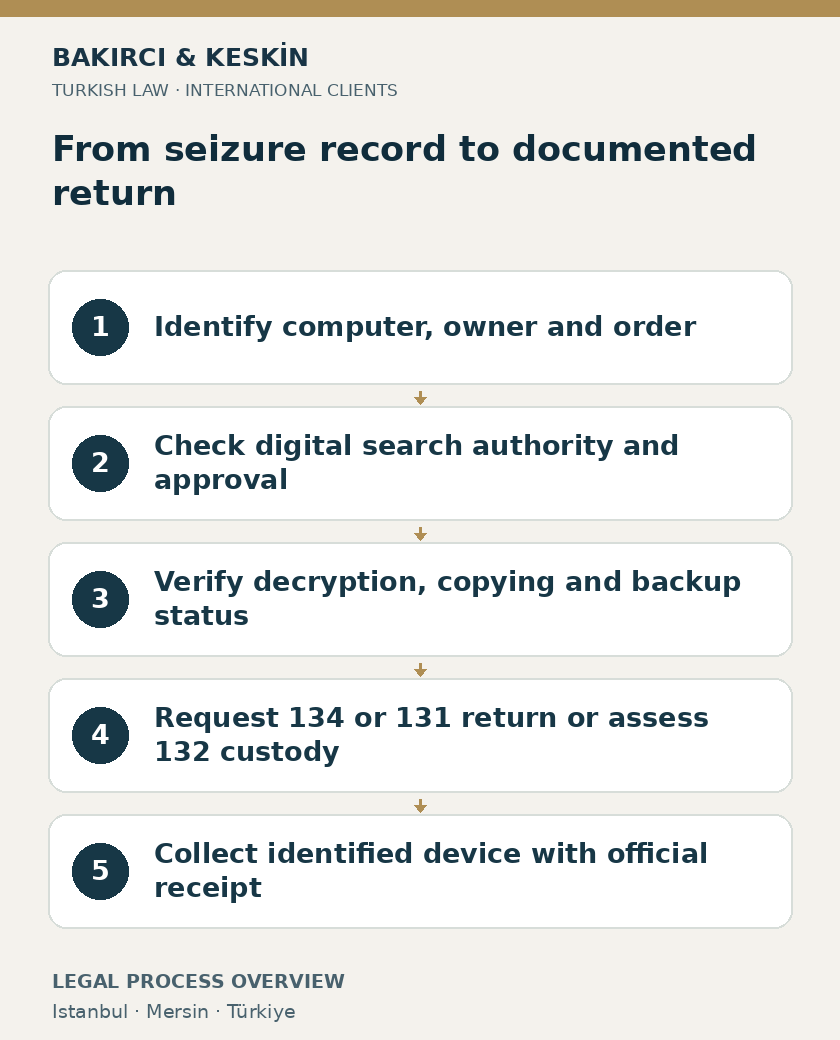
Short answer: A computer seized in a Turkish criminal investigation should not be treated as property that must always remain with the authorities until the trial ends. Criminal Procedure Code Article 134 regulates computer searches, copying, seizure for specified technical reasons, backups and return without delay after decryption and necessary copying. Article 131 provides the general return mechanism. The request should identify the device, the legal basis for custody, the examination already completed and any separate reason asserted for continued retention.
Have a general question about this article? Ask anonymously
Quick summary
| Legal issue | Recovering a Computer Seized in a Turkish Criminal Case: Copying and Return Under Article 134 |
|---|---|
| Short answer | A computer seized in a Turkish criminal investigation should not be treated as property that must always remain with the authorities until the trial ends. Criminal Procedure Code Article 134 regulates computer searches, copying, seizure for specified technical reasons, backups and return without delay after decryption and necessary copying. Article 131 provides the general return mechanism. The request should identify the device, the legal basis for custody, the examination already completed and any separate reason asserted for continued retention. |
| Key legislation | Law No. Criminal Procedure Code No.5271 — Articles 123, 127, 131, 132(5), 134, 267, 268 |
Start with the item recorded in the criminal file
The first task is to identify precisely what was taken. Obtain the search or seizure record, inventory, relevant order and investigation or court number. Record the computer’s manufacturer, model, serial number and the accessories or storage media listed with it. A receipt describing only electronic equipment can leave uncertainty about whether a laptop, external drive, charger or other component is included in a later return request.
Identify the owner, the person using the device and the person from whose possession it was taken. These can be different people. A company-owned laptop used by an employee should not be described as the employee’s personal property merely because it was in that person’s bag. Conversely, an employer’s label should be supported by acquisition and asset records. The request needs a coherent explanation of both ownership and the relevant use.
This guide concerns criminal-procedure custody and examination of computers. A debt-enforcement attachment, customs retention and loss of a device by a private repairer follow different rules. A telephone can also involve distinct questions about stored data, communication records and the actual order. Do not assume that the legal basis for one digital item or one type of examination automatically determines the treatment of every other item taken during the same event.
Holding the device and examining its data are separate acts
Criminal Procedure Code Article 123 addresses property considered useful as evidence or potentially subject to confiscation, including taking into protection and seizure where it is not voluntarily delivered. The physical custody of a computer must be distinguished from the authority to search its stored information, copy records or render them into text. A general description that police took the laptop does not establish the legal basis for every subsequent digital operation.
Article 134 specifically regulates searches of computers, computer programs and computer records used by a suspect in a criminal investigation. It also regulates copying and the circumstances in which the equipment can be seized to perform the technical work. The order and examination record should therefore be checked together. A returned device does not necessarily mean that every evidential copy has been destroyed, and an evidential copy does not automatically justify indefinite possession of the hardware.
A request can address more than one distinct issue, but each should be identified. Return of the physical laptop, provision of the statutory backup copy, review of the legality of a search and an objection to the use of evidence seek different results. Combining them in an unexplained demand to “delete everything and return it” makes the legal basis harder to assess. State the requested act and supporting provision separately.
Article 134 requires specified suspicion and necessity conditions
Article 134(1) requires strong grounds of suspicion based on concrete evidence and the absence of another means of obtaining the evidence. The search, copying and conversion of records into text are authorised by a judge or, where delay is prejudicial, the public prosecutor. These conditions should be read from the actual investigation and order. The usefulness of a computer to investigators does not alone restate the complete statutory test.
Where the prosecutor makes the decision, Article 134 requires submission for judicial approval within twenty-four hours, and the judge must decide within at most twenty-four hours. If the period expires or the judge decides otherwise, the extracted copies and text conversions must be destroyed immediately under that paragraph. The particular records of decision, submission and judicial response are therefore important. A general assurance that approval was obtained is less informative than the dated documents themselves.
These digital-search provisions should not be confused with Article 127’s general seizure approval sequence, which uses submission within twenty-four hours and a judicial decision within forty-eight hours from seizure. The two provisions concern different acts and have different wording. A deadline calculation must identify which act is being reviewed, rather than using one twenty-four-hour figure as a universal maximum for all police possession of electronic equipment.
Article 134(2) identifies why equipment may need to be seized
The second paragraph permits seizure of the equipment where access is prevented by an unresolved password, hidden information cannot be reached or the process will take a long time, so that the required examination and copying can be performed. The technical reason for retaining the hardware should therefore be identified. The record may show that examination has not started, that access remains unresolved or that the necessary copies have already been obtained. Those are materially different positions.
A return request should seek accurate information about the relevant work rather than speculate about what a laboratory must have done. Identify any examination report, delivery to an expert, imaging record or return of the device from the examining unit. If counsel cannot obtain a particular document because of a lawful file restriction, the request can identify the status information needed without pretending that the unseen report proves completion.
The owner’s commercial need for the laptop can be explained with evidence, but it should accompany the statutory argument rather than replace it. Employment duties, software access and business records can show the practical impact of retention. They do not alone establish that the technical conditions have ended or that no separate lawful basis remains. The authority must decide from the actual custody and evidential position.
The Code requires a backup and a copy for the suspect or representative
Article 134(3) requires a backup of all data in the system when the computer or computer records are seized. Under paragraph four, a copy of that backup is provided to the suspect or representative and the delivery is recorded and signed. The provision should not be reduced to a discretionary favour available only if the investigator considers it convenient. Identify whether the required backup and copy records exist in the file.
The statutory recipient matters. A third-party employer who owns the hardware should not assume that paragraph four automatically grants the employer unrestricted access to every personal or investigation-related record on it. Ownership, use, procedural status and access to data must be assessed separately. The request should identify who seeks the copy and in which legal capacity, while preserving any confidentiality issue for proper consideration.
Article 134(5) also allows all or part of the system’s data to be copied without seizing the computer or records. The copied data are printed on paper, the process is recorded in minutes and the relevant persons sign the record. This confirms that physical retention and obtaining evidence are distinct mechanisms. It does not establish that copying without seizure is technically feasible in every case. Identify whether the authorised work can be completed without retaining the hardware and what recorded technical reason supports continued custody.
After decryption and necessary copying, Article 134 requires return without delay
Article 134(2) states that seized devices are returned without delay once decryption has been completed and the necessary copies have been taken. The return condition is tied to completion of those tasks. It is not expressed as a fixed number of days from the original seizure, and it should not be replaced with an invented standard laboratory period. The request should establish the actual technical status and ask for the resulting statutory action.
Where the authority asserts another reason to retain the physical object, obtain that reason and its legal basis. A computer’s possible role as a confiscable item or its physical characteristics as evidence raises a different question from retention solely to copy data. The owner should not assume that the end of one technical task automatically resolves every separately justified measure. Equally, a vague reference to an ongoing case should be examined against the specific return provision and actual need.
Returning the hardware does not itself decide whether data already lawfully obtained can be used as evidence. The legality and evidential effect of the search, preservation of copies and any destruction requirement need their own analysis. A collection receipt should therefore describe the item delivered, not contain an unsupported declaration that all digital records held by the authorities have been erased.
Article 131 provides a return decision before the entire case necessarily ends
Article 131(1) addresses seized property belonging to a suspect, defendant or third person. It provides for return, on the authority’s initiative or on request, where continued custody is no longer needed for the investigation or prosecution, or it is understood that the property will not be subject to confiscation. The prosecutor, judge or court makes the decision according to the procedural position. The article does not impose a universal requirement to wait for the final criminal judgment before making a request.
A focused application should identify the device and claimant, the existing custody basis, the examination completed and the reason the statutory return condition is met. Attach ownership and item-identification documents where relevant. Refer to the actual order and reports rather than relying only on the passage of time. If the investigation has ended or the case has moved to trial, include the decision or court details so that the request reaches the proper authority.
Article 131(2) separately addresses property seized under Article 128 that belongs to the harmed victim and is no longer needed as evidence. That paragraph should not be used as a universal description of every computer seizure. The applicable subsection depends on the measure and the owner’s status. The foreign victim rights guide explains why return of property and compensation for additional loss remain separate questions.
An employer or other owner should establish its own position
A company seeking its computer should provide the acquisition record, asset identifier, assignment to the user and authority of the person instructing counsel. The fact that the owner is not accused does not by itself make the device irrelevant as evidence. Article 131 expressly includes third-party property, so the appropriate argument concerns the actual return conditions and the owner’s proven entitlement rather than a general assertion of innocence.
Distinguish the hardware from licensed software, accounts and data belonging to different people. A return application does not automatically resolve contractual access rights or permission to inspect an employee’s private communications. Counsel should identify the narrow requested remedy and any separate data issue. Where the owner is abroad, corporate documents and translation requirements should be arranged without altering the identity of the entity that actually acquired the equipment.
Conditional delivery for safekeeping is not the same as unconditional return
Article 132(5) allows seized property to be delivered for safekeeping to the suspect, defendant or another person, subject to care, supervision and immediate return when requested. During investigation the decision is made by the chief public prosecutor’s office, and during prosecution by the court. Security can also be required. This is a separate legal arrangement from a final release of the seizure or a determination that the property is no longer needed.
A person offered custody should read and comply with the conditions. Permission to hold the computer does not necessarily permit sale, disposal, alteration or transfer to another country. The proposed custodian must understand the obligation to produce it when requested. Any need to use the device or preserve a particular system condition should be addressed expressly with the authority rather than inferred from physical handover.
Obtain the decision and assess the correct review route promptly
Article 127(4) allows the person from whose possession property was seized to request a judicial decision on the matter at any time. Article 131 expressly permits objection to refusal of a return request. These mechanisms should be distinguished from an informal enquiry to the storage officer. Obtain the relevant written decision so that the legal basis, competent reviewing authority and applicable period can be identified.
For judge or court decisions, Article 268 provides the ordinary two-week objection period from learning the decision under the specified notification framework, unless the law provides otherwise. The route must be checked for the actual authority and decision concerned. Do not apply an outdated seven-day general period or assume that Article 127’s wording makes every later objection timeless. A fresh status enquiry does not necessarily restart a period attached to an earlier refusal.
Arrange an identified and documented handover from abroad
After return is authorised, confirm which unit holds the device and what authority is required for collection. A lawyer’s role in the criminal file and authority for a particular handover should be checked against the receiving unit’s requirements. The guide to appointing Turkish counsel from abroad explains the preparation of representation documents. An instruction sent by email is not proof that the official handover has occurred.
At collection, compare the item with the inventory and record serial numbers, accessories, seals and visible condition accurately. Keep the return decision, signed receipt and any condition noted at delivery. A later allegation of missing components or damage needs a reliable record of what was received. If a separate claim about loss or unlawful retention is contemplated, preserve that evidence without representing the return order itself as an award of compensation.
Frequently asked questions
Must my computer stay with the authorities until the trial ends?
Not as a universal rule. Articles 131 and 134 provide return mechanisms tied to the actual custody and examination conditions.
What does Article 134 require after copying is complete?
Paragraph two requires return without delay once decryption and necessary copying are completed, with any separately asserted custody basis requiring assessment.
Is there one fixed number of days for computer examination?
The cited return provision does not set a universal examination period. Obtain the actual technical status rather than rely on an invented standard duration.
Does physical seizure automatically authorise every data search?
No. Article 134 regulates the digital search and copying separately, including its suspicion, necessity and authorisation conditions.
Can the prosecutor authorise an urgent Article 134 search?
The provision permits that where delay is prejudicial, with submission for judicial approval within twenty-four hours and the specified judicial decision requirement.
Am I entitled to a backup copy?
Article 134(4) provides a copy of the statutory backup to the suspect or representative, with recorded and signed delivery. A third-party owner’s data-access position needs separate assessment.
Can a company request its employee’s seized laptop?
It should prove ownership, identify the device and address the applicable return conditions. Being a third-party owner does not itself eliminate an evidential need.
Is conditional safekeeping the same as final release?
No. Article 132(5) includes care and immediate-return obligations and can require security. The custody conditions remain binding.
Can refusal of return be challenged?
Article 131 expressly permits objection. The authority, decision and applicable period must be checked promptly, including Article 268 where applicable.
Does return mean all copied data must be destroyed?
Not automatically. The legal basis for retained evidence and any specific destruction requirement are separate from physical delivery of the computer.
Official legal sources
Recorded primary-source check dates: 26 October 2026. The official Turkish legislation controls. A new publication-date check is still required.
Contact information
Do not include confidential documents or identity numbers in an initial message. An enquiry does not establish representation or suspend any legal deadline.
Istanbul and Mersin contact details
Bakırcı & Keskin Law Office is Mersin-based. Turkish matters are handled under the applicable jurisdiction and agreed mandate. The competent court and the scope of representation are assessed for each matter.
Istanbul — Polaris Plaza
Maslak Ahi Evran Caddesi, Polaris Plaza No:21, Floor 9, 34475 Sarıyer/İstanbul, Türkiye.Mersin — Profit İş Merkezi
İhsaniye Mahallesi, 4903. Sokak, Profit İş Merkezi No:23, Floor 3, Office 14, 33070 Akdeniz/Mersin, Türkiye.+90 552 224 43 66 · Contact details in English. An enquiry does not establish representation or suspend a legal deadline.
Istanbul Office – Polaris Plaza, Maslak / Sarıyer
Bakırcı & Keskin Hukuk Bürosu
Maslak Ahi Evran Caddesi, Polaris Plaza No:21, Kat:9, 34475 Sarıyer/İstanbul
Our physical offices in Istanbul and Mersin coordinate matters throughout Turkey, subject to jurisdiction and the local steps required for each case. Please specify your preferred office when arranging an in-person appointment.
Open the Istanbul office on Google Maps · Contact and appointments
Contact regarding a legal matter
In your first message, you may briefly state the subject, your country or city, and any relevant notification or recent procedural date. Please do not send identity numbers, medical data, or personal documents. Messaging alone does not constitute legal advice or create a lawyer–client relationship.
Discover more from Bakırcı & Keskin Hukuk Bürosu
Subscribe to get the latest posts sent to your email.