Airline Downgrade in Turkey: Fare Difference and Article 11 Refund
Short answer
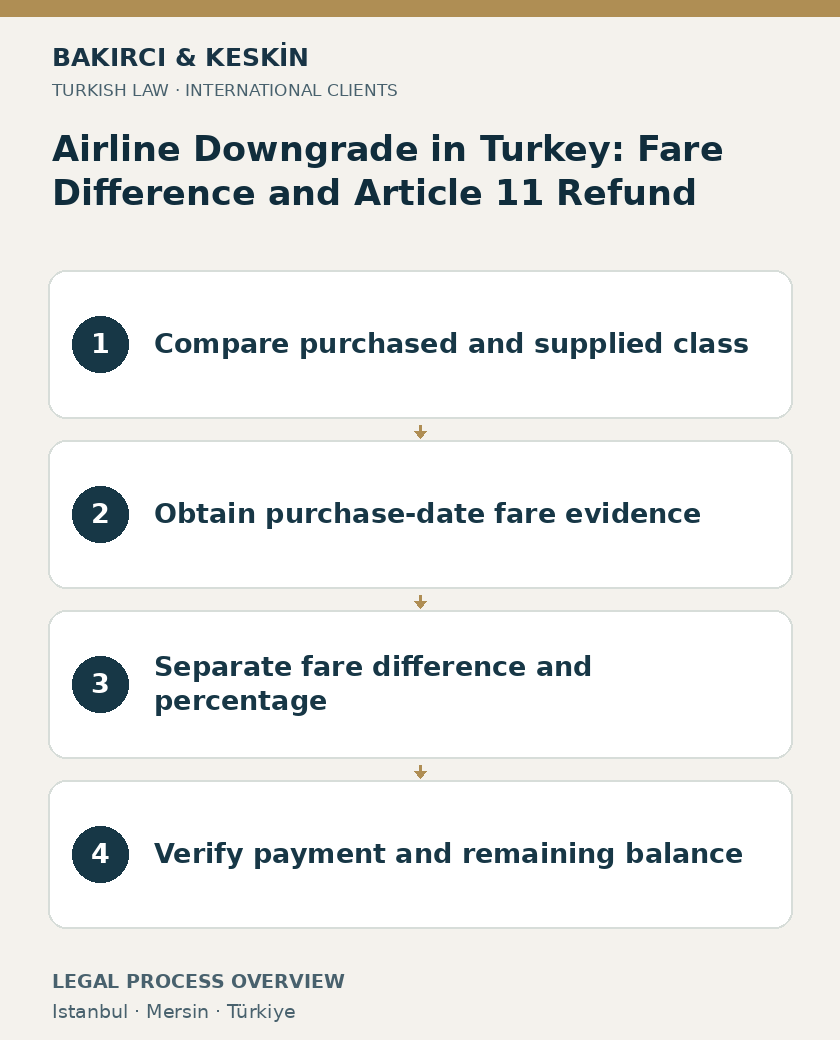
Article 11 of Turkey’s SHY-YOLCU Regulation requires an operating carrier that places a passenger below the purchased service class to repay the fare difference and, additionally, the prescribed percentage of the ticket price. The percentages are 30%, 50% or 75% according to flight distance. Payment is required within seven days, and purchase-date prices govern the downgrade refund. Establish the purchased class, class actually supplied, relevant price and covered flight before calculating the claim.
Have a general question about this article? Ask anonymously
Quick summary
| Legal issue | Airline Downgrade in Turkey: Fare Difference and Article 11 Refund |
|---|---|
| Short answer | Article 11 of Turkey's SHY-YOLCU Regulation requires an operating carrier that places a passenger below the purchased service class to repay the fare difference and, additionally, the prescribed percentage of the ticket price. The percentages are 30%, 50% or 75% according to flight distance. Payment is required within seven days, and purchase-date prices govern the downgrade refund. Establish the purchased class, class actually supplied, relevant price and covered flight before calculating the claim. |
| Key legislation | Law No. SHY-YOLCU Regulation; Law No. 6100 |
Identify the service class the passenger bought
The legal starting point is the class of service purchased, not simply the seat number the passenger expected. Article 11 of the SHY-YOLCU Regulation compares the purchased service class with the class into which the operating carrier placed the passenger. Obtain the ticket, confirmation, fare description and any later paid amendment. These documents establish the contractual baseline before the supplied service is examined.
A booking code, flexibility category, ancillary seat purchase and cabin description can convey different information. Do not assume that every change of booking code is a lower service class, or that every disappointing seat creates the same statutory remedy. Identify the actual product bought and the relevant change. A complaint about a missing contractual feature requires accurate classification even where the passenger remained in the same named cabin.
Retain the description presented at purchase, including accepted amendments and receipts for a later upgrade. The carrier’s current website can describe a different product or aircraft configuration from the one offered when the ticket was sold. Preserve the dated confirmation and relevant terms rather than reconstructing the purchase from an advertisement viewed after the flight.
Confirm that SHY-YOLCU covers the operation
Article 2 covers the specified flights of Turkish carriers to or from Turkish airports and foreign carriers departing from Turkish airports. Identify the operating airline, route and passenger conditions. The nationality of the traveller and the currency used to buy the ticket do not themselves decide the regulation’s application. An inbound foreign-carrier service requires separate consideration under the relevant legal framework.
The operating airline can differ from the marketing carrier or ticket seller. Article 4 defines the operating carrier by the flight performed or intended under its own contract or on behalf of another contracting person. Keep the itinerary’s operating information and any aircraft or carrier substitution notice. A payment to an intermediary does not, by itself, identify the entity that made the class placement.
Article 2 expressly includes passengers transferred by the carrier or tour operator to another flight and also addresses travel involving free, specified discounted and accumulated-mile or point tickets. The scope inquiry and the amount calculation remain separate. Coverage should not be denied merely by importing a different passenger regulation’s exclusions, while the actual price basis must still be established for an Article 11 demand.
Record what the carrier supplied and why the itinerary changed
Preserve both the original and replacement boarding documents. Record the flight operated, date, cabin supplied and communication explaining the change. A carrier-arranged downgrade following an aircraft substitution should be documented through the actual record, without assuming that every aircraft change necessarily altered the purchased service class. The evidence must connect the change to the passenger’s own ticket and carriage.
Keep the passenger’s response as well. Accepting transport in the available cabin, choosing a different itinerary and voluntarily purchasing a new lower-class ticket are different acts. The legal effect of a disputed agreement depends on what was offered and accepted, read with the regulation’s protections. A later claim should not omit a signed arrangement or describe it in terms inconsistent with the original document.
Ask the carrier to confirm the class change in writing and retain any certificate or refund instruction issued at the airport. If the matter was discussed only orally, record the date, location and substance accurately while the details remain available. Do not create a document purporting to be an airline certificate. A passenger’s contemporaneous account and a carrier-issued record have different evidentiary origins.
Article 11 provides two distinct repayment components
Article 11(2) expressly adds the distance-based percentage payment to repayment of the difference between ticket fares. A calculation containing only the fare difference therefore requires examination against the complete provision. Equally, describing the percentage as a substitute for every price adjustment can omit the first component. The demand should show each amount and the evidence used to calculate it.
Identify the purchased fare and the supported comparison for the lower class. Then identify the ticket-price basis used for the percentage. These figures can require explanation in a complex itinerary; they should not be selected solely to maximise the result. Ask the carrier to supply a transparent calculation rather than accept a single unlabelled credit described as a downgrade adjustment.
Distinguish the statutory calculation from a commercial goodwill offer. A carrier can propose an amount without explaining its legal basis, but that proposal is not proof that the Article 11 calculation was performed correctly. Preserve the offer, the figures it uses and any accompanying release. Compare it with the fare evidence and the applicable distance category before deciding whether a balance remains outstanding.
Apply the prescribed percentage to the correct flight
The percentage is 30% for flights of 1,500 kilometres or less, 50% for the intermediate category above 1,500 kilometres and up to 3,500 kilometres, and 75% for longer flights. The boundary values matter: a flight at 1,500 kilometres belongs in the first category, and a flight at 3,500 kilometres in the second. Record the route and distance evidence used in the calculation.
These are percentages of the relevant ticket price, not the fixed euro amounts in Article 8. A downgrade claim should not automatically be presented as EUR 600 merely because the flight was international. The passenger must identify the Article 11 fare basis and distance category. A spreadsheet should label these inputs clearly so that another reviewer can reproduce the result.
The provision does not make the percentage depend on how many hours the passenger arrived late. Arrival timing can matter to a separate delay or cancellation claim, but it should not replace proof of the lower class actually supplied. Keep the route and class evidence together and the delay calculation in a separate part of the file where a disruption claim also exists.
Purchase-date prices govern the downgrade refund
Article 11(3) states that prices at the ticket’s purchase date are taken into account for the refund following placement in a lower class. The current price of a newly searched ticket is therefore not automatically the proper comparison. Obtain the original ticket issue record, fare calculation and available purchase-date pricing information. Preserve the date and terms of any later paid change.
A price displayed after travel can be affected by availability, restrictions, route, sale date and other product conditions. The evidence should compare the relevant service and contractual transaction rather than any cheaper price visible online. Where a historical comparison is disputed, identify precisely what record is missing and ask the carrier to explain the pricing basis it used.
The purchase-date pricing rule should also be kept separate from currency conversion. Article 8 has its own express rule for converting fixed euro compensation into lira at the payment-date Central Bank selling rate. Article 11 addresses downgrade repayment through different wording. Do not import the Article 8 conversion rule into every downgrade figure without establishing the applicable basis for that particular monetary demand.
Keep the original currency and every actual refund currency visible. A bank statement can show a converted receipt that differs from the carrier’s underlying payment. Record the carrier’s amount, the conversion and any fees separately. This prevents a currency movement from being described as an additional unpaid fare difference without examining the actual legal and banking position.
Explain any allocation across a multi-leg ticket
A return or connecting itinerary can involve different service classes on different segments and a single combined price. Identify which segment was downgraded and which services were supplied as purchased. The claim should disclose that structure. Assuming that one affected sector automatically produces a refund calculated on the whole holiday or every flight ignores the need to establish the relevant ticket-price basis.
Request the ticket coupons, fare construction and any allocation used in the carrier’s response. A division by the number of flights is not self-proving merely because it is easy to calculate. Equally, a nominal allocation selected by the carrier should be supported. Where the legislation does not itself supply the proposed arithmetic method, explain the contractual and evidential basis rather than present that method as a quoted statutory formula.
For several passengers, prepare a separate class and price record for each person. Adult, child and infant pricing, paid upgrades and changes made to only part of a booking should remain identifiable. One payment receipt can fund several different carriage rights. The total claim must be reconciled with those individual entitlements, rather than multiplied from a single adult fare without checking the tickets.
Treat paid upgrades, rewards and package prices accurately
A paid upgrade requires the receipt and amendment showing the class actually purchased after the change. The original lower-class confirmation alone can give an incomplete picture. Preserve the amount paid, its currency, issue date and any conditions attached to the upgrade. The claim should explain the transaction that established the class from which the passenger was subsequently moved.
For reward travel, Article 2’s scope does not itself provide a universal cash conversion for miles or points. Keep the account debit, taxes, fees and ticket record, together with the carrier’s applicable terms and response. Do not invent a market value per mile and call it the Article 11 amount. The valuation question must be examined on its actual legal and contractual basis.
A package price can combine air travel with accommodation and other services. Obtain the information needed to identify the air component rather than assume that the entire inclusive price is the airline ticket fare. The package-tour guide explains the organiser’s separate framework. An airline downgrade and a failure of other package services should be recorded as distinct issues.
Article 11(1) also addresses placement in a higher service class: the operating carrier cannot demand an additional payment for that placement. Distinguish this carrier-made upgrade from an upgrade the passenger separately requested and bought. The documents should identify who proposed the change and what was agreed, rather than assuming that every move to a better cabin is necessarily a free statutory benefit.
Keep the seven-day obligation and actual payment separate
Article 11(2) requires payment within seven days through the listed monetary methods, or through vouchers or other services where signed agreement exists. Record the downgrade date, written demand, acknowledgement and payment dates. A carrier’s customer-service estimate should not silently replace the statutory period with an open-ended review process. Identify any dispute about the obligation and calculation expressly.
An accepted refund request, accounting credit and cleared receipt are different stages. Obtain the transaction reference and amount actually returned. Where the ticket was bought through an intermediary, establish whether payment reached that intermediary, the passenger or another recipient and why. A statement that the refund was processed should be reconciled with the actual payment trail before closing the claim.
Any interest or further monetary demand requires an applicable legal basis, starting date and currency. Article 11’s payment period should not be used to invent a universal interest rate. Keep the principal calculation reproducible and assess the consequences of late payment separately under the rules governing the claim.
Examine voucher consent and restrictions on rights
The regulation lists cash, electronic transfer, bank payment orders and cheques, while requiring signed agreement for travel vouchers or other services. A voucher’s value and conditions should therefore be clear before acceptance. Record expiry, eligible travel, transferability and any statement that acceptance settles the downgrade. A balance displayed in a loyalty account is not automatically equivalent to unrestricted cash repayment.
Article 16 prevents contractual provisions from restricting or excluding the regulatory duties. It also protects a passenger’s opportunity to seek additional compensation where inadequate information led to acceptance of less than the regulatory entitlement. Review that protection with the actual offer and signed terms. Do not assume that a fare described as non-refundable defeats Article 11, or that every settlement document can be ignored without examination.
Separate downgrade repayment from other flight claims
Denied boarding, cancellation and delay have their own conditions in Articles 5, 6 and 7. A lower-class seat does not itself establish all those events. The delay compensation guide explains the distinct arrival-delay analysis. Identify any additional disruption from its own evidence and avoid replacing a specific class-change claim with a generic demand for every available payment.
Article 13 preserves compensation under other legal rules and permits the regulation’s compensation to be credited against it. Additional loss still requires proof and a legal basis. Reconcile fare repayments, fixed payments, expense reimbursements and insurer receipts so that the same economic loss is not presented twice under different labels.
Request records that answer the disputed calculation
The useful request identifies the original and reissued tickets, purchased and supplied class, relevant fare construction, purchase-date pricing and payment allocation. Article 199 of the Code of Civil Procedure recognises electronic data as documents, while Articles 219 and 221 address production of relevant documents held by parties and third persons. Specify the record and the fact it is needed to prove.
Keep original email attachments and booking files alongside translations. A translated cabin label should remain traceable to the Turkish or other original description. Identify gaps honestly and preserve the carrier’s explanation. The evidence should establish the purchased product and supplied carriage, rather than rely solely on a passenger’s later opinion about the cabin’s quality.
Prepare a defined claim from abroad
The demand should identify Article 11, the covered flight, class comparison, both repayment components, timing and credited receipts. Article 19 preserves legal remedies and Article 20 provides regulatory supervision. Determine the competent monetary-dispute procedure and any pre-action requirements independently of customer-service correspondence. Returning abroad does not make a pending airline enquiry equivalent to a filed legal claim.
Provide counsel with authority for each represented passenger and the complete fare and payment record. Keep subsequent offers attached to the original calculation, with any revised amount explained. The outstanding remedy should remain tied to the actual downgrade and the current balance, without promising recovery of an amount that the documents do not establish.
Frequently asked questions
Is repayment limited to the fare difference?
Article 11(2) adds the prescribed percentage payment to the fare-difference refund. Both components should be identified and supported.
Which percentages apply?
The regulation specifies 30% for flights up to 1,500 kilometres, 50% for the intermediate band up to 3,500 kilometres and 75% for longer flights.
Does a worse seat always constitute a downgrade?
Establish the purchased service class and the class actually supplied. Seat preferences, ancillary services and booking codes require accurate classification.
Which date’s prices are relevant?
Article 11(3) refers to prices at the ticket’s purchase date. A current online quotation is not automatically the correct historical comparison.
Does the airline have an unlimited refund-processing period?
Article 11(2) prescribes payment within seven days. Record the relevant dates and actual receipt, not merely the acknowledgement of a request.
Must I accept a travel voucher?
The listed non-cash alternatives require the passenger’s signed agreement. Review the offer, restrictions and any settlement language before consenting.
Are reward tickets excluded automatically?
Article 2 includes mile and point travel. The applicable monetary calculation still requires the actual ticket and payment evidence; no universal cash-per-mile figure follows from that scope provision.
Can the airline charge for an upgrade it imposes?
Article 11(1) prohibits an additional charge when the operating carrier places the passenger above the purchased service class. A separately purchased voluntary upgrade is a different transaction.
Does one downgraded segment automatically refund the whole itinerary?
The affected carriage and relevant fare basis must be established. Obtain the ticket and allocation records instead of assuming a whole-itinerary or equal-segment formula.
Is downgrade repayment the same as delay compensation?
No. Article 11 and Article 7 address different events and calculations. Any additional disruption must satisfy its own legal conditions and be reconciled with payments received.
Official legal sources
SHY-YOLCU Regulation, Articles 2, 4, 11, 13, 16 and 19–20; Code of Civil Procedure, Articles 199, 219 and 221. Sources reviewed on 26 October 2026.
Contact information
Do not include confidential documents or identity numbers in an initial message. An enquiry does not establish representation or suspend any legal deadline.
Istanbul and Mersin contact details
Bakırcı & Keskin Law Office is Mersin-based. Turkish matters are handled under the applicable jurisdiction and agreed mandate. The competent court and the scope of representation are assessed for each matter.
Istanbul — Polaris Plaza
Maslak Ahi Evran Caddesi, Polaris Plaza No:21, Floor 9, 34475 Sarıyer/İstanbul, Türkiye.Mersin — Profit İş Merkezi
İhsaniye Mahallesi, 4903. Sokak, Profit İş Merkezi No:23, Floor 3, Office 14, 33070 Akdeniz/Mersin, Türkiye.+90 552 224 43 66 · Contact details in English. An enquiry does not establish representation or suspend a legal deadline.
Istanbul Office – Polaris Plaza, Maslak / Sarıyer
Bakırcı & Keskin Hukuk Bürosu
Maslak Ahi Evran Caddesi, Polaris Plaza No:21, Kat:9, 34475 Sarıyer/İstanbul
Our physical offices in Istanbul and Mersin coordinate matters throughout Turkey, subject to jurisdiction and the local steps required for each case. Please specify your preferred office when arranging an in-person appointment.
Open the Istanbul office on Google Maps · Contact and appointments
Contact regarding a legal matter
In your first message, you may briefly state the subject, your country or city, and any relevant notification or recent procedural date. Please do not send identity numbers, medical data, or personal documents. Messaging alone does not constitute legal advice or create a lawyer–client relationship.
Discover more from Bakırcı & Keskin Hukuk Bürosu
Subscribe to get the latest posts sent to your email.