Turkish Public Debt Payment Order: Fifteen-Day Challenge Under Law No. 6183 Article 58
Short answer: Article 58 of Law No. 6183 gives a person served with a payment order fifteen days to challenge it on the stated grounds: no such debt, partial payment or limitation. For tax debts within tax-court jurisdiction, the action is filed in the competent tax court. The order, service date, debt items and collection history must be examined immediately. Filing does not automatically suspend collection, and a partial challenge must identify the contested part and amount.
Have a general question about this article? Ask anonymously
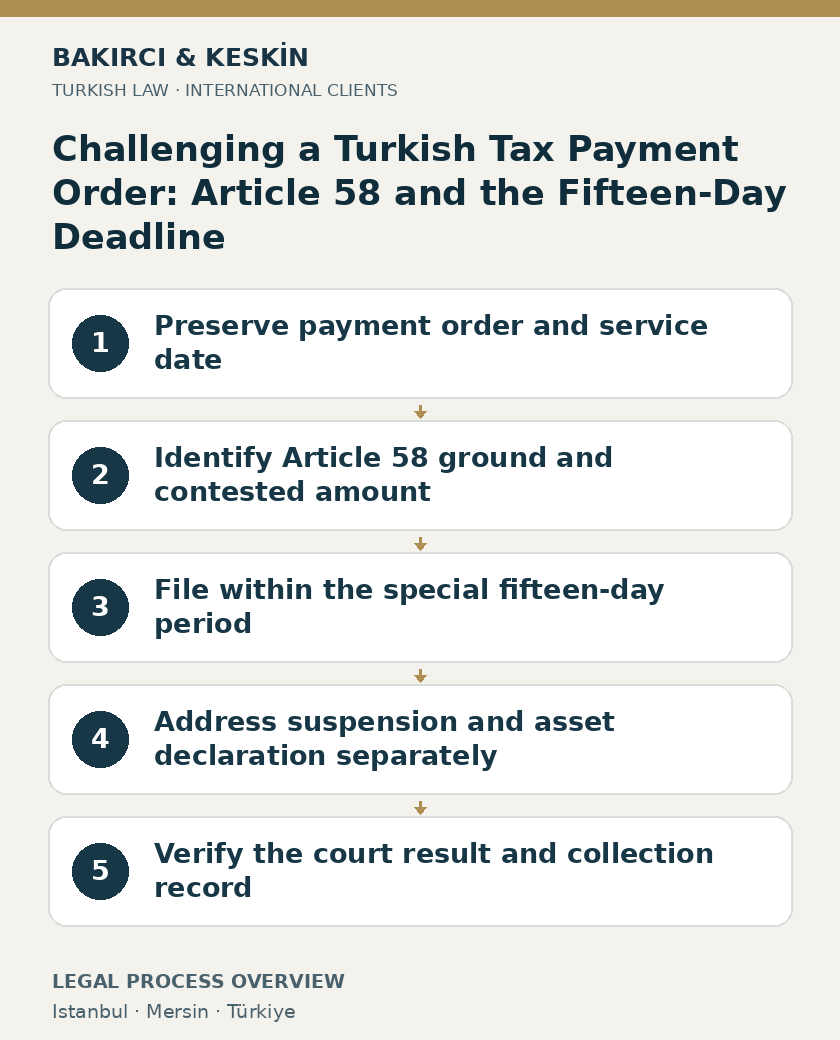
Quick summary
| Legal issue | Challenging a Turkish Tax Payment Order: Article 58 and the Fifteen-Day Deadline |
|---|---|
| Short answer | Article 58 of Law No. 6183 gives a person served with a payment order fifteen days to challenge it on the stated grounds: no such debt, partial payment or limitation. For tax debts within tax-court jurisdiction, the action is filed in the competent tax court. The order, service date, debt items and collection history must be examined immediately. Filing does not automatically suspend collection, and a partial challenge must identify the contested part and amount. |
| Key legislation | Law No. Law No. 6183 on Collection Procedure for Public Receivables — Articles 55, 58–60, 102–104; Law No. Law No. 2576 on Regional Administrative, Administrative and Tax Courts — Articles 6, 13; Law No. Administrative Procedure Law No. 2577 — Articles 7, 8, 27(2),(4), 37(c) |
Recognise the payment order as a collection act
Law No. 6183 Article 55 provides for service of a payment order on a public debtor who has not paid the public receivable when due. The order calls for payment or an asset declaration within fifteen days. It is a formal step in public-debt collection, not merely an accountant’s reminder or an ordinary commercial invoice.
Article 55 specifies information concerning the principal debt and accessory amounts, their nature and amount, where payment is to be made and the stated consequences of non-compliance. The actual order should be read together with its attachments and debt schedule. A short cover message cannot replace examination of the document being challenged.
A payment order should also be distinguished from the assessment that originally created or quantified the tax liability and from a precautionary attachment. Those acts have different legal functions and can have different remedies and starting dates. Receiving a payment order does not automatically restart every deadline applicable to the earlier assessment.
The fifteen-day period requires the actual service record
Article 58 prescribes fifteen days from notification of the payment order. This special period should not be confused with the ordinary thirty-day tax-court period in Law No. 2577 Article 7. The general period applies where a special statute has not fixed another period.
The legal service method and service date must be established. The company should preserve the complete physical or electronic notification record, the payment order and any delivery documentation. The date on which a foreign director reads an internal translation or receives a forwarded email is not necessarily the legally relevant notification date.
The period is not stated as fifteen business days. Article 8 of Law No. 2577 governs general calculation, including holidays and a final day falling on a holiday. The deadline should be calculated from the actual legal record. An informal request to the accountant or collection office should not be assumed to substitute for filing the required court action within time.
Article 58 identifies three grounds for challenge
The first ground is that the person does not owe such a debt. The response should explain why the identified public receivable cannot be pursued against that person through the order. The relevant debtor, legal liability basis, debt item and underlying administrative record must be identified, rather than stating only that the company disagrees with taxation generally.
The second stated ground concerns partial payment. A debtor relying on payment must connect the payment to the particular receivable in the order. The amount, date, payer, collection reference and allocation are relevant. Proof of an unrelated transfer to the tax administration does not establish discharge of the listed debt.
The third ground is that the debt is time-barred. This requires the collection-limitation rules and the actual collection history to be examined. A tax period more than five years old does not, by that fact alone, establish a successful limitation defence. The statutory starting event, interruption and suspension rules must all be considered.
The challenge should remain tied to the collection act and the grounds invoked. Whether a particular objection also raises a defect in the underlying assessment or service requires legal classification. Article 58 should not be presented as an unrestricted replacement for every earlier merits challenge, nor should a valid collection-stage objection be dismissed merely because an assessment exists.
Identify the capacity in which the person is pursued
The payment order may identify the company as primary debtor or pursue a different person under a statutory liability provision. A foreign parent, Turkish subsidiary, individual shareholder and legal representative do not have the same position merely because they belong to the same business group.
The legal basis should therefore be matched to the recipient’s corporate role and the relevant period. Share records, manager appointments, representation authority, changes of office and the dates of the underlying debt can be important. The separate public-debt liability rules for shareholders and managers explain why ownership and representation should not be merged into one assumed liability.
The company structure also needs to be clear. The distinction between a branch and a Turkish subsidiary helps identify the person whose tax and collection record is being examined. A familiar trading name is not enough; the legal entity, tax number and statutory capacity should correspond throughout the file.
A partial challenge must identify the part and amount
Article 58 expressly requires a debtor challenging only part of the debt to state that part and its amount clearly; otherwise the objection is treated as not having been made under that rule. A general request to cancel the order “to the extent excessive” can leave the actual contested portion unclear.
The payment-order schedule should be reconciled item by item with the company’s records. The review should distinguish principal, accessory charges, payment periods and payments already allocated. A bank receipt, accounting entry and collection-office ledger may describe the same transaction differently, so the link between them should be explained.
The scope of the claim also matters for relief. The petition should identify whether cancellation is sought for the entire order or specified items and explain the ground for each disputed amount. The company’s position on an undisputed balance should not be obscured by combining it with a separate contested period or liability basis.
The general collection period starts in the following calendar year
Article 102 provides that a public receivable becomes time-barred if not collected within five years from the beginning of the calendar year following the year in which its due date falls. It preserves special limitation provisions for monetary penalties. The due date and the type of public receivable therefore need to be established before calculating the period.
This collection rule is different from a rule governing the period for assessing a tax. The company should not calculate collection limitation from the financial year alone or assume that every tax-related clock has the same starting point. The original assessment, accrual, due date and later collection acts belong in one chronology but perform different legal functions.
Article 103 lists events interrupting collection limitation. They include payment, attachment, collection through compulsory proceedings, notification of a payment order, asset declarations and the other acts specified in that article. It also states when a fresh period begins and contains particular rules for specified interruption events. The administration’s actual file must be reviewed for those events.
Under the ordinary interruption rule, the fresh period begins at the start of the calendar year following the year of interruption. Article 103 specifies different reference events for the stated judicial reversal, security and judicial suspension situations. For security and a judicial stay, the relevant restart is linked respectively to the end of security or the end of the suspension period, through the following-calendar-year rule. A calculation should therefore identify which paragraph applies instead of simply adding five years to every document date.
Article 103(6) also addresses the first five listed acts where they are directed at, or performed by, a guarantor or the representatives of foreign persons and institutions. The foreign company’s review should therefore include relevant representative and guarantor records. Looking only for communications sent directly to overseas headquarters can omit acts that the statute identifies as relevant to interruption.
Article 104 addresses circumstances in which limitation does not run because proceedings cannot be pursued owing to the debtor being abroad, fraudulent bankruptcy or liquidation of the estate. The condition that pursuit is impossible matters. Foreign residence should not be paraphrased as automatically stopping limitation in every case, and the company should examine the factual and legal basis on which the administration relies.
Article 102 also states that voluntary payments after limitation are accepted. A company considering payment should therefore assess the limitation position before acting, rather than assume that an apparently old debt will automatically be returned after it has been paid voluntarily.
The tax court and its territorial competence must be identified
Article 58 still contains historic wording referring to a tax objection commission. Law No. 2576 Article 13 converts the relevant commission and objection terminology into tax-court proceedings for matters within the tax courts’ jurisdiction. A current challenge should follow that court framework.
Article 6 of Law No. 2576 identifies the tax and related fiscal matters within tax-court jurisdiction, including the relevant application of Law No. 6183. The nature of the receivable matters: the fact that a document is issued under Law No. 6183 does not place every possible non-tax debt in a tax court.
For the tax payment-order dispute addressed here, Article 37(c) of Law No. 2577 identifies the tax court at the place of the office issuing the payment order. The issuing authority must therefore be established from the actual document. The company’s preferred business location or the shareholder’s residence abroad does not replace the statutory venue rule.
The action does not automatically suspend collection
Under Article 27(4) of Law No. 2577, the automatic collection effect associated with specified assessment cases does not extend generally to actions against collection measures. A company challenging a payment order should not assume that filing alone prevents enforcement while the case is pending.
A request for suspension must address Article 27(2): manifest unlawfulness of the act and harm that is difficult or impossible to repair, together with the applicable procedural conditions. The petition should connect the alleged defect to the payment order and substantiate the consequences of continuing collection. General financial inconvenience should not be presented as a guaranteed entitlement to suspension.
The requested scope must correspond to the disputed order or amounts. The court’s decision and its implementation should be tracked through the collection file. The company also needs to distinguish a suspension of collection from cancellation of the underlying debt; interim relief does not itself supply a final determination of every tax issue.
Asset declaration has separate rules
Article 55 calls for payment or an asset declaration within fifteen days. Article 59 describes the declaration, including the relevant property, receivables, rights, income and the prescribed information where attachable assets or income are absent. The company should address this obligation through its authorised representatives and accurate records rather than assuming that filing a lawsuit answers every collection duty.
Article 58 draws a distinction based on the scope of the challenge. Where the entire debt has been challenged and the challenge is rejected wholly or partly, it provides a fifteen-day period for asset declaration from notification of the rejection decision. A challenge to only part of the debt does not extend the asset-declaration period.
This declaration rule should be kept separate from the judicial suspension question. Collection can require its own stay request even where the statutory declaration timing is affected by a full challenge. Article 60 contains separate consequences for failure to comply with the relevant payment and declaration obligations; the position of the actual debtor and representative requires individual assessment.
The former automatic ten-percent surcharge is not the current rule
Older explanations of Article 58 describe an automatic ten-percent surcharge when a payment-order challenge fails. The current consolidated Law records the Constitutional Court’s annulment of the relevant paragraph in its decision of 21 April 2022, E.2021/119, K.2022/48, effective on 2 August 2022. That annulled consequence should not be quoted as a current automatic litigation surcharge.
The annulment does not mean that the original public debt, applicable collection charges or procedural costs disappear. Those matters have their own legal bases. A company should receive a calculation identifying the actual current liability and costs, rather than a deterrent estimate built around the annulled paragraph.
Prepare the original debt and collection chronology
The core file should contain the payment order and service evidence, the debt schedule, relevant assessments and accrual records, due dates, payments, prior collection measures, security arrangements, asset declarations and court orders. Corporate identity and representation records should explain who owes or disputes the amount and who can instruct counsel.
For a limitation defence, records of interruption and suspension are particularly important. For payment, trace the transfer to the actual assessed item. For an objection that no such debt is owed, identify the asserted legal liability and the documents that contradict it. This organisation connects evidence to the three statutory grounds instead of presenting an undifferentiated archive.
Respond promptly and verify the legal effect of the result
A foreign company should coordinate the Turkish filing timetable with its internal approval process immediately. Translation and overseas management review should support the deadline, not obscure the date on which formal service occurred. The court submission, any suspension request and the asset-declaration question require separate instructions and monitoring.
After a decision, the company should establish exactly which order or items were affected and how the collection office implemented it. A successful challenge to one payment order should not be described as resolving unrelated assessments or liabilities. Accurate reporting should distinguish claims filed, interim relief obtained, the final result and the balance that the administration still records.
Frequently asked questions
1. How long does a foreign company have to challenge a Turkish tax payment order?
Article 58 prescribes fifteen days from notification. The legal service record and applicable calculation rules must be checked. The company should not substitute the ordinary thirty-day tax-court period.
2. What grounds does Article 58 identify?
The stated grounds are that no such debt is owed, that it has been partly paid or that it is time-barred. The pleading should connect the actual objection and evidence to the payment order and applicable ground.
3. Can only part of the order be challenged?
Yes, but Article 58 requires the challenged part and amount to be stated clearly. It also provides that a partial challenge does not extend the asset-declaration period.
4. Does filing automatically stop collection?
No. Collection proceedings require a separate suspension analysis under Article 27 of Law No. 2577. The statutory conditions and the actual court order must be addressed.
5. Which tax court handles the payment-order challenge?
For a dispute within tax-court jurisdiction, Article 37(c) identifies the court at the place of the office that issued the payment order. The issuing office and the nature of the public receivable must be established.
6. Is every tax debt older than five years time-barred?
No. Article 102 uses the beginning of the calendar year following the due-date year, and Articles 103–104 regulate interruption and non-running of the period. Special rules for monetary penalties are also preserved.
7. Does being abroad automatically stop collection limitation?
Article 104 links the stated circumstances to an inability to pursue proceedings. Foreign residence alone should not be treated as a complete analysis. The actual collection record and statutory conditions must be examined.
8. Must a losing challenger automatically pay an additional ten percent?
The relevant Article 58 paragraph was annulled by the Constitutional Court, with effect recorded as 2 August 2022 in the current Law. Older descriptions of that automatic surcharge should not be used as the current rule.
9. Does challenging the entire debt affect the asset-declaration period?
Article 58 provides fifteen days from notification of the rejection decision where the whole debt was challenged and the challenge is wholly or partly rejected. This is distinct from obtaining suspension of collection.
10. What documents should be sent to Turkish counsel first?
Send the complete payment order, service record, debt schedule, underlying assessment and due-date documents, payments and prior collection acts. Include corporate identity and authority records and identify the precise amounts and grounds disputed.
Official legal sources
- Law No. 6183 on Collection Procedure for Public Receivables — Articles 55, 58–60, 102–104
- Law No. 2576 on Regional Administrative, Administrative and Tax Courts — Articles 6, 13
- Administrative Procedure Law No. 2577 — Articles 7, 8, 27(2),(4), 37(c)
Recorded primary-source check dates: 26 October 2026. The official Turkish legislation controls. A new publication-date check is still required.
Contact information
Do not include confidential documents or identity numbers in an initial message. An enquiry does not establish representation or suspend any legal deadline.
Istanbul and Mersin contact details
Bakırcı & Keskin Law Office is Mersin-based. Turkish matters are handled under the applicable jurisdiction and agreed mandate. The competent court and the scope of representation are assessed for each matter.
Istanbul — Polaris Plaza
Maslak Ahi Evran Caddesi, Polaris Plaza No:21, Floor 9, 34475 Sarıyer/İstanbul, Türkiye.Mersin — Profit İş Merkezi
İhsaniye Mahallesi, 4903. Sokak, Profit İş Merkezi No:23, Floor 3, Office 14, 33070 Akdeniz/Mersin, Türkiye.+90 552 224 43 66 · Contact details in English. An enquiry does not establish representation or suspend a legal deadline.
Istanbul Office – Polaris Plaza, Maslak / Sarıyer
Bakırcı & Keskin Hukuk Bürosu
Maslak Ahi Evran Caddesi, Polaris Plaza No:21, Kat:9, 34475 Sarıyer/İstanbul
Our physical offices in Istanbul and Mersin coordinate matters throughout Turkey, subject to jurisdiction and the local steps required for each case. Please specify your preferred office when arranging an in-person appointment.
Open the Istanbul office on Google Maps · Contact and appointments
Contact regarding a legal matter
In your first message, you may briefly state the subject, your country or city, and any relevant notification or recent procedural date. Please do not send identity numbers, medical data, or personal documents. Messaging alone does not constitute legal advice or create a lawyer–client relationship.
Discover more from Bakırcı & Keskin Hukuk Bürosu
Subscribe to get the latest posts sent to your email.