Travel Agency Insolvency in Turkey: Mandatory Package-Tour Insurance and Refund Claims
Short answer
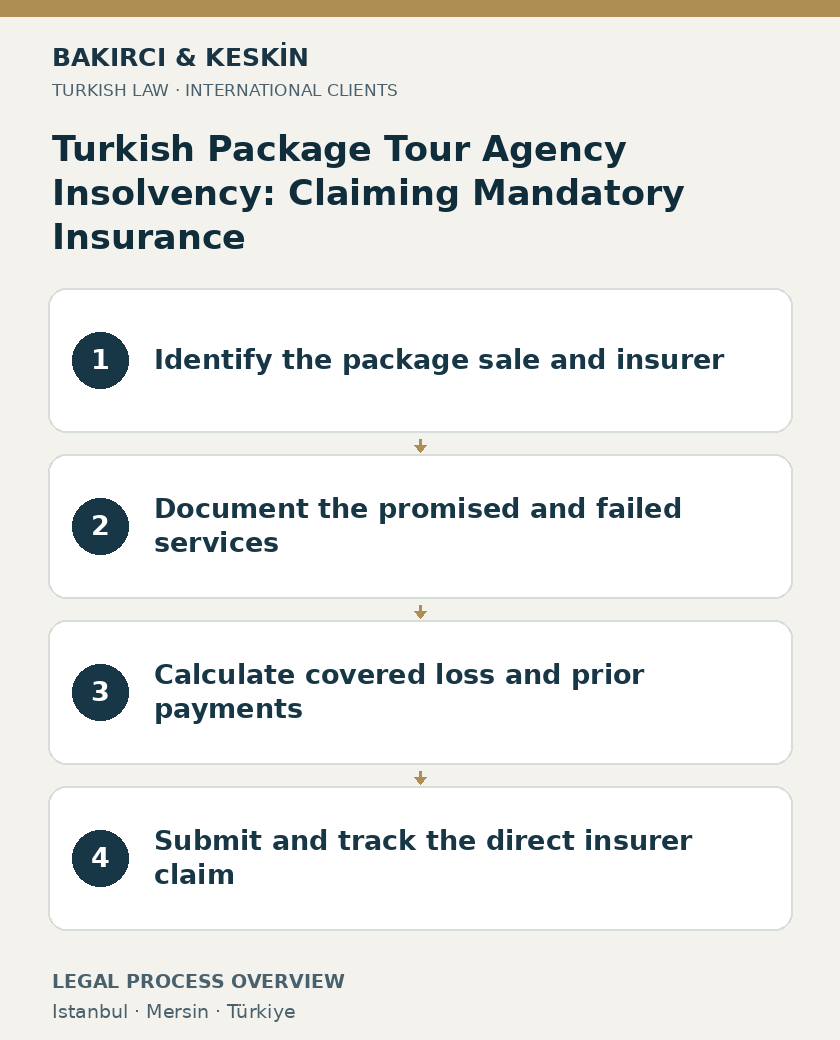
Article 12(a) of Law No. 1618 requires travel agencies to insure their liability for promised services not being delivered, or not being delivered as promised, in package tours sold in Turkey. Agency bankruptcy is expressly included. The insurer’s liability must be at least the package price, and the customer can claim covered loss directly from the insurer. Establish the policy, covered package, failed service and loss; the statutory insurance obligation does not prove that a particular agency actually obtained valid cover.
Have a general question about this article? Ask anonymously
Quick summary
| Legal issue | Turkish Package Tour Agency Insolvency: Claiming Mandatory Insurance |
|---|---|
| Short answer | Article 12(a) of Law No. 1618 requires travel agencies to insure their liability for promised services not being delivered, or not being delivered as promised, in package tours sold in Turkey. Agency bankruptcy is expressly included. The insurer's liability must be at least the package price, and the customer can claim covered loss directly from the insurer. Establish the policy, covered package, failed service and loss; the statutory insurance obligation does not prove that a particular agency actually obtained valid cover. |
| Key legislation | Law No. 1618; Law No. 6502; Law No. 6102 |
Identify a package tour sold in Turkey
The compulsory-insurance provision begins with a specific scope: package tours sold in Turkey. Article 12 of Law No. 1618 on Travel Agencies and their Association should not be rewritten as a guarantee covering every holiday anywhere in the world that includes a Turkish destination. Establish who sold the package, where the sale occurred, the contracting business and the documents forming the agreement.
Article 51(1) of the Consumer Protection Law No. 6502 defines package-tour contracts through the combination of at least two listed service categories for an inclusive price and the duration or overnight-accommodation condition. The categories concern transport, accommodation and other tourism services independent of transport and accommodation. Identify the actual combination rather than relying on the booking’s marketing title.
Article 51(2) retains its application where the details were arranged by the organiser, intermediary or consumer, and where the component services were invoiced separately. Separate invoices therefore do not by themselves disprove a package. Conversely, the presence of several travel receipts does not establish that all services formed one package agreement. Reconstruct the sale from the actual booking record.
Find the contractual agency and its insurance information
Article 10(c) of Law No. 1618 requires the agency to give the consumer detailed programme information and a copy of the contract showing the insurance company covering the package programme. That document is a starting point for identifying the insurer. Retain the booking confirmation, programme, invoice and payment record together so that the policy information can be connected with the specific trip.
The agency’s trading brand, website name and legal entity can differ. Record the legal name and available licence or registration information appearing on the contract, alongside the payment recipient. Identify any organiser and intermediary separately. A logo on a confirmation should not replace proof of which business undertook the obligations or which insured party the policy identifies.
Obtain the policy, certificate, schedule and relevant endorsements where available. Check the insured entity, period, package identification, insured amount and named insurer. Article 12 imposes an obligation to insure; it does not establish that an unknown insurer exists when an agency failed to comply. Missing policy evidence must remain a documented gap, with the agency’s contractual liability assessed separately.
Prove which promised service was not delivered
Article 12(a) addresses liability arising from services promised within the package not being provided, or not being provided in the promised manner, for any reason including agency bankruptcy. The claim therefore begins with the promise. Preserve the agreed itinerary, accommodation description, transport arrangements and included services in the version accepted at booking, together with any later accepted variation.
Compare the contractual undertaking with the actual service record. Supplier confirmations, cancellation messages, attendance records and contemporaneous photographs can establish different parts of that comparison. State exactly which service failed and when. A general expression of disappointment does not identify the insured liability or quantify its consequences, while a detailed record permits the insurer to evaluate the actual complaint.
Article 51(8) of Law No. 6502 expressly preserves the compulsory-insurance provisions while addressing the organiser’s responsibility for non-performance or improper performance. The underlying entitlement and the insurer’s payment obligation must be analysed together. The package-tour cancellation and refund guide explains the separate contractual remedies; this article addresses the insurance route supporting a covered loss.
Bankruptcy is expressly included, but it is not the only trigger
The text of Article 12(a) expressly includes the agency’s bankruptcy among the reasons for failed performance. It should not be described as insurance available only after a formal bankruptcy judgment. The statutory wording also covers non-delivery or inadequate delivery arising for other reasons. Establish the failure and agency liability without adding an insolvency condition that the provision does not impose.
Where bankruptcy proceedings exist, obtain reliable information identifying the entity, court and relevant procedural stage. Keep formal records separate from press reports, an unanswered telephone or a closed office. Those circumstances can prompt investigation, but they are not interchangeable proof of a bankruptcy decision. The insurer claim should describe the established status accurately and attach the documents relied upon.
An agency’s insolvency also creates questions about recovering amounts directly from the agency. Those questions require assessment under the applicable insolvency procedure, including the actual file and deadlines. A direct insurance claim should not cause another necessary step to be missed. Equally, recording an agency claim does not by itself prove that the insurer has received the evidence needed to evaluate its own obligation.
The customer can claim covered loss directly from the insurer
Article 12(a) expressly permits the customer to demand insured loss directly from the insurance company. The customer is therefore not limited by that provision to asking the failed agency to submit a claim on the customer’s behalf. Article 1478 of the Turkish Commercial Code also provides the injured person’s direct claim within the insured amount and the applicable limitation period.
Address the demand to the identified insurer and keep evidence of receipt. Set out the claimant, agency, package, policy details, relevant dates, failed services, amount claimed and supporting documents. Identify payments already received. A demand that names only the holiday resort and total booking price leaves essential questions unanswered about the contractual business, insurance relationship and particular damage.
The direct route does not mean that every demand must be paid without examination. The insurer still needs to assess the relevant policy, liability and covered loss in light of mandatory protections. Request a reasoned response identifying any disputed fact or policy provision. A refusal based on a vague description should be examined against the actual contract and statutory framework.
The package-price minimum is not an automatic award
Article 12(a) requires the insurer’s liability to be at least the package-tour price. This is a minimum insurance requirement. It should not be presented as a rule paying the full package price for every shortcoming, regardless of the service received or the established loss. The demand must distinguish the required cover from the amount legally recoverable on the particular record.
Prepare a calculation linking each claimed amount to the relevant failed obligation. Record the inclusive price, instalments paid, refunds, replacement expenditure and any remaining unpaid balance. Keep the original currency and transaction evidence. Where several travellers appear on one contract, identify the contracting customer, each participant and how the claimed amounts are allocated without multiplying a single payment.
Some disputes concern complete non-delivery; others concern only part of the promised programme. The legal consequences must follow the applicable contractual and statutory remedy. A supplier invoice for an unused component is evidence, but does not alone settle the consumer’s entire claim or the insurer’s obligation. Explain how the calculation reflects both the contractual rights and the actual performance.
Supply information relevant to the event and loss
Article 1479 of the Turkish Commercial Code permits the insurer to request information from the injured person to establish the event causing damage and its amount. The provision concerns relevant documents whose production is possible and whose request can reasonably be justified. Supply the complete booking and payment evidence, and identify unavailable documents and the steps taken to obtain them.
The same article regulates the consequence of failing to provide that material, subject to written notification to the injured person. It limits liability to what the insurer would have had to pay if the obligation had been fulfilled. This is a reason to respond carefully to a relevant document request; it does not justify treating every request as a new statutory deadline extinguishing the customer’s rights.
Maintain a dated index of what was submitted and the insurer’s response. Preserve emails with their attachments, receipts and original files. Translations should retain the identity of the issuer, dates, currency and qualifications in the source document. An overseas client can then instruct counsel from a coherent record without having to reconstruct the booking from scattered screenshots.
Examine compulsory-insurance protections before accepting a policy defence
Article 1484(1) provides that an insurer’s performance obligation towards the injured person continues up to the compulsory-insurance amount even where it has wholly or partly escaped its obligation towards the insured. This distinction matters when an insurer relies on a dispute with the agency. A defence concerning that relationship requires examination under the mandatory third-party protection, not automatic acceptance.
Article 1484(2) separately regulates termination: its effect against the injured person arises only one month after the insurer notifies the competent authorities that the insurance relationship has ended or will end. Obtain the actual termination and authority-notification evidence, together with the loss date. A date printed on a cancellation letter to the agency does not establish every element of that statutory sequence.
These protections should not be expanded into a promise that every insurer must pay every travel loss. Establish the relevant insurance relationship and compulsory cover, then address the particular defence. Article 1484(3) also addresses loss met by social-security institutions. The analysis must retain the statutory qualifications instead of isolating the most favourable sentence and ignoring the remainder.
The five-working-day rule concerns reporting to the Ministry
Article 12(a) requires travel agencies and insurers to send a copy of the insurance contract to the Ministry within five working days after concluding it. Early termination must also be reported within the same period. These are duties of the agency and insurer. They are not a five-day period within which a customer must file an insurance claim after a failed holiday.
The reporting records can nevertheless help establish whether the agency arranged the stated policy and what happened to it. Request the relevant contract and termination information through an appropriate lawful route. Keep the statutory reporting deadline separate from the one-month third-party effect of termination under Article 1484 and from the limitation period governing the compensation demand.
A missed reporting obligation and the merits of an individual compensation claim are different legal questions. Record the evidence of non-compliance where it exists, but do not treat an allegation about reporting as proof of the exact amount owed. The claim still needs the package agreement, failed obligation, liability and loss to be connected with the insurance relied upon.
Optional medical and return-travel insurance is a different protection
Article 12(b) requires the agency, when arranging the package contract, to inform the customer that insurance can be obtained for return to the departure point in the event of accident or illness, and for accident damage and treatment expenses up to the policy limit. This is distinct from paragraph (a)’s compulsory insurance of the agency’s performance liability.
Do not read the agency’s package-performance policy as automatic medical insurance for every traveller. Obtain any separate policy, certificate and schedule covering the traveller, then identify its insured events, limits and territorial period. An assistance telephone number or general brochure does not by itself establish the particular medical or return-travel cover purchased.
The distinction also affects evidence. A performance claim concerns what the agency promised and failed to supply; a medical-insurance claim requires the evidence relevant to its insured event and policy. Some expenses can appear in more than one file. Identify the legal basis and actual payment under each so that the same cost is not presented as wholly unpaid after reimbursement.
The agency’s establishment security is not the same insurance fund
Article 10(e) of Law No. 1618 regulates a separate security furnished for specified agency obligations. Its wording excludes the stated services to customers and transport undertakings and obligations within the insurance limit from that security’s scope. It should not be advertised as an automatic state fund refunding every lost package payment when insurance has not been identified.
Determine the nature of the obligation, the security’s statutory scope and the actual administrative record before pursuing that route. The existence of an agency licence does not prove an unrestricted public guarantee of all customer losses. A demand directed to the Ministry and a direct demand to an insurer involve different legal relationships and should state the relevant basis precisely.
Identify the applicable limitation period and competent procedure
Article 1482 of the Turkish Commercial Code provides a ten-year limitation period, running from the insured event, for compensation claims directed against the liability insurer. Read that provision with Article 1478 and the actual claim. Do not automatically apply the same period to every separate refund, agency, intermediary, insolvency or transport claim connected with the booking.
Record the event date and the relevant procedural history. A customer-service exchange should not be assumed to preserve every time limit or satisfy a required legal step. Counsel must assess the competent forum, any applicable preliminary procedure and the effect of steps already taken. The insurer’s own complaints reference is not a court filing number or proof that litigation has begun.
The customer’s residence abroad does not remove the need to assess jurisdiction and representation. Supply the contract, insurer’s identity and location, contracting parties and any choice-of-law or forum wording for review. A Turkish destination alone cannot resolve every cross-border procedural issue. The claim should be prepared for the legally available forum, with service and authority documents considered before filing.
Keep insurer payments, agency refunds and other recovery visible
Maintain a single payment schedule identifying the payer, recipient, date, amount, currency and purpose. Agency refunds, insurer payments and card recoveries must not disappear from the record merely because they came through different channels. Whether and how a payment affects the remaining entitlement must be assessed, but the same loss cannot honestly be described twice as wholly outstanding.
Air-carrier rights can also arise during the trip. The Turkish flight-delay compensation guide addresses that distinct legal basis. Identify which amount concerns the airline’s regulatory obligation and which concerns the package organiser’s liability. A fixed aviation payment and reimbursement of a particular expense should not be merged without examining their legal character.
Before accepting a settlement, identify the claims and parties released, payment timing, remaining balance and treatment of other recoveries. Article 1480 states that the insurer cannot set off its insurance-contract receivables against compensation payable to the injured person. Any proposed deduction described as the agency’s unpaid insurance debt therefore deserves specific examination under that provision and the compulsory-insurance protections.
Prepare a usable claim file from outside Turkey
Send counsel the complete booking record, accepted programme, payment evidence, policy material, service-failure chronology, insurer correspondence and payment schedule. Identify the customer, each affected traveller and the person authorised to give instructions. Keep original files and explain any missing evidence. The resulting assessment should identify the responsible agency, available cover, substantiated loss, appropriate demand and procedural deadline from the actual documents.
Frequently asked questions
Does Turkish law require insurance against package-tour agency bankruptcy?
Article 12(a) of Law No. 1618 expressly includes agency bankruptcy in the compulsory cover for liability arising from failed or inadequate promised services in packages sold in Turkey.
Must I wait for a formal bankruptcy judgment to claim?
The provision is not limited to bankruptcy. It addresses failed or inadequate performance for any reason, including bankruptcy. Establish the actual liability, policy and covered loss.
Can I claim directly from the insurer?
Yes. Article 12(a) expressly permits a direct claim for covered loss. Turkish Commercial Code Article 1478 also regulates the injured person’s direct claim.
Is the full package price automatically payable for every defect?
No. The package-price rule is a minimum insurance requirement. The customer’s recoverable amount depends on the applicable remedy, proven loss and relevant cover.
Where should the insurance company’s identity appear?
Article 10(c) requires the agency to supply a contract copy showing the company insuring the package programme. Obtain the policy and schedule as well to connect the cover with the actual booking.
Must I report my claim within five working days?
Article 12’s five-working-day rule concerns agency and insurer reporting to the Ministry. It is not the customer’s compensation-claim deadline.
Does policy cancellation immediately defeat the customer’s claim?
Article 1484(2) regulates the effect of termination against the injured person by reference to one month after notice to the competent authorities. The actual policy and notification evidence must be examined.
Does compulsory package insurance automatically cover medical treatment?
Article 12(b)’s information duty concerning optional accident, illness and return cover is separate. Check whether the traveller obtained the relevant policy and what it covers.
Does every holiday involving Turkey fall within Article 12?
The statutory wording concerns package tours sold in Turkey. Identify the actual package, seller and sale circumstances rather than relying only on the destination.
What limitation period governs the liability-insurer claim?
Turkish Commercial Code Article 1482 provides ten years from the insured event. Separate claims connected with the booking need their own deadline and procedural assessment.
Official legal sources
Law No. 1618, Articles 10 and 12; Law No. 6502, Article 51; Turkish Commercial Code, Articles 1478–1480, 1482 and 1484. Current official texts reviewed on 26 October 2026.
Contact information
Do not include confidential documents or identity numbers in an initial message. An enquiry does not establish representation or suspend any legal deadline.
Istanbul and Mersin contact details
Bakırcı & Keskin Law Office is Mersin-based. Turkish matters are handled under the applicable jurisdiction and agreed mandate. The competent court and the scope of representation are assessed for each matter.
Istanbul — Polaris Plaza
Maslak Ahi Evran Caddesi, Polaris Plaza No:21, Floor 9, 34475 Sarıyer/İstanbul, Türkiye.Mersin — Profit İş Merkezi
İhsaniye Mahallesi, 4903. Sokak, Profit İş Merkezi No:23, Floor 3, Office 14, 33070 Akdeniz/Mersin, Türkiye.+90 552 224 43 66 · Contact details in English. An enquiry does not establish representation or suspend a legal deadline.
Istanbul Office – Polaris Plaza, Maslak / Sarıyer
Bakırcı & Keskin Hukuk Bürosu
Maslak Ahi Evran Caddesi, Polaris Plaza No:21, Kat:9, 34475 Sarıyer/İstanbul
Our physical offices in Istanbul and Mersin coordinate matters throughout Turkey, subject to jurisdiction and the local steps required for each case. Please specify your preferred office when arranging an in-person appointment.
Open the Istanbul office on Google Maps · Contact and appointments
Contact regarding a legal matter
In your first message, you may briefly state the subject, your country or city, and any relevant notification or recent procedural date. Please do not send identity numbers, medical data, or personal documents. Messaging alone does not constitute legal advice or create a lawyer–client relationship.
Discover more from Bakırcı & Keskin Hukuk Bürosu
Subscribe to get the latest posts sent to your email.