Voluntary Public Auctions in Turkey: Binding Bids, Payment, Ownership and Buyer Rights
The highest bid, the auction award, payment and acquisition of ownership are not interchangeable events under Turkish law. Articles 274–281 of the Turkish Code of Obligations regulate auction sales and distinguish voluntary public auctions, private auctions and compulsory auctions. In a voluntary auction open to everyone, Article 275 generally concludes the sale when the auctioneer awards the lot to the highest bidder, unless the seller expressed a contrary intention in the conditions. The buyer must then consider payment terms, title transfer, defects and any ground for challenge separately. This guide concerns that civil-law framework, not the special procedure for an enforcement-office auction.
Have a general question about this article? Ask anonymously
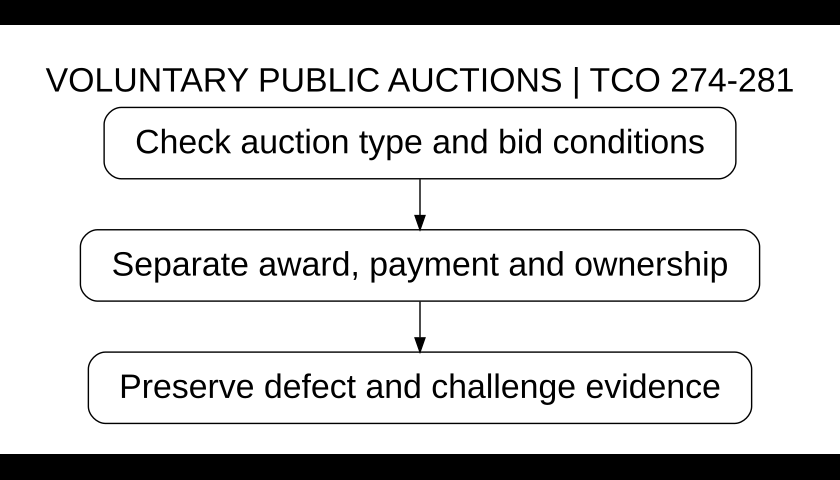
A privately owned auction house can conduct a public auction
Article 274 defines an auction sale by reference to a place, time and conditions fixed in advance and sale to the highest bidder among those present. Article 275 then refers specifically to voluntary public auctions in which everyone can participate. The ownership of the auction business is not, by itself, the statutory classification of the auction.
Distinguish a voluntary public sale from a closed private arrangement and from a sale conducted through compulsory enforcement. The Code expressly preserves special rules for compulsory auctions. A deadline or title rule applicable to one category must not be copied into another merely because all involve competing bids.
The principal source is Law No. 6098, Articles 274–281. Keep the announcement, participation conditions and complete sale terms. A platform’s use of the word auction does not eliminate the need to identify the actual contractual and statutory arrangement.
Article 275 distinguishes the highest bid from an award
In a voluntary auction open to everyone, the sale is generally concluded when the person conducting it awards the item to the highest bidder. The rule is qualified where the seller has expressed a contrary intention in the auction conditions. An offer being the highest does not dispense with reading those conditions and establishing what the auctioneer actually did.
Retain the lot number, bidder identification, bid history and award record. A screen indicating that bidding has ended, a provisional result and a final award can have different functions under the actual arrangement. Do not treat a later payment invoice as the only possible evidence of formation.
The general offer-and-acceptance guide addresses negotiations outside this specific auction setting. An auction analysis should begin with its special rule and conditions rather than assume that a bidder always needs to sign an entirely new contract after the award.
A bidder is bound within the stated sale conditions
Article 276 binds the participant to the bid within the auction conditions. Unless a contrary condition exists, that binding effect ends when a higher bid is made. It also ends where, after asking whether a higher bid exists and finding none, the bid is not accepted immediately.
The timing record must show the relevant events. Identify the bid, any higher bid, the invitation for further bids and the response. A participant’s private intention to withdraw does not establish that the statutory or contractual event ending the bid’s binding effect occurred.
Where the conditions alter the default, preserve the version made available before bidding and the evidence of incorporation. A condition added after the dispute is not automatically part of the original bid. The rule does not permit an organiser to reconstruct the accepted terms retrospectively.
Land auctions have an additional rule about immediate award or rejection
Article 277 requires the award or rejection in an immovable-property auction immediately after the auction. It declares ineffective a condition that keeps the bidder bound after the auction. The provision then excludes compulsory auctions and cases requiring approval of the award by a public official from that rule.
Both the protection and its exceptions should appear in the analysis. A bidder should not be told that every land-auction offer remains open indefinitely because an organiser’s form says so. Equally, the exception for the specified approval situation must not be ignored where it actually applies.
The award record should identify the property precisely. A marketing description, parcel identification and land-register record serve different purposes. The agreement to buy and completion of the required title process remain distinct, even after the auction’s formation stage is resolved.
The default is upfront payment, not automatic credit
Article 278 requires the auction price to be paid upfront unless the auction conditions provide otherwise. This concerns payment timing; it is not a statement that payment must physically consist of banknotes. The method, recipient and any agreed timetable should be identified from the actual terms.
If the price is not paid upfront or according to the conditions, the seller may withdraw immediately under Article 278. A successful bidder should therefore not assume that a general promise to obtain finance automatically supplies an additional payment period. Establish any actual agreement extending the required date.
Record a deposit, the remaining price and any separate charges distinctly. A deposit’s existence does not, by itself, prove that the entire auction price was paid. Additional commissions, taxes or service charges require their own contractual and legal basis rather than being inferred from the fact that the bid succeeded.
Movable ownership and physical collection are separate events
Article 279 states that a person buying movable property at auction acquires ownership at the award. Its final paragraph separately makes voluntary private auctions subject to the general rules on transfer of ownership. The auction’s category must therefore be established before stating that ownership has already passed.
In the auction to which the award rule applies, physical collection can occur later. Preserve the award record and the identity of the lot, then separately document custody, storage, collection and delivery arrangements. The fact that the item remains in the auctioneer’s building does not alone settle the title question.
Ownership, accidental-loss allocation and responsibility for damage are not identical legal issues. The sale-risk guide explains why the relevant risk rule and actual holding arrangement must be examined separately rather than deduced solely from who paid the freight or holds the item.
Land ownership requires registration under the general auction provision
Article 279 provides that ownership of immovable property bought at auction passes through registration in the land register. The auction officer must immediately notify the land registry for registration of the property identified in the sale record. The provision preserves special title-transfer rules for compulsory auctions.
An award in a voluntary auction should not be presented as though it were already a completed registered title transfer. Obtain the actual registration and inspect the property’s legal position. The bidder’s right arising from the sale and registered ownership require separate documentary confirmation.
Foreign-acquisition restrictions and rules applying to the particular property remain separate checks. The auction format does not itself establish eligibility to acquire every Turkish property. A legal review must identify the buyer, property and applicable special regime rather than assume the auction overrides them.
Voluntary-auction sellers are responsible for title claims and defects
Article 280 makes the seller in a voluntary public auction responsible for third-party deprivation and defects in the sold item. It allows exclusion through an express and announced auction condition except in cases of deception. The exclusion’s wording and communication must therefore be proved rather than presumed.
Compare the lot description with the actual goods and relevant records. A condition report, catalogue statement and independent assessment may establish different matters. The review should identify the precise quality or right promised and the departure alleged.
The third-party rights guide addresses the separate seller-responsibility framework. An auction buyer should distinguish a defect in the item from a competing ownership or other right, because those allegations do not have identical elements.
An announced exclusion must be examined, not assumed from “as is” wording
Article 280 requires an exclusion to be expressly stated and announced in the auction conditions and does not extend it to deception. A later statement that all auction goods are sold without responsibility is not automatically evidence of an exclusion incorporated before the buyer bid.
Preserve the catalogue and conditions in the form actually available at the relevant time. An online document may be replaced or updated; the current version alone may not show the bargain at the auction. Retain lawful evidence of the earlier text and any specific representation about the lot.
Other applicable mandatory rules, including the correct classification of a consumer or regulated transaction, need their own review. The general auction provision is not a blanket authorisation to disregard every special protection. The standard-terms guide explains the separate incorporation and control questions.
Compulsory-auction warranty rules must not be imported into voluntary sales
Article 280 excludes the ordinary deprivation and defect-responsibility rules in compulsory auctions. It also states that an auction buyer acquires the property with its status, rights and burdens determined by the land register, sale conditions or law. The actual records therefore remain important even where an item is described as auctioned property.
A private seller should not rely on the compulsory-auction exclusion merely because an auctioneer conducted the sale. Conversely, a compulsory-auction buyer needs the special procedure and remedies applicable to that sale, not an assumption that an ordinary private-sale claim supplies every available remedy.
The distinction should be settled at the beginning of the file. Obtain the sale announcement and the authority under which the sale occurred. A general press description or the venue where bidding took place is not sufficient to establish the legal regime.
Article 281 provides a short route for unlawful or immoral procurement of the award
Where unlawful or immoral methods were used to procure the award, Article 281 allows any interested person to ask the court to cancel it. The application must identify the conduct and its connection with procuring the award. Dissatisfaction with the final price is not, by itself, proof of that statutory ground.
The period is ten days from learning of the cancellation ground and, in all events, one year following the award. Both boundaries must be considered. A claimant should preserve the evidence of when the ground became known instead of assuming that the one-year outer limit provides a full year in every case.
The provision expressly reserves special rules for compulsory auctions. Its ten-day period must not be copied into an enforcement-auction challenge without checking the applicable special legislation. A complaint to the organiser or informal negotiation is not the court application identified by Article 281.
Preserve lawful evidence of the conduct, not unsupported accusations
The challenge file should contain the announcement, conditions, bid and award records, relevant communications and documents supporting the alleged interference. Explain what each proves. A suspicion that bidding seemed unusual must be distinguished from evidence that establishes the prohibited method relied on.
Keep the complete chronology and identify who observed each event. A witness to the final award may not know how an earlier bid was entered. Electronic records should retain their original form where available rather than be replaced with selected extracts that omit relevant context.
The electronic-evidence guide addresses authenticity and preservation. Do not enter other bidders’ accounts, obtain unrelated private records unlawfully or fabricate missing timestamps. A credible challenge depends on traceable facts and the correct procedural step.
Remote bidding and collection arrangements require their own documentation
An overseas participant should identify the person placing the bid, whether that person acts for a disclosed principal and the authority covering the purchase. A payment account in another person’s name does not alone establish who became the buyer. Preserve the registration, instructions and award record together.
Where a platform or remote channel is used, determine how its actual mechanism fits the applicable auction and contract rules. A website label does not establish that every timed online sale follows every default for a physical voluntary public auction. The conditions and legal classification need examination.
Collection, export, transport and insurance are separate arrangements. Winning an auction does not itself supply permission to export a regulated item or establish its insured journey. This guide does not certify any particular lot for cross-border movement; obtain the relevant item and documentary checks before arranging shipment.
Prepare the auction file around the decision being disputed
| Issue | Evidence to preserve |
|---|---|
| Legal auction category | Announcement, participation rules and authority for the sale. |
| Binding bid and formation | Conditions, bid sequence, acceptance and award record. |
| Payment | Price, due date, deposit, agreed charges and receipts. |
| Ownership and custody | The lot identity, award, registration where required and delivery arrangements. |
| Defects or adverse rights | Descriptions, announced exclusions, inspection and rights records. |
| Article 281 challenge | The alleged unlawful conduct, date of knowledge and award date. |
A foreign buyer or seller should retain source-language documents alongside translations and provide any served proceedings immediately with their service records. The assessment must state whether the issue is formation, payment, title, warranty or cancellation. One general complaint about the auction does not automatically preserve every separate remedy.
Frequently asked questions
Is the highest bid always a completed sale?
Article 275 generally uses the auctioneer’s award in a voluntary auction open to everyone, unless the seller expressed a contrary intention in the conditions. Establish the actual award and terms.
When does a bid cease to bind under the default rule?
Article 276 addresses a higher bid or failure to accept immediately after no higher bid is found, unless contrary conditions apply. The bid sequence must be documented.
Can every land bidder be kept bound indefinitely after the auction?
No. Article 277 requires immediate award or rejection and invalidates extended binding conditions, subject to its compulsory-auction and public-official approval exceptions.
Is payment automatically deferred until the buyer obtains finance?
No. Article 278 requires upfront payment unless the conditions provide otherwise. Failure to pay as required permits the seller’s immediate withdrawal under that provision.
When does ownership of a movable auction lot pass?
Article 279 uses the award, while reserving general transfer rules for voluntary private auctions. Identify the legal auction category before applying the result.
Does a voluntary land-auction award itself complete registered ownership?
Article 279 requires land-register registration for immovable ownership under its general rule. It preserves special compulsory-auction provisions.
Are voluntary-auction sellers automatically exempt from defect liability?
No. Article 280 imposes responsibility and permits an express, announced exclusion except in deception, with other applicable mandatory rules separately assessed.
How long is the Article 281 cancellation period?
Ten days from learning of the ground, and in all events one year following the award. The court application and both dates require prompt assessment.
Does that ten-day rule replace enforcement-auction challenge rules?
No. Article 281 expressly reserves special rules for compulsory auctions. Identify the correct procedure instead of importing this period automatically.
What should an overseas bidder keep?
Keep the original conditions, lot description, authority, bids, award, payments, delivery records and evidence of any defect or alleged unlawful conduct.
Official legal sources
Turkish Code of Obligations No. 6098, Articles 274–281; official Ministry text, pages 55–56. This English explanation is not an official translation and does not replace compulsory-enforcement, consumer or regulated-property rules.
Ask about a voluntary auction
State the auction type, lot, award date and the issue with bidding, payment or the item. Mention when any challenge ground became known and use a confidential channel for documents.
Istanbul and Mersin offices
Bakırcı & Keskin Law Office is Mersin-based and works throughout Türkiye with an Istanbul and Mersin focus.
Istanbul — Polaris Plaza
Maslak Ahi Evran Caddesi, Polaris Plaza No:21, Floor 9, 34475 Sarıyer/İstanbul.
Mersin — Profit İş Merkezi
İhsaniye Mahallesi, 4903. Sokak, Profit İş Merkezi No:23, Floor 3, Office 14, 33070 Akdeniz/Mersin.
Call +90 552 224 43 66. An enquiry does not establish representation or suspend a legal deadline.
Contact regarding a legal matter
In your first message, you may briefly state the subject, your country or city, and any relevant notification or recent procedural date. Please do not send identity numbers, medical data, or personal documents. Messaging alone does not constitute legal advice or create a lawyer–client relationship.
Discover more from Bakırcı & Keskin Hukuk Bürosu
Subscribe to get the latest posts sent to your email.