Assignment of Receivables in Turkey: Debtor Notice, Defences and TCO 183–194
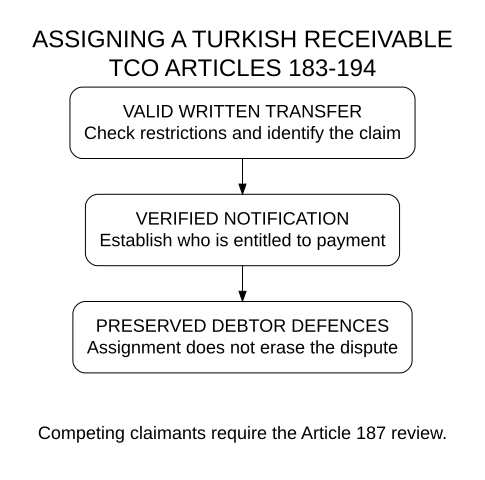
A Turkish receivable can generally be assigned without the debtor’s consent, but the assignment does not erase the debtor’s existing defences. Article 183 of the Turkish Code of Obligations permits transfer unless legislation, the agreement or the nature of the obligation prevents it. Article 184 requires the voluntary assignment itself to be in writing. Articles 186–188 then protect a debtor who pays in good faith without notification, regulate competing ownership claims and preserve qualifying defences and set-off. Buyers, sellers and debtors therefore need different checks: a signed transfer agreement is not the same thing as a verified payment instruction.
Have a general question about this article? Ask anonymously
Identify what is being transferred: the claim, not the whole contract
An assignment changes the creditor of an identified claim. It must be distinguished from transferring an entire contractual position, replacing the debtor or appointing a collection agent. A supplier can assign a receivable while remaining responsible for its own contractual obligations. A collection mandate can authorise somebody to receive money without making that person the owner of the receivable. The title “debt transfer” is not enough to distinguish those arrangements.
Start with a claim schedule. It should identify the original creditor, debtor, source agreement, invoices or other claim references, amounts, currency and any payments already received. For a portfolio, the schedule must allow each included claim to be distinguished from excluded items. A purchase price for the portfolio does not prove the face amount of every underlying debt.
The governing provisions are Law No. 6098, Articles 183–194. Cross-border transactions also require an applicable-law review. The nationality of a purchaser does not by itself decide the law governing the claim or every aspect of its transfer. Our international-contract governing-law guide explains why the contractual and conflict-of-laws questions must remain identifiable.
Article 183: consent is generally unnecessary, but transfer restrictions matter
Article 183 permits a creditor to transfer a claim to a third person without the debtor’s consent unless legislation, contract or the nature of the transaction prevents it. The absence of a debtor signature is therefore not, on its own, proof of invalidity. Conversely, the general rule does not authorise the parties to ignore a binding non-assignment restriction or a special statutory limitation.
Read the source agreement and its incorporated conditions before acquiring the claim. Identify whether the restriction concerns assignment of the particular receivable, transfer of the whole contract, security over the claim or a different transaction. The clause’s wording and scope determine the question to be resolved. A heading in a sales presentation stating “freely transferable assets” does not replace the underlying contracts.
The second paragraph protects a third party who acquires a claim in reliance on a written acknowledgment of debt that contains no prohibition on assignment. Against that person, the debtor cannot invoke an agreed non-assignment provision in the circumstances stated in Article 183. Retain the actual acknowledgment and evidence of reliance; do not treat the exception as removing every restriction from every transaction.
Article 184 distinguishes a completed assignment from a promise to assign
A voluntary assignment is valid only if made in writing under Article 184. A promise to assign is not subject to that form requirement under the same article. The distinction prevents an oral commitment to transfer a receivable later from being presented automatically as the completed written transfer. Review whether the document actually effects the assignment or merely sets conditions for a future closing.
Article 184 does not impose notarisation as the general requirement for every ordinary receivable assignment. That does not eliminate signature, authority or special-form questions. Where a company assigns an asset, confirm the signatory’s representative capacity. Where a special statutory regime applies, Article 194 preserves it. A generic template should not be treated as suitable for every kind of right.
The signed agreement should connect clearly with its final claim schedule. Keep the executed version and the annexes that were part of it, not an unsigned spreadsheet later substituted by an accounts team. For electronic execution, distinguish a legally qualifying electronic signature from a typed name or a copied signature image. The Code’s written-form rules in Articles 14–15 require their own examination.
Statutory or judicial succession follows Article 185
When a claim passes by operation of law or a court decision, Article 185 allows the transfer to be asserted against third parties without a special form or a further declaration of consent by the former creditor. The basis of succession should be shown through the relevant legal event or decision. Do not demand a private assignment agreement where the claimant relies on a different statutory route.
Equally, a party should not label a voluntary purchase a statutory succession to avoid Article 184. Identify what brought about the change of creditor and when it occurred. For a paying surety, the separate subrogation rules under Article 596 govern the rights acquired through performance; they are not identical to a negotiated sale of the claim.
Article 186: why notification matters to a debtor who has already paid
Article 186 protects a debtor who, without having been notified of the assignment by the transferor or transferee, pays the former creditor in good faith. For successive assignments, it similarly addresses payment in good faith to an earlier assignee instead of the latest one. Notification and good faith are both material. The rule is not a blanket permission to ignore an assignment that the debtor knows about.
The debtor’s file should establish when the payment occurred, when the notice was received, what claim the notice identified and what the debtor knew. Keep the bank evidence and the original communication, including its attachments. A later statement from the former creditor that payment was accepted does not alone resolve whether the debtor was still protected at the time.
From the purchaser’s perspective, a signed assignment without an organised notification process creates avoidable uncertainty. Agree who will send the notice, who will receive responses and how payments reaching the former creditor will be accounted for. Article 186 explains the debtor-facing issue; the transfer agreement should separately regulate the parties’ obligations to reconcile and remit money received after closing.
Verify a changed payee without confusing fraud prevention with consent
A demand to use a new bank account should identify the original creditor, the assignee, the claim and the payment destination. Verify the notice through an established communication channel rather than relying solely on contact details supplied in the unexpected message. An authentic assignment and a fraudulent bank-detail change can look similar at first glance. Verification is evidence protection, not a claim that debtor consent is always required.
Ask for sufficient documentation to connect the assignee to the actual receivable. A general statement that a portfolio was sold does not identify which invoice is included. Where the collection firm acts for the assignee, identify that agency as well. Redacted documents still need to establish the relevant chain without disclosing unrelated debtors’ personal or commercial information.
Continue to record maturity and any served response deadline during verification. An unanswered request for clarification does not automatically grant an unlimited payment extension. When genuine competing ownership claims prevent safe performance, Article 187 provides a defined route; merely leaving the funds in the debtor’s own account is not the statutory deposit described there.
Article 187: competing claimants and a court-designated deposit
A debtor faced with a genuine dispute over ownership of the claim can refrain from performance and obtain release by depositing the subject matter at the place determined by the judge. Article 187 makes the risk explicit: a debtor who performs despite knowing of the dispute is responsible for the resulting consequences. Paying whichever claimant applies the greatest commercial pressure is not the statutory solution.
If the ownership dispute is already before a court, remains undecided and the debt is due, either disputing party can require the debtor to make the deposit. Preserve the competing demands and the court-file details. The place-designation process and actual deposit must be distinguished from a final determination of which claimant owns the receivable.
Our consignation guide explains the separate procedural and performance questions. An application, a court order and the completed deposit are different events. The evidence package should show which occurred, the amount or property deposited and the obligation to which it relates.
Article 188 preserves defences and regulates a maturing counterclaim
The debtor can raise against the assignee the defences it possessed against the assignor when it learned of the transfer. Assignment does not transform a disputed invoice into an incontestable debt. Preserve evidence of payment, defective performance, contractual deductions or other asserted defences and identify when each arose. The relevant defence must still be legally established.
Article 188 also addresses a counterclaim that was not due when the debtor learned of the transfer. The debtor can use it for set-off if it matures before or at the same time as the assigned claim. The dates matter: record the transfer-knowledge date and both maturity dates rather than assuming that every later counterclaim can be used against the purchaser.
The general set-off requirements in Articles 139–145 remain a separate part of the analysis. A purchaser should request information about existing disputes and counterclaims before pricing the receivable. A debtor should explain the actual defence rather than merely deny recognition of the new creditor.
Article 189 transfers qualifying accessory rights; Article 190 supplies the evidence
Under Article 189, priority and accessory rights pass with the claim except rights personal to the assignor. Accrued interest is deemed transferred with the principal. List the security and accessories associated with the specific claim, including their amounts and documentary references. Do not infer that the purchaser acquires every independent claim or every unrelated asset held by the seller.
Article 190 obliges the assignor to provide the debt instrument, other evidence documents in its possession and information necessary to assert the claim. The handover should include the underlying agreement, performance records, notices, account history and the relevant dispute correspondence. A bare spreadsheet of debtor names leaves substantial proof questions unanswered.
Security rights can also involve registration, delivery or other asset-specific requirements. The general transfer rule should not be used to bypass those formalities. Record which rights follow automatically under the governing rule and which practical steps remain to make them usable. Separate the legal ownership of the receivable from the records required to enforce it.
Articles 191–193 distinguish sale warranties from collection risk
Article 191 provides that a transfer for consideration carries a guarantee by the assignor of the claim’s existence and the debtor’s solvency at transfer. It distinguishes gratuitous transfers and transfers by operation of law, for which the stated responsibility does not apply. A purchaser must also read the actual contractual warranty and recourse provisions rather than using the statutory summary as a substitute for the signed allocation of risk.
Article 193 identifies claims against an assignor obliged to provide the guarantee: return of the consideration with interest, expenses caused by the transfer, costs of unsuccessful collection attempts and other loss unless the assignor proves absence of fault. Preserve invoices, payment evidence and the steps taken to collect. A claim for the full face value of an uncollectible receivable is not the same calculation as the remedies listed in Article 193.
Article 192 addresses an assignment made towards performance of another debt without specifying the amount to be credited. The assignee must credit what it obtained from the debtor or could have obtained through the required care. The assigned claim’s nominal value therefore does not automatically establish the amount discharged in that arrangement. Keep collection efforts and receipts separate from the transfer price.
Build separate files for the debtor claim and the assignor dispute
The purchaser’s claim against the debtor and its warranty claim against the assignor involve different obligations. Organise the transfer documents, debtor evidence and warranty evidence separately. The debtor’s inability to pay does not, by itself, prove that every warranty condition or claimed expense is established. Nor does a dispute between seller and purchaser automatically eliminate an otherwise valid underlying debt.
For enforcement, confirm the current creditor, complete chain of transfers, amount, maturity and notice record. Retain any court or enforcement documents and their service dates. Our debt collection guide for international clients addresses procedure. Article 194 reserves special rules for particular rights, so negotiable instruments, regulated financial transfers and other special assets require their own legal review.
Frequently asked questions
Must a Turkish debtor sign the assignment agreement?
Article 183 generally permits assignment without debtor consent unless legislation, contract or the nature of the obligation prevents it. The absence of the debtor’s signature is not alone proof of invalidity. Notification and a restriction on assignment are separate questions.
Is an oral assignment sufficient?
Article 184 requires a voluntary assignment to be in writing. It distinguishes a promise to assign, which is not subject to that form requirement. A promise of a future transfer should not be presented as a completed assignment.
Does every assignment require a notary?
Article 184 imposes written form, not universal notarisation. Signature, authority and special statutory rules still matter. Article 194 preserves rules applicable to particular rights.
What if I paid the original creditor before receiving notice?
Article 186 protects performance in good faith to the former creditor where the assignment was not notified. Establish the payment date, notification history and good faith. Knowledge of the transfer can change the analysis.
Can an assignee ignore my existing contract defence?
No. Article 188 preserves defences held against the assignor when the debtor learned of the transfer. The debtor must still identify and prove the defence; assignment itself does not determine whether the invoice was valid.
Can a counterclaim become due after I learn about the assignment?
Article 188 permits set-off of a counterclaim not yet due at that time if it matures before or together with the assigned claim. The general set-off conditions and the relevant dates must also be established.
What should I do when two assignees demand the same payment?
Article 187 provides withholding and court-designated deposit for a genuine ownership dispute. Paying despite knowledge of the dispute exposes the debtor to the resulting consequences. Preserve both claims and arrange the appropriate deposit process.
Does accrued interest pass with the receivable?
Article 189 deems accrued interest transferred with the principal and transfers qualifying priority and accessory rights. Rights personal to the assignor are excluded. Identify the claim and related security rather than assuming every seller asset passes.
What evidence must the seller give the purchaser?
Article 190 requires the debt instrument, other evidence documents in the assignor’s possession and information necessary to assert the claim. An enforceable file needs more than a list of names and invoice totals.
Does buying a receivable guarantee immediate collection?
No. Article 191’s guarantee and Article 193’s remedies are distinct from immediate recovery from the debtor. The transfer terms, existence of the claim, solvency, proof and available assets must be analysed separately.
Official legal sources
Turkish Code of Obligations No. 6098, Articles 14–15 and 183–194; official Ministry text of the assignment provisions. This English explanation is not an official translation. The Turkish text and any applicable special legislation govern.
Istanbul and Mersin offices
For an English-language assignment review, identify whether you are the seller, purchaser or debtor, the claim concerned and any approaching response deadline. Use the English contact section to arrange a confidential document channel. Our Mersin-based practice coordinates matters throughout Türkiye through its Mersin and Istanbul offices.
Istanbul — Polaris Plaza
Maslak Ahi Evran Caddesi, Polaris Plaza No:21, Floor 9, 34475 Sarıyer/İstanbul. Istanbul office information.
Mersin — Profit İş Merkezi
İhsaniye Mahallesi, 4903. Sokak, Profit İş Merkezi No:23, Floor 3, Office 14, 33070 Akdeniz/Mersin.
Call +90 552 224 43 66. General legal information; an enquiry does not establish representation or suspend a deadline.
Contact regarding a legal matter
In your first message, you may briefly state the subject, your country or city, and any relevant notification or recent procedural date. Please do not send identity numbers, medical data, or personal documents. Messaging alone does not constitute legal advice or create a lawyer–client relationship.
Discover more from Bakırcı & Keskin Hukuk Bürosu
Subscribe to get the latest posts sent to your email.