Joint and Several Debtors in Turkey: Creditor Claims and Contribution Under TCO 162–168
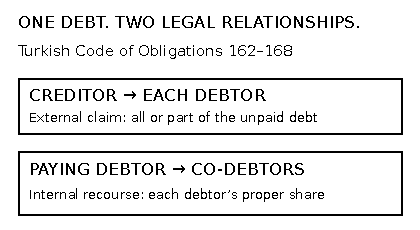
A joint and several debtor can face a claim for the whole unpaid debt even when the debtors agreed to divide the cost between themselves. Article 163 of the Turkish Code of Obligations permits the creditor to seek all or part of performance from all the debtors or from only one. Articles 167–168 govern a different question: the internal allocation after a debtor pays more than the share that debtor should bear. Understanding both relationships prevents two mistakes—treating an internal percentage as a defence automatically binding the creditor, and treating the paying debtor’s contribution claim as another unrestricted claim for the whole debt against any co-debtor.
Have a general question about this article? Ask anonymously
Article 162: establish why the debtors are jointly liable
Article 162 of Law No. 6098 provides that joint and several debt arises when each of several debtors declares acceptance of responsibility for the whole debt to the creditor. In the absence of such a declaration, solidarity arises only in cases provided by law. The existence of more than one name in a commercial file therefore does not, by itself, establish the same liability for every person.
Read the agreement for each participant’s capacity and undertaking. A person can sign as a principal debtor, corporate representative, surety, witness or approving officer. Those roles are not interchangeable. A parent company, subsidiary and director are not automatically one debtor merely because they share an address or trading name. Identify the contractual declaration or statutory provision relied on for the particular person’s responsibility.
The analysis also has to respect the substance of a natural person’s undertaking. Article 603 extends specified suretyship safeguards to other personal-security contracts given by individuals under different names. Calling someone a joint debtor should not be used as a shortcut around that issue where the transaction is substantively personal security. Our personal-security form guide addresses that separate classification.
The creditor’s external right is not divided into internal shares
Once joint and several liability is established, Article 163 gives the creditor a choice: seek the whole debt or part of it from all debtors or from one. The debtors remain responsible until the entire debt has been paid. The creditor’s external right therefore differs from the debtors’ internal arrangement concerning the ultimate economic burden.
A debtor who has agreed internally to bear a particular percentage should distinguish that agreement from any limitation accepted by the creditor. An internal allocation can be relevant to a later contribution claim without limiting the creditor’s right under Article 163. The documents should show whether the creditor actually agreed to a restriction on its claim, rather than merely being told how the debtors intended to divide costs.
There is nevertheless one underlying performance to be satisfied. The ability to pursue several debtors does not authorise recovery of the same unpaid amount repeatedly. The collection record should consolidate payments received from every source and identify the balance remaining. Separate enforcement files do not justify maintaining inconsistent totals that ignore payments already obtained for the same debt.
Article 164 separates personal defences from common defences
Under Article 164, a joint and several debtor can raise defences and objections arising from that debtor’s own personal relationship with the creditor, or from the cause or subject matter of the joint obligation. The provision does not give one debtor unrestricted access to every defence personal to another. Identify whose legal position generates the particular argument.
A defence concerning the existence, performance or subject matter of the common obligation belongs to a different category from a separate agreement between one debtor and the creditor. The precise classification matters when preparing a defence or deciding to pay. A debtor should obtain the underlying agreement and evidence of payments rather than assume the claim is established merely because another debtor has stopped responding.
Article 164 also states that a debtor who fails to assert common defences and objections is responsible towards the others. That internal consequence is important before paying a disputed demand. Preserve the evidence concerning the common defence and the steps taken to raise it. A contribution claim after payment should not ignore a co-debtor’s argument that the paying debtor unnecessarily failed to use an available common defence.
One debtor does not have unlimited power to worsen the others’ position
Article 165 provides that, unless law or contract stipulates otherwise, one debtor cannot aggravate the position of the other debtors through that debtor’s own conduct. This protects the distinction between individual acts and the shared obligation. It does not mean that every act concerning one debtor is legally irrelevant to the others: the statutory and contractual exceptions must still be considered.
A useful review identifies any acknowledgement, amendment, settlement, additional security or other document signed by only one participant. Determine the signatory’s capacity and whether there was authority to act for others. The fact that one debtor negotiated with the creditor does not establish that all debtors authorised a new undertaking on their behalf.
Limitation questions illustrate the need to identify the actual rule rather than generalise. Article 160 states that one joint debtor’s waiver of limitation cannot be asserted against the others. That specific protection must not be confused with separate statutory rules governing interruption of limitation. A file should record the exact act and the provision said to determine its effect.
Article 166: payment and set-off reduce the common exposure
When one debtor extinguishes all or part of the debt through performance or set-off, Article 166 releases the other debtors to the same extent. This is the principal reason a coordinated payment record is essential. The creditor’s remaining claim against the others must reflect the reduction in the common obligation.
For a payment, retain the bank record, recipient identity, payment description and the creditor’s allocation. A transfer to an unrelated account or an unallocated payment cannot simply be assumed to discharge the joint debt. Where several obligations exist, the payment-allocation rules must also be examined. Our payment allocation guide explains that issue separately.
For set-off, establish the mutual claims and the relevant declaration instead of relying solely on an accounting deduction. The set-off guide under Articles 139–145 addresses its conditions. Article 166 describes the effect of an effective set-off on co-debtors; it does not eliminate the need to establish that set-off occurred.
A release of one debtor is not the same as payment by that debtor
Article 166 separately addresses a debtor being released without performance. The others benefit only to the extent permitted by the circumstances or the nature of the obligation. Its final paragraph specifically provides that a release agreement between creditor and one debtor releases the other debtors in the amount of the released debtor’s internal participation share.
A negotiated release should therefore identify the debtor released, the debt concerned and the intended effect on the remaining participants. It should not be read as either an automatic discharge of everyone or a document necessarily having no effect on anyone else. The statutory distinction between payment, other release events and a release agreement must be preserved.
The internal allocation becomes relevant even though the creditor ordinarily has a whole-debt claim. The review needs the agreement or legal relationship establishing that share. A creditor settling with one participant should assess the effect on the residual claim before stating that the entire original balance remains recoverable from the others.
Article 167 determines the internal contribution burden
Unless otherwise agreed or indicated by the nature of the legal relationship between the debtors, Article 167 makes them responsible to one another in equal shares for performance made to the creditor. Equality is therefore a default, not an unalterable result. A contract or the nature of the relationship can establish a different allocation.
The paying debtor should first calculate the share that debtor must ultimately bear. Payment exceeding that share creates a right to seek the excess from the others. Article 167 limits recourse against each co-debtor to that co-debtor’s share. It is incorrect to take Article 163’s whole-debt creditor rule and automatically apply it to the subsequent internal contribution claim.
Prepare an allocation schedule identifying the common obligation, total performance, the basis of each participation share and the resulting contribution due. Distinguish that schedule from a creditor statement showing the external balance. One answers what the creditor has received; the other answers who should bear the payment internally. Both are necessary to avoid demanding contribution for an amount that remains the paying debtor’s own responsibility.
Unrecoverable contributions have their own allocation rule
Article 167’s final paragraph provides that an amount which cannot be recovered from one debtor is borne equally by the other debtors. That rule addresses a failure of recovery within the internal relationship. It should not be invoked merely because one participant has not replied to an informal request.
Document the unpaid contribution, the debtor responsible and the evidence supporting inability to recover it. The legal reviewer must distinguish a contested share from an amount established as unrecoverable. A disagreement over the underlying allocation is not resolved by immediately shifting the disputed amount to another participant.
Keep the original contribution calculation and any later redistribution separate. The records should show why the first amount was due and why the statutory secondary allocation is being invoked. This is particularly important where some debtors are abroad or different creditors have taken action against their assets: administrative difficulty alone should not be treated as a complete account of recoverability.
Article 168: subrogation supports recourse, not a windfall
Under Article 168, a debtor entitled to recourse against the others succeeds to the creditor’s rights in proportion to the amount performed. Subrogation connects the payer’s recovery position with the creditor’s rights. It must be read together with Article 167’s internal share limits; it does not convert every reimbursement demand into an unlimited claim against any co-debtor.
Obtain the documents evidencing the creditor’s claim, relevant security and payment. A receipt stating only that funds arrived can be insufficient to explain the rights said to have passed. Identify the obligation discharged and the scope of the claimed recourse before dealing with any ancillary right or security.
Article 168 also states that a creditor who improves one debtor’s position to the detriment of the others bears the consequences. A creditor’s dealings with one participant can therefore affect the wider relationship. The legal assessment should identify the actual act, detriment and statutory consequence instead of treating the creditor’s settlement as isolated from co-debtor rights.
A coordinated response for foreign co-debtors
International files need a clear distinction between governing law, jurisdiction and the substantive debt relationship. A person living outside Turkey does not cease to be a debtor simply because correspondence is inconvenient. Equally, the existence of Turkish assets does not alone determine every question about a foreign contract. Establish the applicable rules before applying Articles 162–168.
The core review package consists of the agreement creating joint liability, internal allocation documents, the creditor’s demands, payment and set-off records, any release, and all court or enforcement papers. List each legal person separately. Avoid sending only a consolidated group statement that obscures which company or individual signed the undertaking.
For a defending debtor, preserve both common and personal defences. For a paying debtor, settle the internal calculation and evidence before presenting a contribution demand. For a creditor, reconcile recoveries and evaluate any settlement’s effect on remaining claims. These are related tasks but they require different legal explanations and different documentary proof.
Frequently asked questions
Can the creditor demand the whole debt from only one joint debtor?
Yes. Once joint and several liability is established, Article 163 permits a claim for all or part of performance from all debtors or one. Actual recoveries must still be reflected in the remaining common balance.
Does an internal percentage agreement automatically bind the creditor?
No. The internal allocation and the creditor’s external right are separate. Identify any restriction actually accepted by the creditor before treating an internal share as a limit on the Article 163 claim.
Can I rely on a defence personal to another debtor?
Article 164 permits defences arising from your own relationship with the creditor and common defences concerning the debt’s cause or subject. It does not grant unrestricted reliance on another debtor’s purely personal defence.
What happens if one debtor pays part of the common debt?
Article 166 releases the other debtors to the extent of effective performance or set-off. The payment must be connected to the relevant obligation and included in the creditor’s consolidated balance.
Does releasing one debtor automatically release everyone?
Not in full merely because one release exists. Article 166 distinguishes release events and provides that a release agreement reduces the others’ obligation by the released debtor’s internal participation share.
Are contribution shares always equal?
Equal shares are Article 167’s default. A different agreement or the nature of the legal relationship can establish another allocation. The relevant basis must be identified before calculating recourse.
Can the paying debtor claim the whole excess from any one co-debtor?
Article 167 limits recourse against each co-debtor to that person’s share. Its separate rule for an unrecoverable contribution must not be confused with the creditor’s original whole-debt entitlement.
What does subrogation under Article 168 provide?
A debtor entitled to recourse succeeds to the creditor’s rights in proportion to performance. The entitlement operates with the internal allocation rules; it does not justify recovery exceeding the lawful recourse claim.
Does one debtor’s limitation waiver bind the others?
Article 160 states that one joint debtor’s waiver of limitation cannot be asserted against the others. Interruption of limitation is a different issue and must be examined under its own rules.
Is a joint debtor necessarily the same as a joint surety?
No. Principal joint liability and suretyship are different legal positions. The substance of the undertaking and Article 603’s safeguards for individual personal security must be examined rather than relying solely on the label.
Official statutory sources
Turkish Code of Obligations No. 6098, Articles 160 and 162–168, with Article 603 for the separate personal-security question. The official Ministry text, pages 31–32 contains the joint-debtor provisions. This English explanation does not replace the governing Turkish text.
Istanbul and Mersin offices
Bakırcı & Keskin Law Office coordinates Turkish matters from its Mersin and Istanbul offices. For an English-language co-debtor assessment, state whether you face collection or seek contribution after payment in the contact section. Mention any service or hearing date and agree a confidential document channel before sharing account records.
Istanbul — Polaris Plaza
Maslak Ahi Evran Caddesi, Polaris Plaza No:21, Floor 9, 34475 Sarıyer/İstanbul.
Mersin — Profit İş Merkezi
İhsaniye Mahallesi, 4903. Sokak, Profit İş Merkezi No:23, Floor 3, Office 14, 33070 Akdeniz/Mersin.
Call +90 552 224 43 66. General information; an enquiry does not appoint a lawyer or stop a legal deadline.
Contact regarding a legal matter
In your first message, you may briefly state the subject, your country or city, and any relevant notification or recent procedural date. Please do not send identity numbers, medical data, or personal documents. Messaging alone does not constitute legal advice or create a lawyer–client relationship.
Discover more from Bakırcı & Keskin Hukuk Bürosu
Subscribe to get the latest posts sent to your email.