Conditional Contracts in Turkey: Conditions Precedent, Termination and TCO 170–176
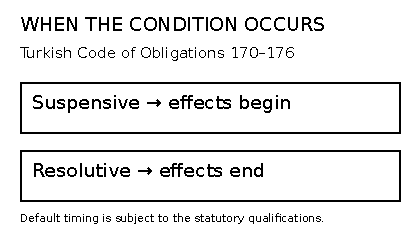
A contractual condition determines whether a legal effect begins or ends when an uncertain event occurs. Under Article 170 of the Turkish Code of Obligations, a suspensive condition postpones the contract’s effects until the condition occurs, unless otherwise agreed. Article 173 regulates the opposite structure: a resolutive condition brings existing contractual effects to an end. Articles 171–176 address the pending period, benefits obtained before fulfilment, succession, bad-faith interference and unlawful conditions. These rules matter when a Turkish transaction depends on an approval, completion step or other identified event. The first task is to read the clause’s legal consequence, not simply search for the English phrase “subject to”.
Have a general question about this article? Ask anonymously
A condition is more than an ordinary performance obligation
A contract can require a party to deliver documents, pay a price or obtain cooperation without making the contract’s legal effects conditional on the event. It can also prescribe an ordinary payment date. Those arrangements should not automatically be classified as conditions under Articles 170–176. The relevant question is what legal effect the parties attached to the uncertain event.
Article 19 of Law No. 6098 directs attention to the parties’ actual common intention when determining and interpreting contractual content. A heading or translated label is therefore only part of the analysis. Read the operative clause with the definitions, payment provisions, completion mechanics and termination provisions.
This distinction changes the remedy sought. Failure to perform an existing obligation can raise breach questions. Failure of an event on which effects depend raises a conditional-obligation question. The same transaction can contain both a cooperation duty and a condition, but the reviewer must identify each separately. Treating every unmet commercial expectation as a failed condition bypasses that necessary classification.
Article 170: suspensive conditions and the beginning of effects
Article 170 describes a contract whose effects are made dependent on an event whose occurrence is uncertain. Unless otherwise agreed, the contract produces its effects from the moment that event occurs. In English transactional language, this is commonly discussed as a suspensive condition or condition precedent, but the Turkish statutory classification remains the relevant legal test.
Identify the event objectively and record how its occurrence is established. A clause should make clear whether it refers to the making of an application, the issue of a decision, receipt of an approval or another specified stage. Those stages are not necessarily the same event. A document showing that an application was lodged does not prove that an approval identified by the contract was obtained.
The default timing is also important. Article 170 does not automatically give the contract retrospective effect from the original signing date when the condition later occurs. A different agreement must be identified rather than presumed. The effective-date clause and any provision allocating benefits or expenses before completion should be read together.
The pending period is not a period without legal duties
Article 171 requires the debtor, until fulfilment of the condition, to refrain from conduct that would prevent proper performance of the obligation. The pending condition therefore does not provide unrestricted freedom to destroy the practical possibility of performance. A party’s conduct during that interval can matter even though the principal conditional effect has not yet begun.
The documents should identify the asset, performance or transaction that must remain capable of fulfilment. Preserve notices concerning access, delivery, documents and cooperation. A record showing what each party controlled is more useful than a general accusation that the other side delayed matters. The relevant obligation and the allegedly obstructive conduct must be connected.
Separate an agreed positive cooperation duty from Article 171’s statutory restraint on conduct preventing proper performance. The contract can specify who must submit documents, pursue an approval or provide information. The review should identify the source of each duty instead of treating every desirable commercial step as an express obligation of the other party.
Protective measures and intervening dispositions under Article 171
Article 171 allows a creditor whose conditional right is endangered to take the measures available to creditors of unconditional claims for protection of their rights. The provision recognises a protectable position during the pending period. It does not require the creditor to ignore a demonstrated threat solely because the condition has not yet occurred.
The particular measure still needs a proper procedural basis, supporting facts and the requirements applicable to it. A statement in correspondence that the creditor reserves its rights is not itself a court order. Identify the threatened right, the act creating the risk and the protection actually requested. Evidence preservation and a measure restricting disposition are different procedural objectives.
The final paragraph states that dispositions made before fulfilment are ineffective to the extent they impair the effects of the condition. The limiting words matter. The article should not be paraphrased as invalidating every act during the pending period regardless of its connection with the conditional right. A dispute requires examination of the actual disposition, the conditional effect and the degree of impairment.
Article 172: benefits from an item delivered before fulfilment
A conditional arrangement can involve delivery of the subject item before the condition occurs. Article 172 addresses the benefits obtained during that interval. If the condition occurs, the creditor to whom the item was delivered becomes entitled to the benefits obtained until fulfilment. If the condition does not occur, the creditor must return the benefits obtained.
This rule makes the pre-completion handover record important. Identify when possession or use began, what was delivered and the benefits actually obtained. Keep the relevant income or use records rather than relying on an undifferentiated final settlement total. The statutory question concerns the benefits from the delivered item during the identified period.
Delivery itself does not establish that the condition occurred. Article 172 expressly contemplates delivery while the condition remains pending. A party should therefore not treat possession, access or a handover receipt as conclusive proof that every conditional requirement was satisfied. The delivery record and proof of the contractual event answer different questions.
Article 173: resolutive conditions and the ending of effects
A resolutive condition makes termination of a contract depend on an event whose occurrence is uncertain. Under Article 173, the contract’s effects cease when the condition occurs. Unlike the Article 170 structure, the contract already has effects before that event. The distinction is between a condition that starts effects and one that ends them.
Unless otherwise agreed or indicated by the nature of the transaction, the ending does not operate retrospectively. An explanation that every resolutive condition automatically erases the entire contractual history would therefore be inaccurate. The agreement and the transaction’s nature must be considered when determining the treatment of earlier performance.
Record the exact event and its date, then identify the obligations affected. The parties’ settlement of advances, completed work, confidential information or delivered property can require examination of other provisions. Article 173 supplies the conditional ending rule; it does not by itself provide a complete accounting mechanism for every commercial handover.
Article 175 prevents a party from manipulating fulfilment in bad faith
The first paragraph of Article 175 states that if a party prevents fulfilment contrary to good faith, the condition is treated as fulfilled. The second paragraph deals with the reverse: if a party brings about fulfilment contrary to good faith, the condition is treated as not fulfilled. Both directions are essential to an accurate explanation of the provision.
The rule is not triggered merely by disappointment with the result. Identify the conduct, the party responsible, the relationship between that conduct and the event, and why the conduct conflicts with good faith. Correspondence, submission records, refusal letters and internal instructions can be relevant, but they must be obtained and used lawfully.
Where an independent authority or third party decides the event, distinguish that decision from the contracting party’s conduct. An unfavourable external decision does not, without supporting facts, establish that the other party wrongfully prevented fulfilment. Conversely, involving a third party does not remove the need to examine deliberate obstruction by a contracting party. The factual chain is what allows the statutory test to be applied.
Succession under Article 174 and prohibited conditions under Article 176
Article 174 addresses a condition involving conduct that need not be performed personally by one party. If that party dies, the heir can take that party’s place. The provision turns on whether personal performance of the conduct is necessary. It should not be expanded into a claim that every approval, qualification or contractual role automatically transfers to heirs.
Article 176 concerns a condition imposed to procure an act or omission contrary to law or morality. The legal transaction subject to that condition is absolutely void. This is not merely a scheduling problem or a condition awaiting further evidence. The purpose and legal character of the condition must be examined before relying on it to compel performance.
A private clause also does not replace a public authority’s legally required permission. The contractual consequences of an approval clause and compliance with the legislation governing the approval are separate questions. When reviewing a regulated transaction, identify the applicable special rules in addition to the general conditional-obligation provisions.
Document the condition in a usable completion record
A focused condition schedule should identify the event, the evidence of occurrence, the party responsible for any agreed cooperation, the relevant date and the contractual consequence. Where several requirements exist, record whether the wording makes them cumulative or alternative. A list of completed administrative tasks is not enough if it does not correspond to the actual legal conditions.
Keep the original wording and all amendments. A later email proposing to remove or alter a condition requires assessment as an amendment, including authority and any applicable form requirement. It should not be treated as effective simply because a commercially involved employee sent it. The representation and ratification guide explains that separate issue.
The handover should also record any advance, benefit or security delivered before the condition occurred. The contract transfer guide is relevant where the conditional transaction changes a contractual party. The novation guide addresses replacement of a debt. Neither legal result follows merely from calling the transaction conditional.
Preparing a dispute without inventing a fulfilment date
The evidence should support the date actually relied on. Separate signing, application, approval, notification, delivery and payment dates. Explain which one corresponds to the event stated in the condition. A chronology that merges those dates can wrongly shift the beginning or ending of contractual effects and obscure the period relevant to benefits or protective measures.
For electronic communications, retain the complete exchange and source records rather than selected screenshots alone. Our WhatsApp and email evidence guide explains the evidential review. A message stating that completion is expected is not the same thing as proof that the specified event occurred.
Finally, identify the remedy actually sought: recognition of effects, performance, protection during the pending period, return of benefits or consequences of a prohibited condition. A served court or enforcement document has its own response requirements. Contractual disagreement does not suspend those requirements, and a message to the other party should not be mistaken for a procedural filing.
Frequently asked questions
When does a suspensive conditional contract take effect?
Under Article 170, effects begin when the condition occurs unless otherwise agreed. Identify the event stated in the contract and the evidence establishing its occurrence.
Is every unpaid obligation a failed condition?
No. An existing performance obligation and a condition controlling contractual effects are different concepts. The complete wording and the parties’ actual common intention determine the classification.
Can a debtor obstruct performance while the condition is pending?
Article 171 requires the debtor to refrain from conduct preventing proper performance until fulfilment. The pending condition is not permission to undermine the obligation.
Can a conditional creditor seek protection before fulfilment?
Article 171 permits protective measures available to unconditional creditors when the conditional right is endangered. The particular measure still requires its applicable procedural conditions and supporting evidence.
Does delivery prove that the condition was fulfilled?
No. Article 172 expressly addresses delivery before fulfilment. The handover and the occurrence of the condition must be proved separately.
Who keeps benefits obtained before the condition occurs?
Article 172 entitles the recipient creditor to those benefits if the condition occurs. If it does not occur, the creditor must return the benefits obtained.
Does a resolutive condition always operate retrospectively?
No. Article 173 provides for non-retrospective ending unless otherwise agreed or indicated by the transaction’s nature. The event and the treatment of earlier performance must be examined separately.
What if a party wrongfully prevents fulfilment?
Under Article 175, prevention contrary to good faith causes the condition to be treated as fulfilled. Wrongfully procuring fulfilment produces the reverse result: it is treated as not fulfilled.
What is the effect of a condition designed to procure unlawful conduct?
Article 176 makes the legal transaction absolutely void where the condition aims to procure an act or omission contrary to law or morality.
What should be included in a condition-review file?
Include the full agreement, amendments, event evidence, dated correspondence, pre-completion delivery records and any served proceedings. Clearly distinguish the signing date from the event that starts or ends effects.
Official sources
Turkish Code of Obligations No. 6098, Articles 19 and 170–176. The official Ministry text, pages 33–34 contains the conditional-obligation provisions. This English guide is explanatory; the Turkish statutory text governs.
Istanbul and Mersin offices
For an English-language review of a condition clause, state the event, its current status and any approaching completion date in the contact section. Bakırcı & Keskin Law Office is Mersin-based and coordinates Turkish matters from Mersin and Istanbul. Agree a confidential channel before sharing the transaction documents.
Istanbul — Polaris Plaza
Maslak Ahi Evran Caddesi, Polaris Plaza No:21, Floor 9, 34475 Sarıyer/İstanbul.
Mersin — Profit İş Merkezi
İhsaniye Mahallesi, 4903. Sokak, Profit İş Merkezi No:23, Floor 3, Office 14, 33070 Akdeniz/Mersin.
Call +90 552 224 43 66. General information; an enquiry does not establish a mandate or suspend legal time limits.
Contact regarding a legal matter
In your first message, you may briefly state the subject, your country or city, and any relevant notification or recent procedural date. Please do not send identity numbers, medical data, or personal documents. Messaging alone does not constitute legal advice or create a lawyer–client relationship.
Discover more from Bakırcı & Keskin Hukuk Bürosu
Subscribe to get the latest posts sent to your email.