Contract Hardship in Turkey: Adaptation, Reserved Performance and TCO Article 138
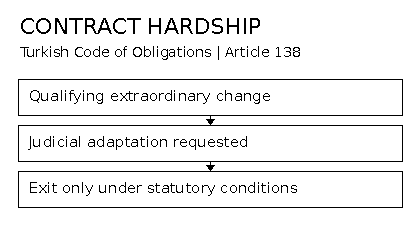
Higher costs do not automatically allow a party to rewrite a Turkish contract. Article 138 of the Turkish Code of Obligations provides a judicial adaptation remedy when an extraordinary change satisfies several cumulative conditions. The situation must have been unforeseen and not reasonably expected to be foreseen at conclusion, must arise for a reason not originating from the debtor, and must alter the original circumstances so seriously against that debtor that demanding performance would conflict with good faith. The debtor must also have left the obligation unperformed or performed while reserving the rights arising from excessive difficulty. The provision expressly extends to foreign-currency debts.
Have a general question about this article? Ask anonymously
The starting point is the bargain actually concluded
Hardship review begins with the original agreement, not with a general description of current economic conditions. Identify the promised performance, price, currency, duration, delivery arrangements and risk allocation. The comparison required by Article 138 concerns the facts existing when this particular contract was made and the later change affecting its performance. A loss-making account alone does not describe that comparison.
Retain the dated agreement, quotations, specifications and relevant negotiation documents. They show the commercial assumptions against which the alleged extraordinary event is assessed. A later internal budget prepared after prices changed is not the same evidence as a costing used when the parties committed themselves. Keep both records, but identify their dates and purposes accurately.
The statutory basis is Law No. 6098, Article 138. A dispute over what the parties originally agreed is a prior interpretation question under Article 19. The hardship remedy should not be used to avoid first establishing the contract’s actual scope, particularly where the alleged additional cost results from a disputed change in quantity or specification rather than an external development.
Extraordinary circumstances must pass the foreseeability test
Article 138 requires an extraordinary situation that the parties did not foresee and were not expected to foresee at conclusion. These are connected but distinct aspects of the test. A party’s assertion that it personally failed to consider a risk is not the same as establishing that the risk was outside what the parties were expected to anticipate.
The timing of the agreement matters. Identify what information existed at signature and distinguish it from information that emerged later. Published market data, supplier communications and the negotiating record can help establish that chronology. The claim should explain the particular change rather than simply attach a list of adverse events that occurred somewhere during the contractual relationship.
The statute does not prescribe a universal percentage increase that automatically establishes hardship. A price movement must be connected with the contractual obligation and the remaining statutory conditions. The legal assessment cannot be replaced by an unsupported rule that a cost increase above a chosen number always entitles the debtor to a corresponding price increase.
The change must not originate from the debtor
A further condition is that the extraordinary situation arises for a reason not originating from the debtor. The file should distinguish the external development from decisions or omissions within the debtor’s own performance arrangements. It should explain why the claimed excessive burden is attributed to the qualifying change rather than merely to an inaccurate original estimate.
Prepare a causal account supported by documents. Identify what changed, when it changed and how it affected the specific cost or obligation. A contractor’s financial difficulty, a buyer’s reduced revenue or a company’s general liquidity problem does not, without that analysis, identify the reason required by Article 138.
This is not an invitation to conceal unfavourable facts. The agreement’s risk provisions, available alternatives and the debtor’s conduct need to be examined together. A reliable assessment separates the effect of the external event from unrelated business losses. That separation is necessary both for deciding whether a claim is available and for explaining the adjustment actually requested.
The threshold concerns good faith, not ordinary inconvenience
The change must alter the circumstances existing at conclusion against the debtor to a degree that demanding performance conflicts with good faith. Article 138 therefore asks more than whether performance has become less attractive. The financial and operational evidence must address the seriousness of the changed burden in the context of the contract.
A useful comparison records the original obligations and the remaining obligations, the original cost basis and the supported current cost, and the contractual mechanism already governing adjustment. Separate taxes, quantity changes, additional work and exchange-rate effects rather than combining everything in an unexplained final figure. This makes it possible to examine which element is said to justify adaptation.
The other party’s position is also relevant to the proposed solution. A request for adaptation should identify the revised term sought and explain how it responds to the demonstrated change. Demanding every commercial concession available is not the same as presenting a reasoned request to adapt a contract to new conditions under the statute.
Performance and reservation of rights are express conditions
Article 138 requires that the debtor has not yet performed, or has performed while reserving the rights arising from the excessive difficulty of performance. This part of the provision should be checked immediately, not treated as an administrative detail to be considered after the last payment. The file needs an accurate record of what has already been performed.
Where performance continued, retain the reservation relied on, its wording, date, addressee and evidence of communication. The reservation should be assessed in relation to the particular obligation and the excessive-difficulty rights being asserted. An unrelated complaint in earlier correspondence does not necessarily establish the reservation described by Article 138.
Do not assume that a later demand retroactively supplies a missing reservation for completed performance. Equally, a document review should not overlook a qualifying reservation merely because it appeared in a notice rather than on a payment receipt. The legal task is to establish the actual reservation and its relationship with performance, not to apply an invented universal formality.
The statute’s recognition of unperformed obligations does not amount to a blanket instruction to stop paying. A unilateral refusal to perform creates its own contractual and procedural risks. Before deciding what to do with an approaching payment or delivery, identify the available claim, the current demand and any necessary protective procedural step.
The primary statutory route is judicial adaptation
When the requirements are satisfied, Article 138 gives the debtor the right to ask the judge to adapt the contract to the new conditions. It does not make the debtor the final decision-maker on a replacement price. Sending a revised invoice, reducing a transfer or publishing a new tariff does not itself establish a judicially adapted obligation.
A properly framed request identifies the provision to be adapted, the change sought and the evidential basis for that change. The claim should distinguish future performance from completed performance and explain the reservation position where relevant. Without that structure, an assertion of hardship can leave the actual relief unclear even when substantial documents have been supplied.
The parties can also negotiate a consensual amendment. Any agreement reached should identify what changes, the effective date and the obligations preserved. A negotiated amendment is not proof that a court has already found Article 138 satisfied. The guide to novation and repayment agreements explains why changing terms must also be distinguished from extinguishing and replacing an existing debt.
Withdrawal or termination is not the first automatic result
Article 138 permits withdrawal where adaptation is not possible. For contracts involving continuing performance, the debtor ordinarily exercises termination rather than withdrawal. The statutory sequence and this distinction should remain visible in the legal analysis. A claim that hardship immediately cancels every contract misstates the provision.
Identify whether the relationship involves continuing performance and what has already been exchanged. The consequences of ending the relationship require examination of the contract, the applicable legal route and the performance record. Article 138 should not be turned into a promise that all earlier payments will necessarily be recovered or all future exposure will disappear.
A termination notice also needs a clear legal basis. The fact that negotiations failed does not itself establish that statutory adaptation was impossible. The review should address the conditions for the chosen exit remedy and any disputed consequences, rather than treating the word hardship as a complete explanation for ending the relationship.
Foreign-currency debt is included, but the conditions remain
The final sentence of Article 138 expressly states that the provision applies to foreign-currency debts. A debt expressed in euros, dollars or another foreign currency is therefore not excluded merely because of its denomination. At the same time, the sentence does not remove the cumulative conditions in the preceding paragraph.
Record the agreed currency, payment arrangement, contract date, relevant exchange-rate evidence and any clause allocating currency risk. Distinguish a currency conversion calculation from a request to adapt the underlying obligation. A party cannot establish the statutory result simply by showing that the amount has a different local-currency equivalent at a later date.
International contracts require a preliminary governing-law analysis. The presence of a Turkish party or Turkish bank account does not alone settle the law applicable to every obligation. Our international-contract governing-law guide explains that separate step. Article 138 should be applied only after the relevant Turkish-law basis is identified.
Fixed-price works contracts require the separate Article 480 review
Article 480 starts with a specific rule: a contractor who agreed a fixed price must produce the work for that price and cannot demand an increase merely because it required more labour or expense than expected. The customer’s obligation also remains the agreed price where the work required less labour or expense. The parties’ chosen pricing structure therefore matters.
The second paragraph contains a particular adaptation route. Where circumstances initially unforeseen, or foreseeable but not taken into account by the parties, prevent production at the fixed price or make it extremely difficult, the contractor can request judicial adaptation. If adaptation is impossible or cannot be expected from the other party, withdrawal is available; where good faith requires, only termination is available.
This wording should not be silently replaced with the different wording of Article 138. A works-contract file needs classification of the price, the work and the relevant circumstances before choosing the statutory route. Our unfinished renovation guide addresses related performance and advance-payment issues without replacing the fixed-price analysis.
Hardship, impossibility and a condition are different issues
Article 136 concerns performance becoming impossible for a reason for which the debtor cannot be held responsible. Article 137 addresses partial impossibility. Article 138 concerns excessive difficulty and adaptation. A claim that performance became expensive does not establish the same legal event as performance becoming impossible.
A contractual condition is different again: its specified event controls the beginning or ending of effects. The conditional-contracts guide explains that structure. The label force majeure, hardship or condition should not substitute for identifying the facts, contractual clause and statutory provision that support the particular consequence sought.
Documents and immediate procedural checks
Provide the full contract, amendments, original cost or pricing records, evidence of the later event and a comparison explaining its specific impact. Add performance records, reservations, notices and the proposed adjustment. Keep the original currencies, units, dates and quantities visible so that an apparent change is not merely the result of comparing unlike figures.
Include every served claim, payment order or termination notice with its delivery record. A request to renegotiate does not by itself constitute the procedural response required by a court or enforcement document. The enforcement guide for international clients explains why the procedural route and deadlines must be assessed separately.
Frequently asked questions
Does every price increase justify adaptation in Turkey?
No. Article 138 requires an extraordinary qualifying change, the statutory foreseeability and responsibility conditions, a good-faith threshold and the relevant performance or reservation position. It does not set an automatic percentage trigger.
Can I set a new price unilaterally under Article 138?
Article 138 provides a right to request judicial adaptation. It does not itself authorise the debtor to impose a new contractual price through an invoice or payment deduction.
Can a debtor who already performed rely on the provision?
The statute covers performance made while reserving the rights arising from excessive difficulty. The reservation and its connection with the performance must be established from the actual record.
Must the extraordinary event originate outside the debtor?
Article 138 requires a reason not originating from the debtor. The evidence must distinguish that cause from unrelated losses, inaccurate estimates or the debtor’s own performance decisions.
Are foreign-currency debts excluded?
No. Article 138 expressly applies to foreign-currency debts. The denomination does not eliminate the remaining statutory conditions or automatically establish entitlement to a different exchange rate.
Does hardship immediately end the contract?
No. The provision first addresses adaptation and permits withdrawal where adaptation is impossible. Continuing-performance contracts ordinarily involve termination rather than withdrawal.
Is hardship the same as impossibility?
No. Articles 136–137 address total or partial impossibility. Article 138 addresses excessive difficulty and its adaptation framework. The event and remedy must be classified separately.
Can a fixed-price contractor demand every additional cost?
Article 480 starts from the agreed fixed price despite additional labour or expense. Its second paragraph provides a distinct qualifying adaptation route, not an unrestricted right to pass all extra costs to the customer.
Does a renegotiation request suspend a legal deadline?
Not by itself. Identify the served document, its service date and the required procedural response. Negotiations and protection of procedural rights must be handled separately.
What evidence should accompany a hardship review?
The contract, original pricing basis, later-event evidence, quantified impact, performance records, reservations and notices are central. Include the proposed adjustment and any served proceedings.
Official legal sources
Turkish Code of Obligations No. 6098, Articles 19, 136–138 and 480. The official Ministry text, page 27 contains Article 138; page 97 contains Article 480. This is an explanatory English guide; the Turkish statutory text governs.
Istanbul and Mersin offices
For an English-language hardship assessment, identify the contract date, changed circumstance, outstanding performance and any reservation through the contact section. Bakırcı & Keskin Law Office coordinates Turkish matters from Mersin and Istanbul. Arrange a confidential channel before sending pricing records.
Istanbul — Polaris Plaza
Maslak Ahi Evran Caddesi, Polaris Plaza No:21, Floor 9, 34475 Sarıyer/İstanbul.
Mersin — Profit İş Merkezi
İhsaniye Mahallesi, 4903. Sokak, Profit İş Merkezi No:23, Floor 3, Office 14, 33070 Akdeniz/Mersin.
Call +90 552 224 43 66. General information; an enquiry does not appoint a lawyer or suspend a deadline.
Contact regarding a legal matter
In your first message, you may briefly state the subject, your country or city, and any relevant notification or recent procedural date. Please do not send identity numbers, medical data, or personal documents. Messaging alone does not constitute legal advice or create a lawyer–client relationship.
Discover more from Bakırcı & Keskin Hukuk Bürosu
Subscribe to get the latest posts sent to your email.