Mistake in Turkish Contracts: Essential Errors, Translation and TCO Articles 30–35
Turkish law distinguishes an essential mistake at contract formation from a simple calculation error or a disappointed commercial expectation. Article 30 of the Turkish Code of Obligations states that a party acting under an essential mistake when the contract is concluded is not bound. Articles 31–33 identify important categories, including mistakes in the declaration, qualifying mistakes in motive and incorrect transmission through a messenger or translator. Articles 34–35 impose good-faith limits and address the mistaken party’s fault. Article 39 adds a one-year period running from discovery. A useful review begins by identifying the actual error and the intended transaction rather than treating every unfavourable signed term as a mistake.
Have a general question about this article? Ask anonymously
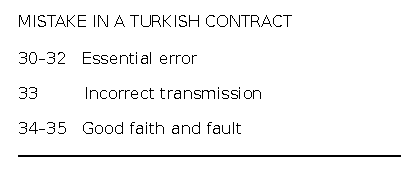
The mistake must concern formation, not simply later disappointment
Article 30 addresses the state of the party when the contract was concluded. The relevant comparison is between the transaction intended and the declaration or factual assumption on which agreement was reached. A later fall in profitability does not by itself establish that the party was mistaken at formation.
Preserve the proposal, instructions, draft exchanges and final signed version. These records help establish the intended contract and the declaration actually made. A statement prepared after a dispute began should be distinguished from a contemporaneous instruction showing what the party meant to approve. The original documents remain important even where the parties used a translator or intermediary.
The primary framework is Law No. 6098, Articles 30–35 and 39. A contract dispute should identify the particular statutory category before deciding what notice or claim to make. The fact that the document is in a foreign language is relevant context, not an automatic statutory finding that consent was defective.
Article 31 identifies essential mistakes in the declaration
The first listed category concerns declaring an intention to enter a contract different from the one intended. The second concerns declaring an intention about a different subject. Those rules require a precise account of the intended legal transaction or subject matter. Merely saying that the agreement was not what the person expected leaves the statutory comparison incomplete.
The third category concerns directing the declaration to someone other than the person with whom the party actually intended to contract. The fourth addresses contracting with a person other than the one considered because of particular qualities. Identity and relevant qualities must therefore be identified from the transaction rather than inferred from a later preference for another commercial partner.
The fifth category concerns a declaration accepting a substantially greater performance burden, or substantially less counterperformance, than was actually intended. The statutory wording requires a significant difference. The relevant quantities, price terms and intended exchange should be documented so that the argument is not reduced to a general complaint that the bargain was expensive.
Simple arithmetic errors are corrected rather than invalidating the contract
Article 31 expressly states that simple calculation mistakes do not affect the contract’s validity and that correction is sufficient. This is a distinct rule. A wrong total produced from agreed figures should not automatically be treated as the same issue as a genuinely different declaration about the obligation undertaken.
Retain the underlying figures, formula, units and original schedule. Identify which component is said to be wrong: the agreed input, the operation performed or the resulting total. A calculation can only be corrected coherently once the figures that were actually agreed have been established.
Do not silently amend an executed record and present it as though it were the original. Preserve the original and the proposed correction separately. The statutory availability of correction does not justify altering evidence. Any revised record should accurately show what was changed and why.
Article 32 treats mistakes in motive differently
The starting rule in Article 32 is that a mistake in motive is not an essential mistake. A party’s personal reason for wanting the transaction therefore does not automatically become a condition of contractual validity. The distinction prevents every disappointed subjective expectation from being turned into a right to reject an otherwise agreed bargain.
The article provides a qualification. The mistake can be essential where the mistaken party regarded the relevant motive as the basis of the contract and treating it that way accords with the good-faith rules applicable in business dealings. The other party must also have been in a position to know of that situation.
Identify the particular assumed fact and the evidence showing its foundational role. Record what was communicated to the other side and why that side could recognise its importance. An undisclosed personal calculation should not be described as a jointly understood contractual foundation without supporting evidence.
This analysis is separate from a later extraordinary change in circumstances. Our hardship and adaptation guide addresses Article 138. A fact misunderstood at conclusion and a circumstance changing afterwards have different statutory starting points.
Article 33 covers incorrect transmission by a messenger or translator
Article 33 applies the mistake rules when the intention concerning formation is incorrectly transmitted by an intermediary such as a messenger or translator, or by a means of communication. The provision recognises that the declaration reaching the recipient can differ from the intention transmitted by the party.
For a translation issue, retain the source-language wording, the translation actually used and the evidence of what the recipient received. Identify the precise difference and its effect on the declared obligation. A general assertion that the translation was poor is less informative than identifying the term, quantity, identity or legal effect transmitted incorrectly.
The translator’s involvement does not make every contract automatically void. Article 33 refers back to the mistake framework. The nature and significance of the transmitted error, the good-faith limits and the timely exercise of rights still need examination.
Distinguish inaccurate transmission from a representative acting without authority. In one case the issue is the message conveyed; in the other the issue is the power to bind another person. The unauthorised-representation guide explains the latter. Both can arise in an international file, but their legal elements should not be conflated.
Article 34 prevents reliance on mistake contrary to good faith
Article 34 states that the mistaken party cannot invoke the mistake contrary to good faith. Identifying a discrepancy is therefore not the end of the legal assessment. The proposed use of the mistake argument and the other party’s response must also be considered.
The second paragraph gives a specific consequence: if the other party declares willingness to conclude the contract in the sense intended by the mistaken party, the contract is treated as having been concluded in that sense. The law therefore addresses the possibility of preserving the intended bargain rather than necessarily ending the relationship.
Record the precise terms of such a response. Agreement to the intended meaning is different from an unrelated commercial compromise. A person cannot accurately explain the case without considering whether the counterparty offered the actual transaction that the mistaken party says it wanted.
The mistaken party’s own fault can create compensation exposure
Article 35 provides that a party at fault in its mistake must compensate the damage arising from the contract’s ineffectiveness. It also provides an exception: compensation cannot be requested where the other party knew or should have known of the mistake. The right to rely on mistake and the potential responsibility for resulting loss are therefore separate questions.
The file should identify how the error occurred and what the other party knew. Preserve instructions, checking records and the communications surrounding execution. The analysis should not assume either that every mistaken signature is careless or that a party invoking an essential mistake can never owe compensation.
The second paragraph allows the judge, where equity requires, to award further compensation without exceeding the benefit expected from performance. This statutory qualification must be kept distinct from a promise that all expected contractual profit is automatically recoverable. The actual loss, the legal conditions and the statutory limit require examination.
Article 39 runs from learning of the mistake
A party who contracted because of mistake is treated as having approved the contract if, within one year from learning of the mistake, it neither notifies the other side that it is not bound nor asks for return of what it gave. The discovery date is therefore a central factual issue.
Record how the discrepancy was identified and the documents showing when the party learned of it. A later expert explanation does not necessarily mean the error was first discovered on that later date. Earlier correspondence revealing the same issue must be considered when assessing the chronology.
Article 39 should not be paraphrased solely as a universal one-year lawsuit deadline. It identifies notification of the non-binding position or a request for return. A notice should state the contract and the supported mistake clearly, while any separate court or enforcement response is prepared under the relevant procedural rules.
Mistake is not the same as deception, duress or non-performance
Deception is governed by Article 36 and does not require the same fundamental-mistake threshold. Duress is addressed by Articles 37–38. The deception and duress guide explains those different grounds. A notice should not accuse the counterparty of intentional deception merely because the sender has identified an error.
Failure to carry out an agreed obligation is also distinct from misunderstanding at formation. The impossibility guide concerns a later inability to perform under different statutory conditions. The correct classification depends on the facts, not on a preference for a particular cancellation route.
Where multiple issues exist, maintain a separate explanation for each. Identify the formation error, any misleading conduct and any later breach without treating them as synonyms. This permits the legal reviewer to assess the available grounds and their consequences coherently.
What foreign parties should put in the review file
Provide every executed language version, the version negotiated, source instructions and the document containing the alleged discrepancy. Identify the exact words or figures at issue. Include the translation used at execution, not only a fresh translation prepared after the dispute, because the earlier version is part of the formation evidence.
Explain the intended transaction in a short factual statement tied to contemporaneous records. Keep it separate from legal conclusions. The reviewer should be able to compare what was intended, what was communicated, what was signed and what the other party understood without reconstructing the chronology from unlabelled screenshots.
For messages and email, preserve complete records and attachments lawfully. Our electronic-evidence guide addresses authenticity and original records. Altering or selectively rebuilding a conversation can create an additional problem unrelated to the original contractual mistake.
Match the legal position with the practical remedy
A declaration that a party is not bound does not itself move money, correct a register or stop a pending proceeding. Identify the desired outcome and the assets or documents involved. Correction of arithmetic, preservation of the intended bargain, return of performance and a defence to collection are different practical tasks.
Include any payment order, summons, judgment or demand and its service record. The contract argument must be raised through the appropriate mechanism where proceedings exist. An ongoing translation review should not be treated as an assumed suspension of a response deadline.
In a cross-border transaction, establish the applicable law before applying these Turkish provisions. The governing-law guide explains that preliminary issue. A foreign nationality or place of signature does not alone settle the legal effect of the alleged mistake.
Frequently asked questions
Does any misunderstanding release a party from a Turkish contract?
No. Article 30 requires an essential mistake at conclusion, with the categories and qualifications in Articles 31–35. Timely action under Article 39 must also be considered.
What happens to a simple arithmetic error?
Article 31 says simple calculation errors do not affect validity and are corrected. Identify the agreed inputs and the calculation error rather than assuming the whole bargain can be rejected.
Is a mistake about my personal motive always essential?
No. Article 32 starts with the opposite rule. Its exception requires a contractual foundation consistent with good faith and recognisable to the other party.
Can an inaccurate translation fall within the mistake rules?
Yes. Article 33 applies the framework where formation intent is incorrectly transmitted by a translator, messenger or other means. The actual error and remaining legal requirements must be established.
What if the other party accepts exactly what I intended?
Article 34 treats the contract as concluded in that intended sense when the other party declares acceptance of it. The response must correspond to the asserted intended bargain.
Can I owe compensation for my own mistake?
Article 35 imposes compensation for resulting damage where the mistaken party was at fault, unless the other side knew or should have known of the mistake. The provision also contains an equity-based qualification.
When does the Article 39 period start for mistake?
It starts when the affected party learns of the mistake. The discovery chronology must be supported by the documents rather than automatically equated with signing or a later legal consultation.
Is a mistake claim an accusation of fraud?
Not necessarily. Mistake and deception have different statutory elements. Identify the supported facts before alleging intentional misconduct by the counterparty.
Should the original translation be discarded after correction?
No. Retain the translation actually used, the source text and the later correction separately. The execution-stage version is important evidence of what was communicated.
Does sending a complaint automatically stop enforcement?
No. The substantive mistake argument and the procedural response to an enforcement or court document are separate. Review the full document and service date promptly.
Official legal sources
Law No. 6098, Articles 30–35 and 39; official Ministry text, pages 6–7. This English discussion explains the statutory framework; the Turkish text controls.
Istanbul and Mersin offices
For an English-language mistake assessment, identify the disputed term, the intended meaning and the discovery date in the contact section. Bakırcı & Keskin Law Office coordinates matters from Mersin and Istanbul. Agree a confidential channel for original contracts and translations.
Istanbul — Polaris Plaza
Maslak Ahi Evran Caddesi, Polaris Plaza No:21, Floor 9, 34475 Sarıyer/İstanbul.
Mersin — Profit İş Merkezi
İhsaniye Mahallesi, 4903. Sokak, Profit İş Merkezi No:23, Floor 3, Office 14, 33070 Akdeniz/Mersin.
Call +90 552 224 43 66. General information; an enquiry does not preserve a deadline or create a mandate.
Contact regarding a legal matter
In your first message, you may briefly state the subject, your country or city, and any relevant notification or recent procedural date. Please do not send identity numbers, medical data, or personal documents. Messaging alone does not constitute legal advice or create a lawyer–client relationship.
Discover more from Bakırcı & Keskin Hukuk Bürosu
Subscribe to get the latest posts sent to your email.