Can a Creditor Reject Partial Payment in Turkey? Acceptance, Receipts and the Remaining Debt
Sending part of an overdue debt does not automatically force a Turkish creditor to accept a new instalment plan. Article 84 of the Turkish Code of Obligations permits rejection of partial performance where the whole debt is ascertained and due. If the creditor accepts partial performance, the debtor cannot withhold the part that the debtor acknowledges. Acceptance of money and release of the remaining debt are different legal acts. The payment record must therefore identify what was due, what was accepted, how it was allocated and whether the parties actually agreed to extinguish or reschedule anything else.
Have a general question about this article? Ask anonymously
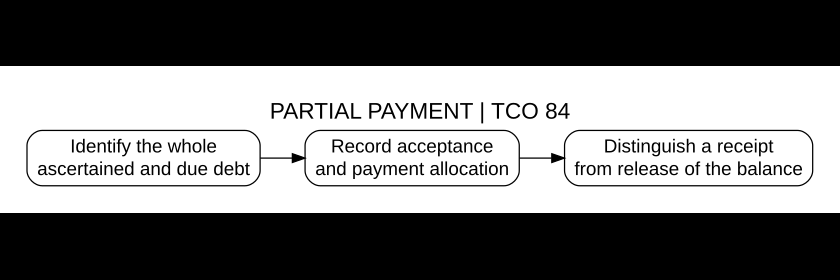
Article 84 requires an ascertained and due whole debt
The first paragraph of Law No. 6098, Article 84 identifies two conditions: the entire debt must be ascertained and it must be due. The rule should not be quoted as an unrestricted right to refuse any payment in every relationship, regardless of the obligation’s scope or maturity.
Establish the underlying agreement, the amount owed and the relevant maturity date. An invoice, a judgment and an account still disputed between the parties can have different significance. A creditor’s demand for a particular total does not, merely by stating a number, settle every factual or legal dispute about that total.
The contractual due-date guide explains how maturity is identified and calculated. Where only one agreed instalment has become due, the review should begin with that obligation rather than assume that every future instalment is already payable. Any claimed acceleration needs its own contractual and legal basis.
An agreed instalment is different from unilateral partial performance
When the parties have agreed to payment by instalments, payment of the full current instalment is not simply the debtor choosing to pay an arbitrary fraction of an already due whole. Read the schedule, any acceleration clause and the actual payment history. The applicable obligations come from that arrangement and the relevant statutory rules.
A debtor who cannot meet an existing due date can propose a revised schedule, but the proposal is not the same as the creditor’s agreement. A message saying that a small sum will be sent every month should not be treated as automatically replacing the original maturity terms.
Preserve the proposal and the actual response. An acknowledgement that a payment arrived can concern receipt only, while a signed arrangement can address new dates or settlement of the balance. The contract-amendment guide explains why agreement, authority and any applicable form requirement must be checked separately.
Acceptance prevents withholding the acknowledged portion
The second paragraph of Article 84 states that, when the creditor accepts partial performance, the debtor cannot refuse to perform the part the debtor has acknowledged. A dispute about an additional amount should therefore not be used to describe an admitted portion as if no obligation to perform it existed.
Identify what the debtor actually acknowledged. An admission concerning one invoice, a concession made only under a settlement condition and an unconditional recognition of an account balance need not have the same scope. Quote the complete communication and retain its conditions rather than extracting only the amount favourable to one side.
The creditor’s acceptance should also be documented. Record the amount, date, recipient and the purpose communicated by the parties. The payment becoming visible in a bank account is relevant evidence, but disputes about acceptance of attached settlement conditions require review of the wider record.
Acceptance of part does not itself establish a release of the rest
Article 132 provides for extinguishing a debt wholly or partly by a release agreement. That is a separate legal act from receiving a payment on account. A debtor relying on a release of the balance must identify the agreement supporting it, not simply point to the creditor’s receipt of a smaller sum.
Likewise, a creditor should read the actual wording of a proposed settlement before accepting it as ordinary part payment. A condition that a payment will settle a defined claim requires a proper interpretation of the parties’ declarations and conduct. Neither side should assume that the bank-reference field alone conclusively decides every question about a disputed release.
Record whether a release takes effect on signature, receipt of an agreed payment or another specified event. A settlement promising a future payment is not proof that payment has occurred. The release’s scope should identify the debt and any expressly retained claims instead of using an unexplained phrase that all matters are closed.
A new payment document does not automatically replace the old debt
Article 133 requires an express intention to novate where a new obligation is to extinguish an existing one. A new note, surety document or payment schedule therefore needs interpretation before it is described as erasing the original claim. The novation guide addresses that distinct mechanism.
The parties can agree a different maturity or compromise without necessarily replacing every legal feature of the old debt. Identify what remains in force, what changes and what ends. The distinction can affect existing security, interest and later arguments about which obligation is being enforced.
A partial payment should be reconciled with both documents where a new arrangement exists. Do not enter the same transfer as payment against two separate balances unless the legal relationship actually supports that accounting. The purpose of the reconciliation is to show one traceable reduction of the relevant obligation.
Acceptance and allocation are different questions
Article 100 allows a debtor who is not late with interest or expenses to deduct a partial payment from principal and prohibits a contrary agreement. Where those statutory conditions are not met, the account requires the appropriate allocation analysis rather than an assumption that every payment automatically reduces principal first.
The same provision prevents the debtor, where the creditor holds security for part of the claim, from directing the partial payment to the secured or better-secured part. The creditor’s receipt of money and the legal allocation of that money should therefore be recorded separately.
Where several debts exist, Articles 101–102 supply further allocation rules. The payment-allocation guide explains that framework in detail. A debtor should identify the obligation paid, and a creditor should keep the receipt and account consistent with the legally applicable allocation.
A debtor can request a receipt for the amount paid
Article 103 permits the performing debtor to request a receipt. Where the whole debt has been paid, the debtor can also request return or cancellation of the debt instrument. Those rights provide a documentary close-out mechanism, but the distinction between partial and full payment remains important.
For partial payment, or where the instrument records other rights of the creditor, Article 103 limits the demand to a receipt and annotation of the payment on the instrument. A debtor should not assume that paying one part entitles the debtor to take the original note away as though the entire documented relationship ended.
The receipts and returned-instruments guide addresses the fuller documentation framework. The receipt should identify the relevant debt, amount and date accurately. A generic confirmation that money was received can leave an avoidable dispute about which obligation it discharged.
Unreserved receipts can create important presumptions
Article 104 gives particular significance to unreserved receipts for periodic performances, treating earlier periods as performed in the stated circumstances. A creditor should therefore distinguish a receipt for one period from language intended to preserve a dispute about previous periods.
A receipt for the entire principal also supports the statutory presumption concerning interest, and return of the debt instrument supports the presumption that the debt ended. These rules should not be rewritten as saying that every receipt for any small payment proves every other obligation was settled.
Keep the wording and context of the receipt intact. Where a reservation is made, identify the claims retained and communicate it appropriately. The evidential consequences are tied to the actual document and circumstances, not to the heading receipt alone.
Accrued interest and penalties require attention when principal is finally discharged
Article 131 states that accessory rights and obligations generally end when the principal debt ends. It separately preserves accrued interest and penalty rights where they were reserved by agreement, by notification up to performance, or where the circumstances show the reservation.
A creditor receiving the final principal payment should therefore review the intended treatment of accrued items instead of assuming they remain recoverable indefinitely without examining the reservation rule. A debtor should likewise distinguish a discharge of principal from an express settlement of every accessory claim.
The provision reserves the special rules on immovable pledges, negotiable instruments and concordats. This article does not replace those regimes with a universal statement that every security disappears after any partial payment. Identify what ended and the legal treatment of the remaining rights.
A lawful refusal of part payment is not automatically creditor default
Article 106 concerns unjustified refusal of properly offered performance or failure to perform necessary preparatory acts. Where Article 84 permits refusal of a partial performance, that refusal should not automatically be characterised as unjustified rejection of the whole performance required by the contract.
The analysis must first establish what was properly due and offered. A claim that the creditor refused payment is incomplete if the offer concerned a different amount, an unauthorised new timetable or a condition the creditor never accepted. The creditor’s actual response should be preserved as well.
The creditor-default and deposit guide addresses the lawful routes where its conditions exist. Sending funds to an arbitrary account or keeping cash aside privately is not automatically the statutory deposit that discharges an obligation.
Several sureties provide an express example of a special acceptance rule
Article 593 requires acceptance of a partial payment from one of several sureties where it is at least that surety’s share. The special rule should not be overlooked by applying Article 84 in isolation. The actual surety arrangement and the relevant share must be established.
The multiple-sureties guide explains the distinct external and internal positions. A payment proposed by a surety can also have consequences for recourse, collateral and the amount remaining due from others.
Other specific relationships can have their own rules. This guide does not declare that a general civil-code paragraph overrides mandatory consumer, employment, insolvency or instrument-specific provisions. Classify the debt before relying on a broad statement that a creditor can always refuse or must always accept.
Part payment can affect limitation without settling the full amount
Article 154 expressly includes partial performance within the acknowledgment events that interrupt limitation. The payment must be connected with the relevant debt and its legal scope examined. A payment concerning one obligation is not automatically an acknowledgment of every claim in a wider commercial dispute.
The limitation-interruption guide explains the separate period consequences. An acknowledgment analysis is different from an agreement releasing the unpaid balance. The same transfer can therefore require more than one legal inquiry.
Do not treat payment correspondence as a substitute for responding to a served claim. A court or enforcement document can require a separate procedural act within its own period. Negotiating a balance or making a payment does not, by itself, establish that the necessary response was filed or the proceeding formally closed.
Prepare a payment record that leaves the remaining dispute identifiable
| Item | Question to resolve |
|---|---|
| The original obligation | What amount was ascertained and due? |
| The proposed payment | Was it unconditional part performance or a settlement proposal? |
| Acceptance | What did the creditor actually accept? |
| Allocation | Which debt, principal, interest or expense was reduced? |
| Receipt and reservation | What was acknowledged and what remained disputed? |
| Remaining balance | Was it retained, rescheduled or released by an established agreement? |
For a party abroad, retain the original currency, bank records and complete communications alongside translations. Identify the account holder and any representative’s authority. The conclusion should explain the net debt and the legal effect of each declaration rather than assume that a transfer reference settled the entire case.
Frequently asked questions
Can a creditor refuse part of a Turkish debt?
Article 84 permits refusal where the whole debt is ascertained and due. The actual obligation and any special rule must be checked.
Can a debtor impose a new instalment schedule by sending small amounts?
The payments alone do not establish the creditor’s agreement to new dates. Preserve the proposal, response and any valid amendment.
Does accepting part automatically release the unpaid balance?
No such automatic result follows from Article 84. Release under Article 132 requires examination of the parties’ agreement and its scope.
Can the debtor withhold the admitted part after the creditor accepts partial performance?
Article 84’s second paragraph prevents refusal to perform the part acknowledged by the debtor in that situation. Identify the actual acknowledgment.
Does a partial payment always reduce principal first?
Article 100 gives the stated principal-deduction right where the debtor is not late with interest or expenses. Allocation requires the applicable conditions and account.
Can the debtor demand the original instrument after only part payment?
Article 103 provides a receipt and annotation for partial payment. Return or cancellation of the instrument concerns the separate conditions for full discharge.
Does rejecting part payment automatically put the creditor in default?
No. Article 106 requires unjustified refusal of proper performance. A refusal permitted by Article 84 must not automatically be treated as creditor default.
Can a special surety rule require acceptance?
Yes. Article 593 addresses several sureties and a partial payment at least equal to the offering surety’s share. Establish that arrangement before applying the rule.
Can part payment interrupt limitation?
Article 154 includes partial performance in its acknowledgment framework. The relevant debt and scope of the payment must be identified.
Does payment alone close a court or enforcement file?
Do not assume procedural closure from the transfer alone. Reconcile the amount and complete the applicable procedural steps, including any required response to served papers.
Official legal sources
Turkish Code of Obligations No. 6098, Articles 84, 100–106, 131–133, 154 and 593; official Ministry text, page 16, containing Article 84. This English explanation is not an official translation and does not replace rules specific to the debt concerned.
Ask about a partial payment
State the amount due, the amount paid and whether a settlement or instalment agreement exists. Do not send account credentials or confidential documents in the initial enquiry.
Istanbul and Mersin offices
Bakırcı & Keskin Law Office is Mersin-based and works throughout Türkiye with an Istanbul and Mersin focus. Arrange a confidential channel for the agreement and payment records.
Istanbul — Polaris Plaza
Maslak Ahi Evran Caddesi, Polaris Plaza No:21, Floor 9, 34475 Sarıyer/İstanbul. Istanbul office directions.
Mersin — Profit İş Merkezi
İhsaniye Mahallesi, 4903. Sokak, Profit İş Merkezi No:23, Floor 3, Office 14, 33070 Akdeniz/Mersin. Mersin office directions.
Call +90 552 224 43 66. An enquiry does not establish representation or suspend a legal deadline.
Contact regarding a legal matter
In your first message, you may briefly state the subject, your country or city, and any relevant notification or recent procedural date. Please do not send identity numbers, medical data, or personal documents. Messaging alone does not constitute legal advice or create a lawyer–client relationship.
Discover more from Bakırcı & Keskin Hukuk Bürosu
Subscribe to get the latest posts sent to your email.