Several Sureties for One Turkish Debt: Shares, Missing Co-Sureties and Recourse
Several people signing security for the same Turkish debt does not automatically mean that every signer has the same exposure or the same claim against the others. Article 587 of the Turkish Code of Obligations distinguishes co-suretyship, joint and several commitments and independent undertakings. It also protects a surety who relied on others joining where the creditor knew or should have known of that assumption. Article 588 separately defines security for a surety’s debt and security for the surety’s recourse claim. The creditor-facing liability, each person’s maximum amount and the internal contribution account must be examined separately.
Have a general question about this article? Ask anonymously
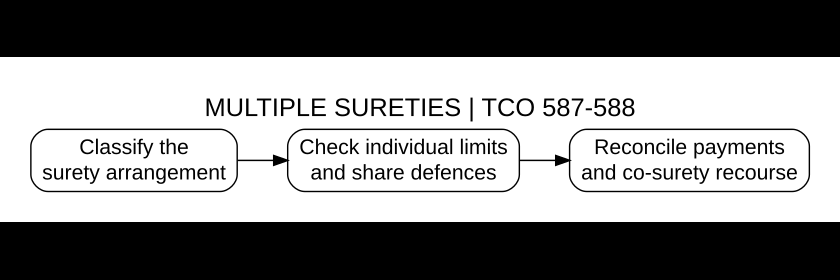
Begin with the same debt and a valid undertaking from each person
Article 587 concerns several persons providing suretyship for the same debt. Identify that debt precisely: the principal agreement, borrower, creditor and secured obligations. Security for different facilities should not be combined merely because the borrowers belong to the same business group.
Obtain every executed undertaking and its amendments. Record the signing date, maximum liability and relevant contractual category for each person. A draft listing an intended signer is not proof that the person entered a valid suretyship. The file must distinguish proposed participation from an undertaking that actually exists.
The personal-security form guide addresses the separate validity safeguards. Article 587 does not cure an invalid signature or missing required formal element simply because other people signed properly. The legal position of each security provider needs its own initial check.
Ordinary co-suretyship allocates two different kinds of responsibility
The first paragraph of Article 587 of Law No. 6098 makes each co-surety responsible as an ordinary surety for that person’s own share and as a surety for the other sureties in respect of their shares. It should not be reduced either to unlimited identical exposure or to a statement that the person’s own share is always the only relevant amount.
The distinction affects the conditions under which payment can be requested. Identify the allocated shares and the statutory character of the responsibility for each component. The creditor’s account should show which part is sought and on what basis rather than demand an undifferentiated total from every signer.
The ordinary and joint-surety enforcement guide explains the separate order-of-pursuit and collateral rules. Those provisions remain relevant; the mere presence of multiple sureties does not erase their conditions.
Joint and several co-sureties have a specific protection
Article 587 makes each surety who undertakes joint and several responsibility with the debtor or among the sureties responsible for the whole debt. This must be read with Article 589’s maximum-liability rule and the remainder of Article 587. Whole-debt wording is not permission to disregard the ceiling in the particular undertaking.
A surety can refuse to pay more than that person’s share until proceedings have been initiated against all sureties who became jointly liable earlier or at the same time and can be pursued in Turkey. The timing and territorial qualifications are express. A later-added surety is not automatically treated as an earlier or simultaneous participant for this protection.
The same share-related protection is available where the other sureties have paid their shares or supplied real security. Preserve the relevant payment and security records. A statement that another person promised to help is not the same as proof of payment or provision of the security contemplated by the article.
The share defence needs an actual enforcement chronology
Prepare a list of the co-sureties, their undertaking dates, the shares asserted and the proceedings started against each. Establish which persons can be pursued in Turkey for the statutory inquiry. Nationality alone does not answer every question about the legal availability of proceedings.
A demand letter and formal pursuit are different events. Obtain the actual proceeding records rather than assume that a message to all signers satisfies the condition concerning initiation of proceedings. Conversely, do not describe a qualifying proceeding as nonexistent simply because it has not yet resulted in payment.
The protection concerns refusal of the amount above the surety’s share. It should not be presented as an automatic release from every obligation in the file. Other defences, maturity, collateral and the maximum amount remain separate questions, each requiring its own supporting documents.
The expected participation of others can be legally decisive
Article 587 addresses the creditor who knew or should have known that a person gave suretyship assuming others were or would become sureties for the same claim. If that assumption later fails, the statutory consequence is release of that surety from the suretyship obligation. The creditor’s knowledge or required knowledge is an essential part of the rule.
Preserve the negotiations, signing conditions, correspondence and draft structure showing the assumption. A surety’s undisclosed personal hope that somebody else would assist is not the same factual case as a condition or expectation known to the creditor. The relevant evidence must connect the person’s decision to the anticipated other undertakings.
The provision also addresses the creditor releasing one of the co-sureties or a determination that one suretyship is invalid. These events must be examined within the stated knowledge-and-assumption framework. It would be inaccurate to claim that every release of any security provider automatically discharges every other surety in every arrangement.
Independent sureties follow a separate paragraph
People can independently provide suretyship for the same debt. Article 587 states that each is responsible for the entirety of that person’s suretyship obligation. Unless otherwise agreed, the paying surety can seek recourse against the others in proportion to their shares in the total surety amounts.
This is not automatically an equal split by the number of people. The different secured amounts and the applicable agreement must be identified. A person with a smaller maximum undertaking should not be assigned the same internal proportion merely because all names appear on the creditor’s contact list.
The distinction from co-suretyship should be established from the actual undertakings and surrounding arrangement. Separate signature dates can be relevant, but the analysis should not rely only on the fact that papers were signed in different rooms or files. The legal relationship and common assumptions require a substantive review.
Payment can create rights against other sureties
For the joint co-surety arrangement in Article 587, the paying surety has recourse against the others to the extent they have not already paid their own shares, subject to contrary agreements. The statute expressly permits use of that right before recourse against the principal debtor.
Keep the creditor payment record and the calculation of the portion borne by the paying surety. A settlement proposal is not proof that a payment occurred. The internal demand should also account for payments the other sureties made directly to the creditor, not only payments they made to the person now seeking contribution.
The recourse against the principal debtor guide addresses a neighbouring but different claim. Recourse against co-sureties and recourse against the borrower should be reconciled so that the same payment is not recovered twice through separate demands.
An internal account must reflect credits and the actual secured debt
A contribution schedule should begin with the debt and the sum discharged, then identify each surety’s relevant undertaking and share. Separate principal, permissible interest and other supported items. The creditor’s original headline balance is not necessarily the sum for which every surety is legally responsible.
Article 589 imposes the agreed maximum and excludes the stated agreements imposing contractual penalties or loss caused by invalidity of the principal relationship. Those controls cannot be bypassed by relabelling a creditor’s unsupported charge as a contribution claim between sureties.
Record any release, compromise or special internal agreement and examine its scope. An agreement between two participants does not automatically bind a third who did not join. The contribution calculation must identify the legal basis for the allocation it proposes rather than rely on an informal statement that everyone was involved in the business.
Article 588 distinguishes security for the surety from security for recourse
A person who gives the creditor security for the surety’s debt is a surety for the surety under Article 588 and is responsible alongside that surety as an ordinary surety. The secured obligation is therefore not simply assumed to be identical to the borrower’s direct obligation in every respect.
A recourse surety, by contrast, secures the paying surety’s recourse claim against the debtor. Identify the creditor of that particular secured claim and the event giving rise to it. An undertaking securing reimbursement is not automatically an additional direct guarantee to the original lender.
The drafting and document review should use consistent role names. Borrower, original creditor, first surety, surety for a surety and recourse surety are distinct positions. Translating all of them as guarantor can obscure who can demand payment from whom and which obligation must first exist.
A qualifying partial tender cannot simply be ignored
Article 593 provides that, where several people are sureties for a debt, the creditor must accept a partial payment offered by one surety if it is not less than that surety’s share. This is a specific rule within the suretyship framework, not a general assertion that every creditor must accept any small instalment from any debtor.
Establish the share and the actual offer of payment. The statute also provides consequences for an unjustified refusal, with a distinct reduction rule in joint co-suretyship. The legal consequence should be tied to the proven tender and the relevant category, not asserted merely because a negotiation over payment failed.
The creditor-duties guide addresses acceptance, information and security records in more detail. A surety should preserve the tender, response and payment evidence before relying on a statutory release or reduction.
Changes and expiry must still be checked for each undertaking
Article 583 requires changes increasing a surety’s responsibility to satisfy the form prescribed for suretyship. A change to the main facility or the addition of another participant should not be treated as silently increasing every existing maximum. The executed amendment and its legal effect need individual assessment.
The expiry and ending rules also remain separate from contribution. The surety expiry guide addresses the relevant statutory framework. A co-surety list does not prove that all undertakings are still effective on the date a new demand is sent.
Where the actual relationship or executed instrument identifies a different security category, review that classification before applying these suretyship rules. A legal label in English does not automatically determine the statutory result. The complete undertaking and the principal debt remain the starting documents.
Build one schedule for external exposure and another for internal recourse
| External creditor claim | Internal contribution claim |
|---|---|
| Valid undertaking and maximum amount | The payment actually made and debt discharged |
| Ordinary, joint or independent classification | The applicable shares or total-surety proportions |
| Maturity, collateral and pursuit conditions | Payments already made by other sureties |
| Share defence and relevant proceeding dates | Any valid contrary internal agreement |
| Known assumption about other sureties | Amounts recovered from the principal debtor |
| Release, invalidity and expiry records | The remaining supported net contribution |
These schedules can refer to the same documents while answering different questions. A creditor’s right to pursue an amount and the final allocation between paying parties should not be collapsed into one unexplained balance.
International surety files need a separate law and procedure review
Provide every language version, original signature record, party identity and relevant notice. A foreign-executed undertaking can raise governing-law and formal-validity questions before the Turkish co-surety rules are applied. Residence abroad does not automatically establish a defence or remove the need to respond to served proceedings.
The file should state what the creditor is demanding, what each surety has paid and whether the present dispute is external enforcement or internal recourse. This prevents a response aimed at the borrower from being mistaken for a defence to a claim by another surety.
If a payment order or lawsuit has been served, retain the full document and service record. Asking the creditor to explain the shares does not itself constitute the procedural response required in that case. The substantive assessment and procedural protection must proceed together.
Frequently asked questions
Does the presence of several sureties mean equal liability?
No. Article 587 distinguishes co-surety and independent arrangements, and each undertaking’s maximum and applicable share must be identified.
What is the starting rule for ordinary co-suretyship?
Each person is an ordinary surety for that person’s own share and a surety for the other sureties in respect of their shares. The relevant enforcement conditions remain important.
Can a joint co-surety resist payment above its share?
Article 587 provides that protection until qualifying earlier or simultaneous co-sureties who can be pursued in Turkey are proceeded against, and also in its stated payment or real-security circumstances.
What if an expected co-surety never signs?
Article 587 can release the surety where the creditor knew or should have known that the undertaking depended on the stated assumption about others’ participation and that assumption fails.
Does releasing one surety always release every other signer?
Do not assume that result without the statutory conditions. The relevant knowledge, participation assumption and arrangement must be established.
Must the paying co-surety first recover from the borrower?
For the co-surety recourse described in Article 587, the statute permits use of the right before recourse against the principal debtor, subject to the stated allocation and agreements.
How is recourse between independent sureties allocated?
Unless otherwise agreed, Article 587 uses each person’s proportion in the total surety amounts. It is not necessarily an equal headcount split.
What does a recourse surety secure?
Article 588 defines security for the surety’s recourse claim against the debtor. That is different from directly securing the original lender’s claim.
Can a creditor reject every partial payment from a surety?
Article 593 requires acceptance in the multiple-surety situation where the offered payment is at least the offering surety’s share. Establish the actual tender and share.
What records are needed for a co-surety review?
Provide every undertaking, maximum amount, signing date, participation correspondence, payments, security, proceedings and any release or internal allocation agreement.
Official legal sources
Turkish Code of Obligations No. 6098, Articles 583 and 585–593; official Ministry text, pages 118–120. This English explanation is not an official translation and does not replace review of each executed undertaking.
Ask about several sureties
State whether the creditor or another surety is demanding payment, the signing dates and the sums already paid. Do not send identity or confidential financial records through the initial enquiry.
Istanbul and Mersin offices
Bakırcı & Keskin Law Office is Mersin-based and works throughout Türkiye with an Istanbul and Mersin focus. Arrange a confidential channel for the suretyship and payment records.
Istanbul — Polaris Plaza
Maslak Ahi Evran Caddesi, Polaris Plaza No:21, Floor 9, 34475 Sarıyer/İstanbul. Istanbul office directions.
Mersin — Profit İş Merkezi
İhsaniye Mahallesi, 4903. Sokak, Profit İş Merkezi No:23, Floor 3, Office 14, 33070 Akdeniz/Mersin. Mersin office directions.
Call +90 552 224 43 66. An enquiry does not establish representation or suspend a legal deadline.
Contact regarding a legal matter
In your first message, you may briefly state the subject, your country or city, and any relevant notification or recent procedural date. Please do not send identity numbers, medical data, or personal documents. Messaging alone does not constitute legal advice or create a lawyer–client relationship.
Discover more from Bakırcı & Keskin Hukuk Bürosu
Subscribe to get the latest posts sent to your email.