Buying a Turkish Trademark: Assignment Agreement, Notarisation and Registry Protection Under Article 148
Short answer
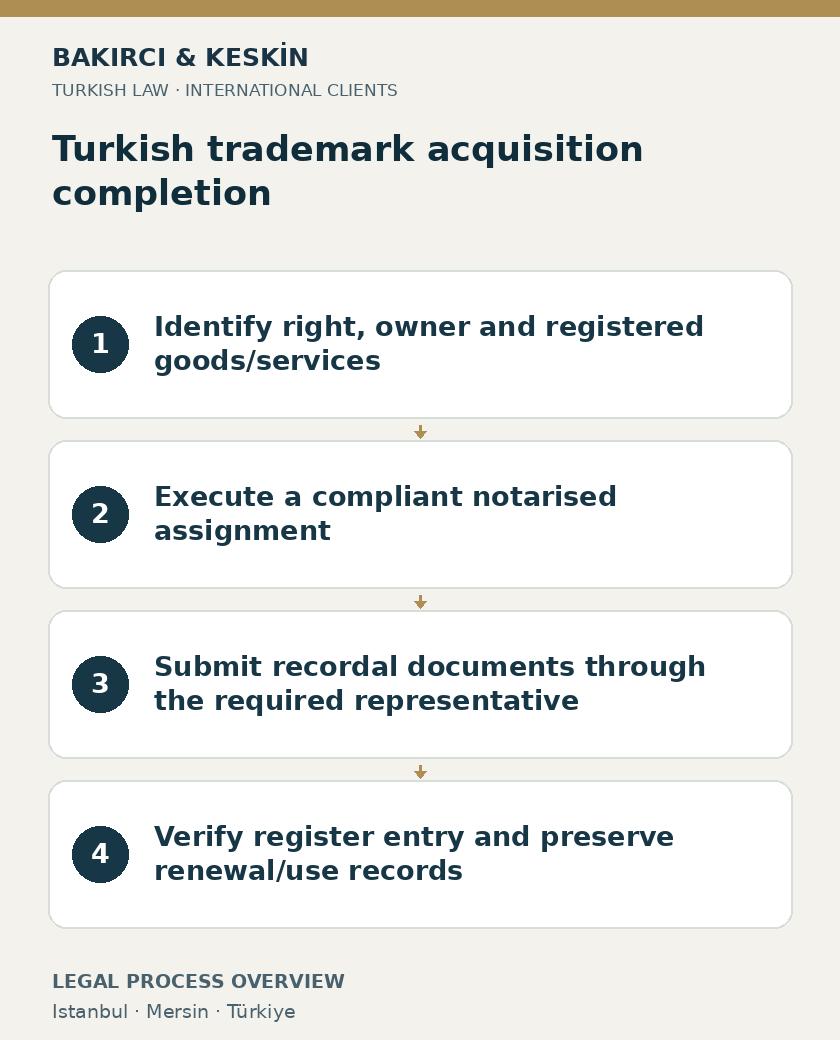
A Turkish trademark can be transferred separately from the business and for all or part of its registered goods and services. Article 148 of Industrial Property Code No. 6769 requires a written assignment in notarised form for validity. Recording an ordinary assignment with TÜRKPATENT protects the resulting rights against good-faith third parties; guarantee and collective marks have a separate rule making recordal a condition of validity. An overseas acquisition therefore needs a Turkish rights schedule, a compliant transfer document and a completed recordal procedure.
Have a general question about this article? Ask anonymously
Quick summary
| Legal issue | Turkish Trademark Assignment After a Brand Acquisition: Form, Partial Transfer and Recordal |
|---|---|
| Short answer | A Turkish trademark can be transferred separately from the business and for all or part of its registered goods and services. Article 148 of Industrial Property Code No. 6769 requires a written assignment in notarised form for validity. Recording an ordinary assignment with TÜRKPATENT protects the resulting rights against good-faith third parties; guarantee and collective marks have a separate rule making recordal a condition of validity. An overseas acquisition therefore needs a Turkish rights schedule, a compliant transfer document and a completed recordal procedure. |
| Key legislation | Law No. Industrial Property Code No. 6769; Law No. Industrial Property Code Implementation Regulation; Law No. Private International and Procedural Law No. 5718 |
Identify the Turkish asset and the person entitled to transfer it
A brand acquisition must identify each Turkish right that changes hands. The corporate name, trading name, logo artwork, domain name and registered trademark are different assets. A reference to the brand in an overseas purchase agreement does not establish which Turkish registration, application or specification the parties have included. The starting record should contain the mark, application or registration number, registered owner, filing date, current status and complete goods and services list.
Article 148(8) of the Industrial Property Code extends the transaction rules to applications. The schedule should therefore distinguish pending applications from registrations. It should also identify whether the right is an ordinary individual mark, a collective mark or a guarantee mark, because the legal effect of recordal differs. Status checks must be current at signing and at completion: a historic certificate does not establish that the same owner and protection remain on the register.
The Turkish trademark search and clearance guide explains the register review in more detail. For an acquisition, the search serves a further purpose: reconciling the seller’s asset list with the public record and identifying missing registrations, inconsistent names and unresolved ownership changes before the assignment is executed.
Separate the commercial acquisition from the legal transfer of the mark
Article 148(2) permits industrial property transactions independently of the business. A buyer can acquire a Turkish mark without buying the seller’s shares or entire undertaking. Conversely, a share purchase changes ownership of the company while the company remains the trademark proprietor. These transactions should not be recorded as interchangeable events. The required filing follows the change in the identity of the rights holder, not the commercial label used for the acquisition.
Article 125(4) of the Implementation Regulation provides a separate recordal route for changes arising from mergers, divisions, contributions in kind and business acquisitions. It requires the relevant trade registry publication or a document approved by competent authorities, alongside the request and fee. An ordinary contractual assignment falls under Article 125(1). Selecting the correct route prevents a corporate succession file from being treated as a conventional asset sale without its supporting evidence.
Cross-border transaction documents also need a governing-law review. Articles 23 and 28 of Law No. 5718 address protection of intellectual property and contractual obligations relating to intellectual property respectively. The governing law of the purchase agreement and the rules governing the Turkish right should be analysed separately. A foreign governing-law clause is not a substitute for checking Turkish transfer and register requirements.
Meet the notarised assignment requirement before relying on completion
Article 148(4) states that industrial property transactions are subject to written form and that assignment agreements are valid only when made in a form approved by a notary. For a Turkish trademark assignment, notarisation is therefore a validity issue. A purchase-price receipt, unsigned asset schedule or email approving the transaction does not by itself demonstrate compliance with that statutory requirement.
The transfer instrument should identify the transferor and transferee, the relevant Turkish mark and number, and the rights transferred. The identities must reconcile with the register and with the signatories’ authority documents. Where a company executes through an authorised representative, the file should establish the representative’s authority to bind that company to the transfer. Commercial completion and legal execution should be coordinated so that the buyer does not release the consideration while an essential transfer instrument remains incomplete.
Documents executed outside Turkey require a separate examination of execution, authentication and translation. An apostille authenticates the relevant public document for its treaty purpose; it does not rewrite the agreement or establish that its substantive terms transfer the intended rights. The applicable country and document route should be checked under the guide to foreign documents, apostilles and certified translations. The correct legal form must be established before treating document authentication as the final step.
Define the goods and services in a partial assignment
Article 148(6) permits transfer for all or some of the goods and services for which a mark is registered. Article 125(3) of the Implementation Regulation requires a partial assignment agreement to state the transferred goods or services and their class numbers. The specification, rather than a commercial description of the business division, determines the recorded scope. The closing schedule should reproduce the relevant registered wording accurately and identify the retained portion separately.
A class number alone does not resolve which goods or services within that class are included. The parties need a clear match between the contract and the existing registration. The assignment cannot give the transferee protection for goods absent from that registration. Any need for additional protection belongs in a separate application analysis and should not be hidden within the transfer language.
The regulation provides for a new registration number and file in the transferee’s name for the transferred part. It also expressly states that the protection commencement date and protection period do not change. The buyer should therefore retain the original filing and protection information together with the new number. A new recordal number is an administrative consequence of the split, not a new ten-year term.
Understand what recording the assignment changes
Under Article 148(5), a transaction is entered in the register and published in the Bulletin following a party’s request, payment of the fee and satisfaction of the regulatory conditions. Rights arising from an unrecorded transaction cannot be asserted against good-faith third parties. This makes recordal a substantive part of the acquisition’s protection even where an ordinary trademark assignment has already met the statutory validity requirements.
The agreement should allocate responsibility for filing, responding to deficiencies and delivering proof of recordal. A contractual promise to file is not evidence that the register has changed. The buyer should obtain the submitted request, its supporting documents, the official response and the updated record. An entry containing the wrong owner or an incomplete specification requires correction; possession of a filing receipt alone does not establish that the intended transaction has been recorded.
Article 148(7) creates an important exception for guarantee and collective marks: their transfer is valid upon recordal. These marks should not be treated under the ordinary distinction between assignment validity and protection against third parties. Their classification must be identified at the beginning of the transaction so that the completion conditions reflect the statutory rule.
Prepare a recordal package that matches the executed transfer
Article 125(1) of the Implementation Regulation identifies the basic assignment recordal materials: a request form, information showing payment of the fee, an assignment agreement containing the trademark registration number and mark name, and a Turkish translation approved by a sworn translator where the agreement is in another language. The underlying agreement must also comply with Article 148’s notarised form rule. Reading the regulation without the Code would omit that essential validity requirement.
The document package should use consistent legal names and identifiers. Changes of company name, succession events and earlier unrecorded transfers must be reconciled with the owner appearing on the register. Translation should preserve the distinction between an immediate transfer, an obligation to transfer later and a licence. These concepts produce different legal consequences, and a translation that blurs them makes the recordal evidence less reliable.
The fee should be checked against TÜRKPATENT’s current trademark fee schedule when filing. Assignment, partial assignment and changes following corporate restructuring should be identified under the appropriate transaction category. The official fee and the costs of representation, execution, authentication and translation are separate items; an acquisition budget should identify each rather than treating the register fee as the entire completion cost.
Arrange the required representation for an owner abroad
Article 160(3) requires persons domiciled abroad to be represented before TÜRKPATENT by a trademark or patent attorney. Acts carried out personally without the required representation are treated as not having been performed. An overseas buyer should therefore appoint the appropriate registered professional before relying on a submission to the Office. Legal advice on the acquisition agreement and representation before the Office are related tasks with distinct professional requirements.
Under Article 160(4), where such a representative is appointed, proceedings are conducted through that representative and service on the representative counts as service on the principal. The acquisition team needs a functioning instruction and reporting arrangement. Register correspondence should reach the person responsible for the transaction, particularly where a deficiency response or another time-sensitive act is required. Changing the owner without arranging continuing correspondence leaves the acquisition file operationally incomplete.
Article 160(5) allows the Office to require the original or an approved copy of the authority document where necessary. The buyer should preserve the signed authorisation and the corporate documents supporting it. The assignment agreement, corporate authority to execute it and authority to represent the buyer before the Office should be reviewed as separate instruments.
Check statutory pre-emption before acquiring a co-owned share
Article 148(3) applies where an industrial property right has several owners and one owner sells all or part of that owner’s share to a third party. The other co-owners have a statutory pre-emption right. The buyer or seller must notify them of the sale. This issue concerns a sale of a co-owned share and should not be confused with dividing an individually owned mark by goods and services.
The right expires three months after the sale is notified to the entitled co-owner and, in all circumstances, two years after the sale. Where the parties do not agree, it is exercised by proceedings against the buyer. Before a transfer of the share is ordered, the pre-emption claimant must deposit the price in cash at the place and within the period fixed by the court. The provision excludes sales by compulsory auction.
An acquisition of a share therefore needs an ownership analysis and a notification record. Recording the buyer as a co-owner does not justify ignoring the statutory rights of the other co-owners. The transaction file should show the nature of the interest sold, the sale date, the notice documents and the delivery evidence relevant to the applicable time limits.
Review licences, security and disputes alongside ownership
Article 148(1) permits a trademark to be licensed, pledged, provided as security and attached. Ownership review should consequently extend beyond the proprietor’s name. The buyer needs the register information and the underlying agreements or decisions that define existing burdens. A transfer instrument should not simply assume that a change of owner eliminates every earlier arrangement.
Article 24 distinguishes exclusive and non-exclusive licences and makes a licence non-exclusive unless otherwise agreed. It also restricts transfer and sublicensing by the licensee unless the contract permits them. Acquisition review should identify who is authorised to use the mark, the covered goods and services, contractual duration and the terms governing the licence. Those documents inform the buyer’s ability to use and commercialise the acquired asset.
Disputed ownership requires a different analysis from a voluntary assignment. Where a Turkish commercial agent registered the mark without authority, the relevant statutory remedies are explained in the guide to recovering a mark registered by a Turkish agent. A settlement transfer still needs an executable document and appropriate recordal; the existence of a dispute does not make an informal promise an adequate completion record.
Preserve the existing protection dates and evidence of use
Article 23 provides a ten-year protection period from the application date, renewable in ten-year periods. The ordinary renewal request and fee-information window is the six months before expiry; a further six months after expiry is available subject to the additional fee. An assignment does not replace that timetable. The buyer should obtain the renewal history and allocate responsibility for any renewal falling near completion.
Article 9 addresses genuine use in Turkey during the five years following registration and uninterrupted five-year periods of non-use, subject to justified reasons. Transfer is not listed as a fresh start for that rule. The acquisition file should therefore include relevant use records, existing licences and information about discontinued use. Payment for the trademark does not itself establish genuine use of the mark for its registered goods or services.
Close with evidence of the right acquired
A completed file should connect the registered asset, the seller’s authority, the notarised transfer, the payment and the recordal result. It should also preserve the goods and services specification, any co-owner notices, relevant licence and security documents, and the renewal diary. This provides a coherent chain of title for later licensing, enforcement, financing or sale.
Before releasing the file, compare the recorded proprietor and transferred scope against the executed agreement. Confirm that the responsible representative holds the current contact instructions and that outstanding official correspondence has been addressed. The practical objective is a verifiable Turkish right in the correct owner’s name, supported by documents explaining how that owner acquired it.
Frequently asked questions
Does buying a foreign company automatically require assignment of its Turkish mark?
A share purchase ordinarily changes the company’s shareholders rather than the identity of the company holding the mark. The transaction must be analysed to determine whether the proprietor itself changes. A separate asset transfer, merger or other restructuring may require a different recordal route and supporting documents.
Can a Turkish trademark be transferred without selling the business?
Yes. Article 148(2) permits the relevant industrial property transactions independently of the undertaking. The agreement should identify the Turkish right precisely and satisfy the statutory form requirements. Other assets associated with the brand require their own identification and transfer analysis.
Is a signed assignment agreement enough?
Article 148(4) makes notarised form a condition of validity for an assignment. A merely signed document should not be assumed sufficient. Execution abroad also requires examination of the appropriate authentication, translation and applicable form rules before the instrument is used for Turkish recordal.
Can the seller transfer only some registered goods or services?
Yes. Article 148(6) permits a partial transfer, and Regulation Article 125(3) requires the agreement to specify the transferred goods or services and class numbers. The transferred portion receives a new record, but its protection commencement date and duration remain unchanged.
Why record an ordinary assignment if the agreement is already valid?
Article 148(5) prevents rights arising from an unrecorded transaction from being asserted against good-faith third parties. Recordal also provides the public ownership record needed for subsequent dealings. A valid agreement and a completed register update should both be documented.
Are collective and guarantee marks subject to a different rule?
Yes. Under Article 148(7), transfer of a collective or guarantee mark is valid upon recordal. The transaction team must identify the mark type before applying the ordinary assignment analysis. Completion conditions should reflect the legal effect of the register entry.
Can a buyer based abroad submit the recordal personally?
Article 160(3) requires persons domiciled abroad to act before TÜRKPATENT through a trademark or patent attorney. Personal acts without that representation are treated as not performed. The buyer should appoint the appropriate registered representative and arrange reliable handling of official correspondence.
Does a partial assignment give the buyer a new ten-year term?
No. Regulation Article 125(3) states that the start and duration of protection do not change for partially transferred rights. The new registration number identifies the separated record. Renewal must continue to be calculated using the existing protection timetable.
Do other owners have rights when a co-owned share is sold?
Article 148(3) gives the other co-owners pre-emption rights on a sale of a share to a third party. It prescribes notification, a three-month period from notification and an absolute two-year period from sale. Compulsory auction sales are excluded by the provision.
Does assignment remove a trademark’s non-use history?
The assignment provisions do not restart the five-year use rules in Article 9. The buyer should examine the existing use history and obtain relevant records from the seller. Renewal dates, licences and pending disputes also remain necessary parts of the acquisition review.
Official legal sources
- Industrial Property Code No. 6769 — Articles 9, 23, 24, 148(1)-(8), 160(1)-(5)
- Industrial Property Code Implementation Regulation — Articles 125(1), 125(3), 125(4)
- Private International and Procedural Law No. 5718 — Articles 23, 28
Recorded primary-source check dates: 26 October 2026. The official Turkish legislation controls. A new publication-date check is still required.
Contact information
Do not include confidential documents or identity numbers in an initial message. An enquiry does not establish representation or suspend any legal deadline.
Istanbul and Mersin contact details
Bakırcı & Keskin Law Office is Mersin-based. Turkish matters are handled under the applicable jurisdiction and agreed mandate. The competent court and the scope of representation are assessed for each matter.
Istanbul — Polaris Plaza
Maslak Ahi Evran Caddesi, Polaris Plaza No:21, Floor 9, 34475 Sarıyer/İstanbul, Türkiye.Mersin — Profit İş Merkezi
İhsaniye Mahallesi, 4903. Sokak, Profit İş Merkezi No:23, Floor 3, Office 14, 33070 Akdeniz/Mersin, Türkiye.+90 552 224 43 66 · Contact details in English. An enquiry does not establish representation or suspend a legal deadline.
Istanbul Office – Polaris Plaza, Maslak / Sarıyer
Bakırcı & Keskin Hukuk Bürosu
Maslak Ahi Evran Caddesi, Polaris Plaza No:21, Kat:9, 34475 Sarıyer/İstanbul
Our physical offices in Istanbul and Mersin coordinate matters throughout Turkey, subject to jurisdiction and the local steps required for each case. Please specify your preferred office when arranging an in-person appointment.
Open the Istanbul office on Google Maps · Contact and appointments
Contact regarding a legal matter
In your first message, you may briefly state the subject, your country or city, and any relevant notification or recent procedural date. Please do not send identity numbers, medical data, or personal documents. Messaging alone does not constitute legal advice or create a lawyer–client relationship.
Discover more from Bakırcı & Keskin Hukuk Bürosu
Subscribe to get the latest posts sent to your email.