Car Damage or Theft in a Turkish Car Park: Operator Liability Under TCO 579–580
A Turkish car-park operator cannot remove its statutory responsibility for an accepted vehicle simply by printing “park at your own risk” on a ticket. Article 579 of the Turkish Code of Obligations addresses destruction, damage and theft of vehicles and accessories entrusted to operators or accepted by their employees. It provides specified defences and a conditional limit of ten times the daily custody fee where no fault is attributable to the operator or its employees. Article 580 separately regulates retention for fees and custody expenses. A compensation claim and a demand to release a retained vehicle therefore require different legal explanations.
Have a general question about this article? Ask anonymously
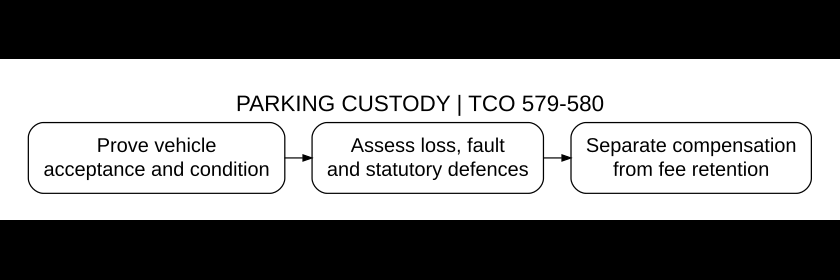
Prove acceptance of the vehicle, not merely its location
Article 579 refers to property entrusted to the operator or accepted by its employees. The vehicle’s presence near a business is not the entire legal test. Establish the parking or custody arrangement, the operator’s role and the circumstances in which the vehicle entered and was held.
Keep the entry ticket, payment record, reservation, number-plate record and any key-handover receipt. Where an employee accepted the vehicle, record the business for which the employee acted and the location of the handover. A uniform, logo or verbal assurance can be relevant evidence, but the claim should identify the actual operating business rather than rely only on a brand name.
Different arrangements must be distinguished. Renting a defined space, leaving a vehicle for repair and handing it to a valet can involve different undertakings. The legal review should determine the applicable custody relationship from the facts instead of assuming that every place where a car stops creates the same obligation.
Article 579 covers vehicles and their accessories
The provision expressly includes motor vehicles and their accessories among the property protected when entrusted to the relevant operator. The starting point for a vehicle claim is therefore the car and the components or items properly falling within that statutory category.
Do not automatically classify every loose object inside the vehicle as a vehicle accessory. A bag, cash, jewellery or business equipment can require a separate analysis of the item and any custody undertaking. The fact that an object was inside a car is not a complete legal explanation of its relationship with the vehicle.
Prepare separate inventories for vehicle damage and other missing property. Record factory or later-installed equipment, identifiers, photographs and the evidence showing the relevant item was present when the vehicle was accepted. This prevents a dispute about an unrecorded bag from obscuring an independently documented scratch, broken component or missing vehicle.
The statutory starting point is responsibility for loss, damage or theft
Under Law No. 6098, Article 579, operators of garages, car parks and similar places are responsible for destruction, damage or theft of the specified property accepted into their custody. The provision should not be reduced to a statement that the driver must always identify the particular person who caused the loss.
The claimant still needs evidence of the vehicle’s acceptance and the loss relied on. An entry photograph and collection photograph can establish different points in the chronology. Keep the original records and explain when each was made rather than presenting an image without a date as proof of the vehicle’s condition throughout the whole stay.
A disappearance, collision, damaged accessory and mechanical fault require different factual analysis. The legal account should describe the observed condition and event without turning every unexplained defect into an accusation of deliberate misconduct. Where the vehicle is available, an appropriate technical assessment can help distinguish an old condition from the loss attributed to custody.
The operator must establish a statutory ground of defence
Article 579 permits the operator to escape responsibility by proving that the loss arose from fault attributable to the depositor, a visitor, a person accompanying or serving the depositor, from force majeure, or from the nature of the property. These are identified grounds, not a general permission to deny all claims.
Review the explanation and supporting records. A statement that another driver must have caused the damage does not, by itself, establish a complete statutory defence. Equally, information about the depositor’s own actions, vehicle condition or accompanying persons must not be omitted where it is relevant to the event.
The cause of the loss needs to be distinguished from the fact that it was discovered in the car park. A vehicle can enter with an existing fault, while a new custody-related incident can also produce a later-discovered defect. The chronology and technical evidence must connect the claimed loss with the relevant period and the defence asserted.
The ten-times daily fee ceiling depends on absence of operator fault
Article 579 limits responsibility for each stored item to ten times its daily custody fee only where no fault is attributable to the operator or its employees. The absence of the qualifying fault is therefore central to applying the ceiling. It is inaccurate to describe ten times the fee as the maximum recovery in every parking dispute.
Evidence concerning key control, movement of the vehicle, access and release can be relevant to the fault assessment. Identify the particular act or omission and the loss connected with it. A general complaint that the service was unprofessional is not a substitute for showing what happened.
The daily custody fee also needs proof. Keep the applicable tariff and invoice, particularly where the receipt shows an hourly charge, a package or an extended stay. The article does not supply an invented universal daily amount. A calculation must explain its factual basis rather than multiply an unrelated charge by ten.
The ceiling is not an automatic payment entitlement. The actual loss, its amount and the applicable responsibility must still be established. Similarly, showing attributable fault does not itself prove every consequential amount demanded; each item of compensation needs its own supported basis.
Printed disclaimers cannot replace the statutory rules
Article 579 expressly states that the operator does not escape responsibility by announcing that it assumes none or by making responsibility dependent on conditions not stated in the Code. The form of the announcement does not change that rule. A ticket, sign or website condition should be retained as evidence, not treated as conclusive merely because the customer saw it.
Identify the exact disclaimer the operator relies on. An instruction to remove valuables and a blanket denial of all vehicle liability are different statements. The presence of a disclaimer also does not resolve whether a particular loose item was part of the accepted custody arrangement.
The liability-exclusion guide addresses the wider contractual framework. In a parking case, the specific Article 579 rule should remain at the centre of the analysis rather than being replaced with a general debate over fine print.
Key handover and vehicle movement require a clear record
Record whether keys were left with staff, how the vehicle could be moved and what instructions were given. Permission to reposition a car for parking should not automatically be described as permission to use it for an unrelated purpose. The actual scope of the custody and movement arrangement matters.
The general custody rule in Article 563 prohibits use of the stored property without the depositor’s permission. It provides consequences for unauthorised use, including an appropriate use payment and extended responsibility for unexpected-event loss, subject to its stated defence. That rule requires examination of the actual use rather than an assumption that possession of keys gives unrestricted authority.
Where a dispute concerns release to another person, preserve the collection ticket, identification procedure and communications. The issue is not only who physically drove away, but what authority the operator relied on when giving up custody. A missing paper ticket and an unauthorised release should not be treated as automatically identical events.
Damage discovered at collection should be documented before conditions change
Tell the operator what was discovered and request an incident record. Photograph the affected area and the wider vehicle, preserving the original files. Record the time, location and people who directly observed the condition. Avoid moving straight from discovery to a repair invoice without preserving the evidence connecting the damage with custody.
A prompt report helps establish the chronology, but the hotel-specific forfeiture wording in Article 578 should not be casually copied into Article 579 as an invented identical parking deadline. The applicable notice and procedural requirements must be identified for the actual legal relationship. Reporting promptly is not a substitute for checking a served claim’s separate response period.
Where repair, dismantling or disposal risks changing relevant evidence, the evidence-preservation guide explains a distinct procedural route. An insurer’s inspection, a private repair estimate and a court-directed examination have different purposes and should be described accurately.
Repair cost, value loss and other expenditure are not one automatic total
A damage schedule should separate the repair work, any claimed residual loss in value and other expenditure. Identify the documents supporting each item and the causal connection with the event. A quotation establishes an estimated repair cost, not necessarily payment or the appropriate measure of every head of loss.
Keep the vehicle’s relevant age, condition and prior damage records available. A replacement part can improve a previously worn component, while a genuine post-repair value issue can require its own assessment. The claim should neither ignore the pre-incident condition nor assume that every new invoice must be paid in full under Article 579.
For a missing vehicle, distinguish registration, possession, finance arrangements and any insurance payment. The person who deposited the car and the person entitled to claim a particular economic loss are not always the same. The review should identify the claimant’s legal interest instead of treating every person on the booking as the owner of the whole claim.
Rental vehicles create an additional contractual account
A hirer may face a separate charge from the rental company after a parking incident. That demand should be reviewed with the rental terms, pre-rental condition record, custody evidence and any insurance arrangement. It does not automatically establish what the car-park operator owes under the statute.
Separate a rental deposit deduction from an agreed final settlement. Keep the calculation, supporting repair or loss evidence and correspondence contesting any unsupported amount. A bank-card charge proves a financial transaction; it does not by itself establish that every component of the deduction was legally justified.
The underlying custody claim should still identify the correct operator and event. Do not assume that paying the rental company’s demand automatically resolves the claim against the operator, or that the operator’s insurer has accepted liability merely because it opened a file.
Article 580 provides security for charges, not ownership of the car
Article 580 gives operators a right of retention over property entrusted to or placed in the relevant facilities to secure fees and claims arising from custody expenses. It applies the rules on a landlord’s retention right by analogy. This is a security mechanism connected with the relevant claim, not an automatic transfer of ownership.
Where release is refused, request a clear statement of the claimed charges and the legal basis of retention. Identify the period, tariff and expenses. A dispute about compensation for damage and an invoice for parking are distinct obligations; neither should silently erase the other without a legally supported discharge or set-off analysis.
The operator should not present retention as permission to drive, sell or dismantle the vehicle at will. The customer should not treat disagreement with an invoice as authority to remove property through force. A release dispute requires examination of the retention right and the applicable procedure, not escalation through self-help.
Police, insurance and evidence requests should be coordinated
Where theft or another suspected offence is involved, preserve a factual account for the competent authorities. A criminal investigation and the civil responsibility of the operator have separate legal questions. A police report is useful evidence of what was reported, but it does not itself determine compensation under Article 579.
Ask for preservation of relevant entry, exit, access and incident records. Do not assume an unrestricted right to obtain recordings involving unrelated people. The request should identify the vehicle and time interval and leave access to personal data and evidence to the applicable lawful process.
Keep all insurance and operator payments in one reconciliation. The same repair or property loss should not be claimed again as unpaid after it has already been satisfied. Any residual claim should explain what remains and why the particular claimant is entitled to recover it.
Preparing a claim while outside Turkey
The initial file should contain the custody evidence, operator identity, condition records, incident report, fee documents and supported damage schedule. Add rental or finance documents where relevant, and identify any key or collection authority issue. Preserve source-language documents beside translations.
Our electronic-evidence guide explains why complete message records matter. For an already served proceeding, include the full document and service record. Negotiating with a parking business does not itself satisfy a formal response requirement.
A hotel-operated car park also needs the correct classification. The hotel belongings guide explains the accommodation-property rules. The hotel three-times-fee ceiling and the parking ten-times-fee ceiling should not be exchanged merely because the same business provides both services.
Frequently asked questions
Does a park-at-your-own-risk sign remove operator liability?
No. Article 579 prevents the operator from avoiding statutory responsibility through such announcements or additional conditions not stated in the Code.
Is compensation always limited to ten times the parking fee?
The Article 579 limit uses the daily custody fee and applies only where no fault is attributable to the operator or its employees. The actual loss must still be established.
What proves that the vehicle was accepted?
The ticket, payment, reservation, entry record, key receipt and surrounding evidence can establish the custody arrangement. Mere presence near the business is not the complete statutory test.
Is every item inside the car automatically an accessory?
No automatic rule follows from Article 579. Loose belongings require their own classification and examination of the custody undertaking and evidence.
Can an operator rely on force majeure without proof?
Article 579 requires proof of the statutory cause relied on. Naming an external event is not itself a complete defence to the particular loss.
Does leaving keys authorise unrelated use of the vehicle?
Not automatically. The scope of permission must be established. Article 563 separately prohibits unauthorised use within the general custody framework.
Can the operator retain a vehicle for unpaid charges?
Article 580 provides a retention right securing fees and custody-expense claims, with landlord-retention rules applied by analogy. The particular claim and conditions require review.
Does retention permit immediate private sale?
No unrestricted power of that kind follows from Article 580. Retention, ownership and the procedure for realising security are separate issues.
Does a rental company’s charge prove the parking claim’s amount?
Not by itself. The rental account, actual damage, custody responsibility and payments already received must be examined separately.
What should be preserved before repair?
Keep entry and collection condition evidence, photographs, the incident report, technical assessments, fee records and relevant communications. Consider the appropriate evidence-preservation procedure where necessary.
Official legal sources
Turkish Code of Obligations No. 6098, Articles 563 and 579–580; official Ministry text, page 116. This English guide explains the provisions; the Turkish statutory text governs.
Ask about a parking custody dispute
State the parking location, entry and discovery dates, type of loss and whether the vehicle is being retained. Do not include identity numbers or confidential documents in the initial enquiry.
Istanbul and Mersin offices
Bakırcı & Keskin Law Office coordinates Turkish matters from its Istanbul and Mersin offices. Arrange a confidential channel for vehicle, custody and insurance records.
Istanbul — Polaris Plaza
Maslak Ahi Evran Caddesi, Polaris Plaza No:21, Floor 9, 34475 Sarıyer/İstanbul. Istanbul office directions.
Mersin — Profit İş Merkezi
İhsaniye Mahallesi, 4903. Sokak, Profit İş Merkezi No:23, Floor 3, Office 14, 33070 Akdeniz/Mersin. Mersin office directions.
Call +90 552 224 43 66. General information; an enquiry does not establish representation or suspend a deadline.
Contact regarding a legal matter
In your first message, you may briefly state the subject, your country or city, and any relevant notification or recent procedural date. Please do not send identity numbers, medical data, or personal documents. Messaging alone does not constitute legal advice or create a lawyer–client relationship.
Discover more from Bakırcı & Keskin Hukuk Bürosu
Subscribe to get the latest posts sent to your email.