Turkish Contractor Exceeds the Estimate: Fixed Prices, Extra Work and TCO Article 482
A Turkish contractor’s estimate is not an unlimited authority to charge whatever the project eventually costs. Article 482 of the Turkish Code of Obligations gives the client a specific remedy where an initially approximate price will be excessively exceeded without the client’s fault. The rule differs from a fixed-price contract under Article 480 and from price assessment under Article 481. It also treats work on the client’s land separately. Before accepting a higher invoice or stopping the project, identify the agreed price mechanism, the original scope, authorised additions and the reason for the increase.
Have a general question about this article? Ask anonymously
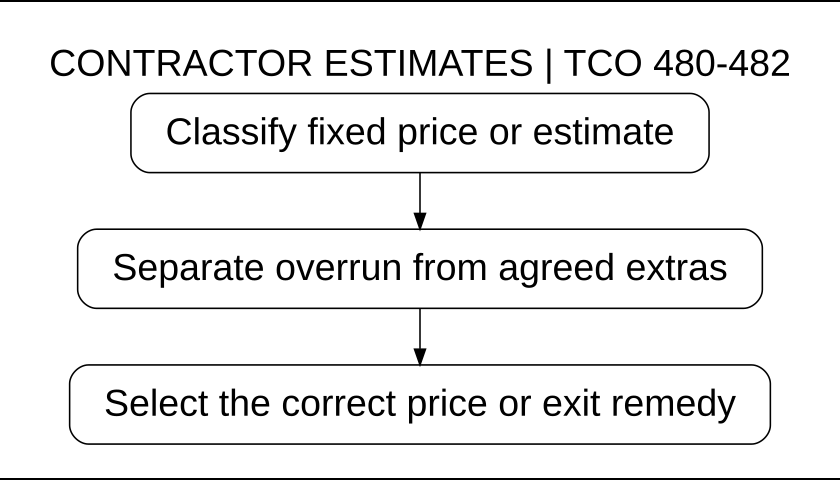
Classify the price before discussing a percentage increase
A fixed overall price, an approximate estimate and a price not agreed in advance are different legal arrangements. Article 480 concerns the first; Article 481 addresses the latter two. Article 482 then provides a special protection connected with an initially approximate price. Applying that protection requires establishing the relevant original estimate.
Read the accepted quotation with its schedules and the parties’ communications. A document headed quotation can contain a fixed commitment or an estimate subject to stated quantities. The title alone does not decide the agreement. Record the words used, the items included and any expressly agreed adjustment mechanism.
The statutory source is Law No. 6098, Articles 479–482. The contract’s real content must be identified before an increased demand is classified as an agreed price, a requested variation, an expense calculation or an excessive overrun.
A fixed-price contractor generally bears higher labour and expenditure
Article 480 requires a contractor who agreed a fixed overall price to produce the work for that amount. The contractor cannot request an increase merely because more effort or expenditure was required than anticipated. A mistake in the contractor’s own cost budget is not automatically an amendment to the client’s agreed price.
The same article also provides a specific adaptation route for circumstances not initially foreseen, or foreseeable but not taken into account, that prevent or make performance extremely difficult at the agreed fixed price. It addresses judicial adaptation and, under its conditions, withdrawal or termination. That exception is more precise than a statement that every cost increase is payable.
Conversely, when the work requires less labour or expenditure than expected, Article 480 generally leaves the full fixed price payable. This reciprocal allocation of cost risk distinguishes a fixed price from a running account of actual expenditure. The hardship and adaptation guide discusses the related but distinct general adaptation framework.
Article 481 does not make the contractor’s invoice conclusive
When price was not fixed in advance or was determined approximately, Article 481 directs assessment by reference to the work’s value at the place and time it was performed and the contractor’s expenditure. The final price therefore requires an evidential assessment; it is not established solely by the amount typed into a later invoice.
Retain quantity measurements, the agreed standard, procurement records and documents showing the work performed. A supplier invoice proves a stated charge by that supplier, but it must still be connected with this project. Equipment retained for other work and materials not used require separate accounting rather than automatic inclusion.
Do not collapse the work’s value and expenditure into an unexplained total. A reasoned valuation should show its method and avoid counting the same element twice. Where an expert assessment is required, provide the accepted scope and source records rather than ask the expert to infer the bargain from a disputed final bill.
Article 482 requires an initially approximate price
The first condition is an approximate price established at the outset. Identify the actual estimate and the transaction it covered. A private budget the client never communicated, or an informal figure from an unrelated provider, is not automatically the estimate contemplated by the agreement.
The estimate should be read in its context. A figure covering only an initial stage does not necessarily estimate the whole project. A range, provisional quantity or excluded item must remain visible. An English summary should not remove qualifications found in the signed Turkish quotation.
Where no initial approximate price was established, Article 481 may still govern determination of a price not agreed in advance. That does not justify pretending that Article 482’s initial-estimate condition has been proved. Price assessment and the special overrun remedy are separate questions.
The increase must be excessive, not simply any increase
Article 482 uses the threshold of an excessive overrun. Its text does not prescribe a universal numerical percentage that resolves every case. A guide should therefore not invent a statutory ten-percent or twenty-percent cancellation rule and present it as the wording of this provision.
Compare like with like. The initial figure and projected final amount should concern the same scope, quantities and price basis. Identify taxes, currency, exclusions and approved additions consistently. A comparison between a tax-exclusive initial estimate and a tax-inclusive expanded project can misstate the true increase.
The reasoned analysis should explain the scale and source of the excess in the actual bargain. A detailed forecast can show that a substantial overrun will occur before every expense has been incurred. The statutory language concerns it becoming apparent that the estimate will be excessively exceeded; it does not require ignoring that evidence until the final invoice arrives.
The overrun must arise without the client’s fault
Article 482 expressly includes absence of the client’s fault in the excessive overrun. The factual account must therefore identify changes, instructions, access restrictions and other acts said to have affected cost. A conclusion based only on the two price totals leaves this separate condition unanswered.
Keep original specifications apart from later instructions. A client’s documented choice to add work or alter materials needs to be assessed according to the agreement. A contractor’s own correction of an error should not automatically be described as a paid client variation simply because the corrective work occurred after the estimate.
Include documents supporting both sides’ explanations. The review should identify which increases relate to authorised changes, which to the original work and which remain disputed. That structure allows the legal conditions to be tested instead of treating every extra cost as either automatically payable or automatically unlawful.
The general provision allows withdrawal before or after completion
Under Article 482’s first paragraph, the client can withdraw before the work is completed or after completion when the specified conditions exist. Completion alone does not therefore eliminate the general statutory route. The paragraph must, however, be read with the special rule for work on the client’s land.
Record when the likely excess became apparent, the information provided and the response. A demand for clarification, a proposal to limit the scope and a declaration withdrawing from the agreement have different effects. The chosen remedy should be stated accurately rather than left to inference from an angry message.
The financial consequences require their own account of performance, payments and retained value. Article 482 should not be advertised as an automatic entitlement to every advance plus all replacement expenses. Identify the supported legal basis for each amount sought and avoid overlap.
Work on the client’s land has a distinct price and termination rule
Where the work is being produced on the client’s land, Article 482’s second paragraph allows the client to request an appropriate reduction of the price. For unfinished work, it also allows the client to stop the contractor from continuing and terminate by paying an equitable amount for the completed part.
The distinction between completed and unfinished work is material to the termination alternative. Establish the project’s actual stage at the relevant time, not merely whether the final invoice was paid. Completion, delivery and acceptance must be documented rather than treated as synonyms.
The land-specific provision should not be replaced with a blanket statement that every delivered structure can be removed and every payment refunded. Nor should every service performed at an address automatically be classified as work on the client’s land. The subject matter and statutory category require examination.
Do not confuse the equitable-payment route with voluntary cancellation
Article 484 addresses the client’s separate decision to end an unfinished works contract while paying for the part performed and compensating the contractor’s entire loss. That is not the same wording or statutory basis as the land-work alternative in Article 482.
The voluntary project-cancellation guide explains that distinct route. A notice relying on an excessive estimate overrun should identify the estimate, excess and relevant conditions rather than simply say that the client no longer wants the project.
The correct classification matters for the contractor as well. A claim for the full consequences of voluntary cancellation should not ignore a properly supported Article 482 argument. Each side should address the actual legal basis rather than choose the most favourable label without examining the facts.
A variation register isolates agreed additions from disputed excess
For each asserted change, retain the instruction, the person who authorised it, the contractor’s response and the effect on price. State whether a sum was agreed, a new estimate was provided or pricing was left to another supported mechanism. The word extra on a final invoice is not itself evidence of assent.
A site representative’s authority should be checked separately from the fact that the representative was present. Permission to arrange access or choose a finish does not necessarily confer authority to approve a substantial new budget. The relevant mandate and communications explain the scope.
The amendment and signature guide addresses the form and consent questions. Approved additions should be reflected in the comparison, but an unaccepted revised quotation should not silently replace the original estimate.
Technical defects and cost overruns require different analyses
A project can exceed its estimate and also contain defects. Article 482 addresses the pricing situation; Articles 474–477 concern inspection, defect remedies and acceptance. A complaint about price should not replace a necessary notice concerning defects in the delivered work.
The renovation disputes guide covers those broader issues. A technical report should identify whether the disputed expenditure concerns original work, repair of deficient performance, an improvement or a genuine extra instruction.
Where another contractor will intervene, preserve the earlier condition and progress through an appropriate lawful process. The evidence-preservation guide explains that separate step. Replacement work can otherwise remove the evidence needed to value what the first contractor supplied.
Reconcile the account before paying or demanding a refund
Article 479 generally links the client’s payment obligation to delivery of the work. Where staged delivery and separate prices were agreed, each part’s price becomes due upon its delivery under that provision. The actual payment schedule and any valid special agreement must still be examined.
Build an account showing the initial estimate, accepted changes, supported work value, payments, direct supplier payments and any credits. Identify whether a claimed amount is already paid, merely invoiced or only projected. That distinction matters when selecting a price-reduction claim, a defence to an invoice or a repayment demand.
Maintain the original currencies and explain every conversion used. A cost increase caused by inconsistent conversion dates is not the same thing as an increased quantity or contractor expense. The assessment must show its accounting method rather than conceal that difference inside a single total.
Review adjustment clauses rather than accepting them at face value
A contract can contain provisions about provisional sums, quantities or price adjustment. Their scope must be established before the estimate is treated as an unconditional ceiling or an unrestricted cost-plus arrangement. Read the clause with the accepted description of the work.
Pre-written conditions also raise the incorporation and control rules in Articles 20–25. The standard-terms guide explains why the presence of a unilateral price-change clause does not, by itself, establish that every later increase binds the client.
An agreed new price can change the factual starting point, but it requires proof of the agreement and its scope. A client’s acknowledgement that an estimate email arrived is not automatically approval of every revised amount. Preserve the exchange in full.
An overseas client’s review file should make the comparison reproducible
| Document group | Question it answers |
|---|---|
| Initial quotation and contract | Was the price fixed, approximate or left unagreed? |
| Original scope and exclusions | What did the initial amount actually cover? |
| Approved variations | Which additions changed the authorised work or price? |
| Cost and progress records | Why will the estimate be exceeded and what has been completed? |
| Client instructions and access records | Is the alleged excess attributable to the client? |
| Payment reconciliation | Which supported sum remains payable or returnable? |
For an international agreement, determine governing law and any mandatory consumer or other special provisions before applying the domestic framework. The governing-law guide addresses that initial issue. A pending lawsuit or payment order still requires a timely procedural response, independently of negotiations over the project account.
Frequently asked questions
Does an estimate allow unlimited final charges?
No. Articles 481–482 require price assessment and provide a specific remedy for an excessive initial-estimate overrun without the client’s fault. The actual agreement and evidence control.
Does Article 482 set a universal percentage threshold?
No fixed percentage appears in its text. Establish an excessive increase in the particular bargain instead of presenting an invented numerical threshold as statutory law.
Can a fixed-price contractor charge more merely because costs rose?
Article 480’s general rule says no. Its separate adaptation conditions must be established where relied on; an ordinary budget overrun does not automatically change the fixed price.
What if no price was agreed in advance?
Article 481 assesses price using the work’s value at the place and time of performance and contractor expenditure. Article 482 additionally requires an initially approximate price.
Must the client wait for the final invoice?
Article 482 addresses it becoming apparent that the estimate will be excessively exceeded. The forecast and other statutory conditions must be supported by evidence.
Can the general withdrawal right apply after completion?
The first paragraph expressly covers before or after completion. The special second paragraph for work on the client’s land must be assessed separately.
What is different for work on the client’s land?
Article 482 allows an appropriate price reduction and, for unfinished work, stopping further work and terminating against an equitable payment for the completed part.
Do approved additions belong in the overrun comparison?
Yes. Establish their agreed scope and price effect. An expanded project must not be compared with the original estimate as though no additions occurred.
Is this the same as voluntarily cancelling under Article 484?
No. The provisions have different conditions and financial consequences. State the supported reason for ending the relationship rather than use the labels interchangeably.
Which records are needed for an English-language review?
Provide the initial estimate, contract, scope, variations, progress and cost records, notices and complete payment reconciliation, together with any served proceedings.
Official legal sources
Turkish Code of Obligations No. 6098, Articles 20–25 and 474–484; official Ministry text, page 97, setting out Articles 479–482. This English explanation is not an official translation or a substitute for valuation of the actual project.
Ask about a contractor’s increased price
State the initial estimate, current demand, work completed and any approved additions. Send confidential contracts and financial records only through an agreed secure channel.
Istanbul and Mersin offices
Bakırcı & Keskin Law Office is Mersin-based and works throughout Türkiye with an Istanbul and Mersin focus.
Istanbul — Polaris Plaza
Maslak Ahi Evran Caddesi, Polaris Plaza No:21, Floor 9, 34475 Sarıyer/İstanbul.
Mersin — Profit İş Merkezi
İhsaniye Mahallesi, 4903. Sokak, Profit İş Merkezi No:23, Floor 3, Office 14, 33070 Akdeniz/Mersin.
Call +90 552 224 43 66. An enquiry does not establish representation or suspend a legal deadline.
Contact regarding a legal matter
In your first message, you may briefly state the subject, your country or city, and any relevant notification or recent procedural date. Please do not send identity numbers, medical data, or personal documents. Messaging alone does not constitute legal advice or create a lawyer–client relationship.
Discover more from Bakırcı & Keskin Hukuk Bürosu
Subscribe to get the latest posts sent to your email.