Ending a Mandate in Turkey: Resignation, Death and Unfinished Affairs Under TCO 512–514
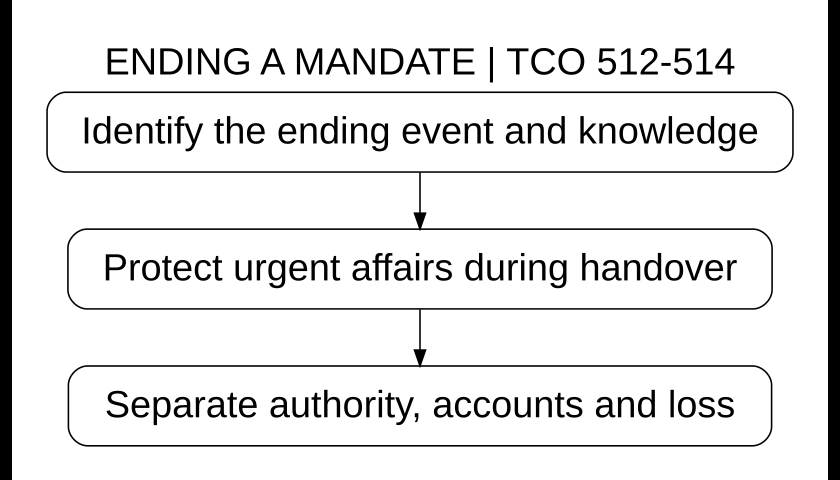
Ending a Turkish mandate does not always mean that every task can be abandoned immediately or that every later act is automatically without legal effect. Article 512 of the Turkish Code of Obligations permits unilateral termination by either party but requires compensation for loss caused by inappropriate timing. Article 513 addresses death, loss of capacity and bankruptcy, subject to the agreement and nature of the work, and imposes a protective continuation duty where the principal’s interests are endangered. Article 514 separately governs work done before the agent learns that the contract ended. A reliable handover must identify the ending event, knowledge, urgent affairs and outstanding account.
Have a general question about this article? Ask anonymously
A mandate is not identical to every agency or representation arrangement
Article 502 defines a mandate as an undertaking to conduct a business or transaction for the principal. The internal arrangement concerns what work is owed, the instructions, remuneration and expenses. It must be distinguished from the authority to make legal transactions binding on another person.
The English expression agency agreement can also describe a commercial agency, employment or distribution relationship governed by different provisions. Identify the actual undertakings and the applicable contract type before treating Article 512 as the complete answer to every termination question.
The main source is Law No. 6098, Articles 502 and 512–514. This guide concerns the internal mandate and the period when unfinished affairs pass to someone else. The existing power-of-attorney revocation guide addresses the separate practical task of withdrawing documented authority from abroad.
Article 512 gives both parties a unilateral ending route
The principal and the agent can each terminate the mandate unilaterally under Article 512. The provision does not make ending dependent on a mutual settlement of every disputed expense. The right to end and the account arising from the work already undertaken are distinct questions.
The declaration should identify the mandate and its scope. A person can have several separate engagements with the same counterparty. An instruction to stop one transaction should not automatically be reported as terminating every unrelated service, while a complete ending notice should not be reduced to an administrative pause without reading its wording.
Record who communicated the decision, that person’s capacity and the evidence of communication. A draft letter saved but never sent does not establish the other party’s knowledge. A message from an unauthorised family member or employee also requires an authority assessment before it is treated as the principal’s final instruction.
Inappropriate timing can create a separate compensation claim
Article 512 requires the party ending the relationship at an inappropriate time to compensate the other party’s resulting loss. A statutory right to terminate therefore does not mean termination is necessarily cost-free in every circumstance. Equally, the provision does not award a fixed cancellation fee merely because the relationship ended.
Identify the timing problem and the loss caused by it. The account should distinguish damage attributable to the manner or timing of the ending from an unpaid fee for earlier work or a properly incurred expense. A demand for compensation should explain that causal distinction rather than combine every outstanding issue into one penalty.
The factual review should include pending deadlines, the opportunity for replacement, warnings and the steps actually taken to avoid an unmanaged transition. Article 512 does not prescribe one universal notice period for all mandates. A special professional or procedural rule, where applicable, must be checked separately rather than invented from the general provision.
The ending decision does not decide whether earlier work was proper
A principal’s wish to change agents is not itself proof of misconduct. An agent’s resignation is not itself an admission of fault. Allegations about earlier performance must be connected with the actual duties and evidence, including the instruction and care requirements in Articles 505–507.
The instructions and delegation guide explains that separate review. Preserve both the original directions and approved changes. A later dispute over the quality of the work should not lead either party to alter the historical record of what was authorised.
The same distinction matters in settlement. A handover can proceed while the parties reserve an earlier compensation dispute. The inventory and closing communications should state what is acknowledged, delivered or left unresolved instead of treating every practical cooperation as a complete release.
Article 513 supplies a default rule for death, incapacity and bankruptcy
Unless the contract or the nature of the work indicates otherwise, the mandate ends automatically upon the death, loss of capacity or bankruptcy of the principal or agent. Article 513 also applies the rule where a legal-person party ceases to exist. Each event requires evidence of the actual legal position.
Read any continuation clause and the work’s nature before announcing an absolute result. The statutory qualification is part of the rule. A guide saying that every mandate inevitably ends on death regardless of its content would omit the exception stated in the provision.
Obtain the relevant official event record and the contract. Temporary absence, an informal report of illness, an unpaid invoice and a formal loss of capacity or bankruptcy are not interchangeable. Do not substitute a rumour or an assumption about an individual’s condition for the legal event relied on.
A company officer’s departure is not necessarily the company’s disappearance
Article 513 addresses the legal-person party ceasing to exist. First identify whether the principal was the company or an individual acting personally. The departure or death of the individual who signed for a company should not automatically be equated with the company itself ceasing to exist.
Review the engagement, signatory capacity and current corporate records. A new management team may need to communicate fresh instructions or revoke authority, but those acts have their own legal effect. The earlier officer’s name in the email chain does not by itself identify the contracting principal.
Where the legal entity is undergoing a formal process, obtain the relevant representation and administration documents. The authority of a liquidator, insolvency office or successor must be established under the applicable rules. Article 513 is not a substitute for examining who can currently give instructions for the party concerned.
Ending can trigger a duty to protect the principal’s affairs
Article 513 requires continuation where the ending of the mandate endangers the principal’s interests. The agent, the agent’s heir or representative must continue performance until the principal, the principal’s heir or representative can manage the affairs personally. The provision addresses the gap between ending and effective control of the unfinished work.
This protective duty should be tied to the actual danger and necessary transition. Identify what must be preserved, which step cannot safely be postponed and who is able to take over. It does not turn every former agent into an unrestricted long-term manager of all the principal’s affairs.
The record should distinguish protective continuation from new discretionary business. Preserve the reason for each step, the person acting, communications and expenditure. That account makes it possible to assess whether the action protected the existing matter or went beyond the transitional task.
Establish the successor’s ability and authority to take over
The end point in Article 513 is not merely the existence of somebody describing themselves as a relative or successor. Identify the person entitled to take control and whether that person can actually manage the relevant affairs. Different documents may establish inheritance, representation and practical receipt of the file.
Provide the pending work schedule and essential records through an appropriate confidential channel. The handover should show what was transferred, who received it and which matters still need attention. A message saying the matter is now yours is not necessarily evidence of a usable transfer.
Where heirs disagree or no authorised representative is available, identify the appropriate legal route rather than treat the most vocal participant as automatically authorised. The general continuation duty does not resolve every inheritance or corporate-representation dispute.
Article 514 protects work done before the agent learns of the ending
For work carried out before the agent learns that the mandate ended, Article 514 makes the principal or heirs responsible as though the contract continued. The date of the ending event and the date of the agent’s knowledge must therefore be recorded separately.
A later discovery that the principal died or the agreement ended does not automatically justify describing every intervening act as knowingly unauthorised. Establish the actual chronology and evidence of notification. Conversely, the provision should not be used to disregard proof that the agent already knew.
Keep the relevant communication in its complete form, including attachments and delivery information. A cropped screenshot can omit the event or instruction of which the agent was informed. The knowledge inquiry requires a traceable record, not a retroactively chosen date intended to improve one side’s account.
External authority requires its own review under Articles 42–45
Article 42 permits limitation or revocation of authority arising from a legal transaction while preserving rights under the underlying employment, mandate or partnership relationship. It also protects good-faith third parties where authority was communicated to them but its revocation was not. Ending the internal relationship and notifying outside parties are therefore separate tasks.
Article 44 requires return of an authority document, or deposit at the place determined by the judge, when authority ends. Its further rule addresses damage to good-faith third parties where the principal or successors fail to take the necessary steps to recover the document. Retain the document inventory and return record.
Article 45 concerns acts while the representative does not know authority has ended and expressly excludes the case where the third party knew. That external rule must not be collapsed into Article 514’s internal mandate rule. The international representation guide addresses the separate cross-border authority inquiry.
The account must separate fees, expenses, receipts and loss
Article 508 requires an account on the principal’s request and delivery of what the agent received in connection with the mandate. Article 510 separately addresses reimbursement of qualifying expenses and advances and discharge from third-party obligations. Ending the engagement does not make one side’s account replace the other side’s entitlement automatically.
The accounting guide and expense-reimbursement guide explain those distinct obligations. Identify funds held, expenses paid, outstanding supplier debts and remuneration according to their actual legal basis.
Any claim for loss caused by inappropriate termination timing should remain separately itemised. An agent should not treat all future proposed fees as automatically earned, and a principal should not assume that termination proves every earlier payment refundable. The engagement and applicable special rules determine the supported balance.
Digital access and original records need a controlled handover
Identify the documents, keys, access permissions and electronic records connected with the mandate. Separate the principal’s records from unrelated private information belonging to the former agent. A legitimate need for the file does not authorise entering someone else’s personal email or banking account without permission.
Use an inventory that distinguishes originals, copies and records lawfully retained by a court, public authority or third party. A scanned image of an original instrument should not be described as delivery of the original unless that is what occurred. Likewise, an unavailable item should be identified honestly rather than covered by a general statement of complete handover.
Changes to access should be coordinated with the actual authority and safety needs of the matter. Retain evidence of what was transferred or disabled and avoid destroying material relevant to the pending account. The objective is continuity and a traceable record, not retaliatory interference with either party’s systems.
Special proceedings do not pause because the mandate ended
A hearing, filing period, contractual response date or administrative requirement belongs to the underlying matter. An internal ending notice does not itself adjourn the hearing, file an objection or appoint a replacement representative. The pending procedural record must be reviewed separately.
Where a professional representative is involved, apply the particular profession and procedure’s rules on withdrawal, notification and continuing duties. Articles 512–514 do not supply a universal number of days that can safely be substituted for those rules.
For a principal or successor abroad, supply the original mandate, authority documents, ending or event records, communication chronology, account and urgent dates. Preserve source-language records beside translations. The legal conclusion should identify what ended, when it became known, which protective work remains and who is authorised to receive the file.
A handover record should answer six practical questions
| Question | Record to retain |
|---|---|
| What relationship ended? | The engagement, scope and relevant continuation terms. |
| What caused the ending? | The termination declaration or official event document. |
| When did the agent learn? | The complete notice and communication evidence. |
| What required immediate protection? | Pending affairs, deadlines and documented protective steps. |
| Who could take over? | Authority, successor status and the actual handover inventory. |
| What remains financially unresolved? | The separate fee, expense, remittance and damages accounts. |
Frequently asked questions
Can either party end an ordinary mandate unilaterally?
Article 512 permits unilateral ending by the principal or agent. The relationship’s classification and any special rules must first be established.
Is unilateral ending always free of compensation?
No. Article 512 requires compensation for loss caused by ending at an inappropriate time. The timing, causal connection and loss need evidence.
Does every mandate inevitably end on death?
Article 513’s default rule is qualified by the agreement and the nature of the work. Review those before stating the effect of death in the particular relationship.
Does the death of a company signatory necessarily end the company’s mandate?
Not merely because that individual signed for the company. Identify the contracting party; an officer’s death is not automatically the legal person’s cessation.
Can urgent affairs simply be abandoned after ending?
Article 513 requires protective continuation where ending endangers the principal’s interests, until the principal, heir or representative can manage the affairs.
What about work done before the agent learned of the ending?
Article 514 makes the principal or heirs responsible for that work as though the mandate continued. Establish the actual knowledge chronology.
Is ending the mandate the same as notifying every third party that authority ended?
No. The underlying contract and external representation have separate rules. Articles 42–45 require review of notice, documents, knowledge and third-party protection.
Does termination itself settle fees and expenses?
No. Account for earned remuneration, qualifying expenses, money held and any separately supported timing-related loss. A release requires its own basis.
Does Article 512 create one universal notice period?
The provision does not prescribe a single number of days for all mandates. The circumstances and applicable professional or procedural rules require separate examination.
Does changing agents stop a court deadline?
Not by itself. The underlying proceeding and required response continue under their own rules. Preserve the served document, service date and handover record.
Official legal sources
Turkish Code of Obligations No. 6098, Articles 42–45, 502 and 508–514; official Ministry text, page 103, containing Articles 512–514. This English explanation is not an official translation or a substitute for special representation and professional rules.
Ask about an unfinished mandate
State the ending event, when it became known and which tasks or dates remain urgent. Arrange a confidential channel before sending personal, corporate or financial records.
Istanbul and Mersin offices
Bakırcı & Keskin Law Office is Mersin-based and works throughout Türkiye with an Istanbul and Mersin focus.
Istanbul — Polaris Plaza
Maslak Ahi Evran Caddesi, Polaris Plaza No:21, Floor 9, 34475 Sarıyer/İstanbul.
Mersin — Profit İş Merkezi
İhsaniye Mahallesi, 4903. Sokak, Profit İş Merkezi No:23, Floor 3, Office 14, 33070 Akdeniz/Mersin.
Call +90 552 224 43 66. An enquiry does not establish representation or suspend a legal deadline.
Contact regarding a legal matter
In your first message, you may briefly state the subject, your country or city, and any relevant notification or recent procedural date. Please do not send identity numbers, medical data, or personal documents. Messaging alone does not constitute legal advice or create a lawyer–client relationship.
Discover more from Bakırcı & Keskin Hukuk Bürosu
Subscribe to get the latest posts sent to your email.