Publishing Contracts in Turkey: Unpaid Royalties, Reprints and Translation Rights
A Turkish publishing agreement does not automatically authorise unlimited editions, translations or combined publication of an author’s separate works. Articles 487–501 of the Turkish Code of Obligations regulate the publishing contract, including written form, the extent of transferred rights, print runs, payment and sales accounts. Article 495 requires an express contractual provision for translation rights to pass to the publisher. Article 497 requires accounts and customary supporting documents where remuneration depends on sales. An author seeking unpaid royalties should therefore examine both the payment account and the scope of the publication actually authorised.
Have a general question about this article? Ask anonymously
Identify the publishing undertaking and the person entitled to grant it
Article 487 describes a contract in which the owner of an intellectual or artistic work, or a successor, entrusts it to a publisher for publication, and the publisher undertakes reproduction and publication. The agreement is therefore more than delivery of a manuscript file. Identify the work, the rights holder and the publication the publisher undertook.
The contracting rights holder and the individual author are not always the same person. A successor must establish the relevant entitlement, while a representative must establish authority to contract for the person represented. A payment to an editor or intermediary should not be treated as proof that the publisher acquired every necessary right.
The primary source is Law No. 6098, Articles 487–501. This guide concerns contractual publishing duties and remuneration. The separate intellectual-property rules governing protected works, economic rights and infringement must also be considered where those issues arise.
Written form is required for validity
Article 488 makes the publishing contract’s validity dependent on writing. Preserve the complete executed agreement and schedules identifying the work, language, format, editions and remuneration. A summary of a telephone conversation is not automatically the same as an agreement satisfying the required form.
The separate Copyright Law No. 5846, Article 52, requires agreements and dispositions concerning economic rights to be written and to identify the rights individually. Do not treat a general publishing label as a substitute for specifying the economic rights actually granted. Article 489’s extent-and-duration rule must be read together with those intellectual-property requirements.
Where the parties later change the publication or payment terms, examine the applicable amendment form as well. The written-amendment guide explains the distinction between statutory form, supplementary provisions and an agreed signing requirement.
The contract should also identify the version entrusted for publication. A revised manuscript, an approved proof and an earlier draft can contain materially different text. Keep version and approval records with the execution documents so that a later dispute does not rest on an unexplained file name or an isolated signature page.
The publisher receives rights only to the extent and for the time required
Article 489 provides that the author’s rights pass to the publisher to the extent and for the duration required to perform the publishing contract. The provision should not be paraphrased as an unrestricted assignment of every use of the work forever. The contract’s purpose and expressly granted rights remain central.
The person arranging publication is responsible to the publisher for lacking the right to publish when the contract was concluded and, for a protected work, for lacking the copyright entitlement. Establish the chain of rights before representing the manuscript as available for the proposed publication.
Article 489 also requires disclosure before contracting where all or part of the work has already been entrusted to another publisher or published with the rights holder’s knowledge. Retain prior agreements and publication records. A new publisher should not be asked to assume that earlier online availability, serial publication or another edition is legally irrelevant.
Edition number, copy quantity and contractual duration must not be confused
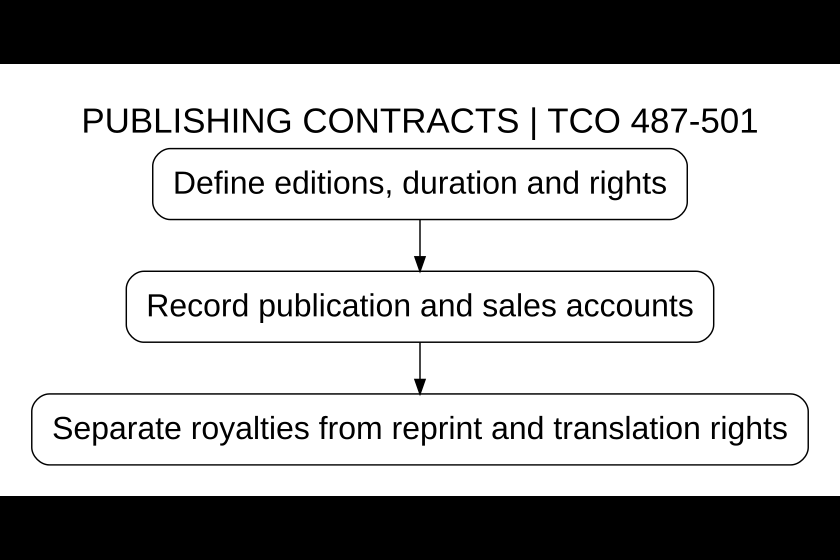
Article 491 gives the publisher only one edition where the agreement does not specify the number of editions. It also requires the parties to agree the contract’s duration or the number of copies. These are distinct measurements: the number of editions is not the same as the number of physical copies printed.
A review should identify each measurement in the agreement and the production record. A clause allowing one edition does not itself establish an unlimited copy quantity, while a specified quantity does not necessarily authorise repeated new editions. Avoid translating both statutory expressions as print run without explaining which is meant.
Request production, inventory and distribution records where the dispute concerns excess printing or an alleged new edition. A retail listing can show availability but does not necessarily establish how many copies were printed. The account needs the actual production and stock evidence, not only promotional language.
Failure to produce an authorised new edition has a specific remedy
Where the publisher is authorised to produce several specified editions or all new editions, Article 491 addresses failure to publish again after the available copies are exhausted. The rights holder must give a suitable period for the new edition. If the publisher does not produce it within that period, the rights holder can withdraw from the agreement.
Establish exhaustion of the copies and the notice giving the additional period. A book temporarily unavailable at one retailer does not, without more, prove exhaustion of the publisher’s relevant stock. The publisher’s inventory and distribution position should be examined alongside the agreement.
The statute does not supply one universal thirty-day reprint period for every work. The period must be suitable for the publication concerned. Preserve the demand and delivery record, and distinguish this particular route from a general complaint that sales are disappointing.
Reproduction and distribution are affirmative publisher obligations
Article 492 requires appropriate reproduction without abridgements, additions or changes. It also requires the promotion and distribution necessary to increase sales and the measures needed for that purpose. The publisher’s contractual task therefore cannot be reduced to storing a file or producing a token copy without examining the publication undertaking.
Compare the approved work with the published version where alteration is alleged. Identify the changed passages and any actual consent or separate editing arrangement. The mere existence of an editorial process does not establish permission for every substantive change.
The publisher sets the sale price subject to not making sale of the work more difficult. A pricing dispute should examine the actual price and its relation to the publication rather than assume the author has an unrestricted statutory power to dictate every retail decision. Production, promotion, distribution and pricing need their own evidence.
The author’s correction right and a successor’s updating right differ
Article 493 permits the author to correct and improve the work, and successors only to update it, provided the publisher’s interests are not harmed and its responsibility is not increased. The distinction between authors and successors should remain visible when an estate or another successor proposes changes.
Costs not provided for in the agreement but required by such corrections and improvements are borne by the person arranging publication. Record the change, its cost and the original allocation. A disagreement over additional editing expenses should not be concealed inside an unexplained deduction from the royalty statement.
The publisher cannot make and reproduce a new edition without giving the author the opportunity to improve the work or successors the opportunity to update it. Keep the notification and response history. Giving that opportunity is different from assuming that silence authorises an unrelated rewrite.
Combined editions and translations require separate authority
Article 494 states that permission to publish several works separately does not authorise combined publication. Conversely, permission to publish all works or works of one category together does not authorise separate publication of each. A collected edition and an individual edition are therefore not automatically interchangeable uses.
Article 495 separately requires translation rights to be expressly mentioned for them to pass to the publisher. A general statement that the publisher will distribute the book internationally should not be treated, without interpreting the actual grant, as proof that translation rights were expressly transferred.
For a multilingual publication, identify the original work, authorised language, translator arrangements and the publisher’s actual grant. The right to publish the original and the right to create or exploit a translation require a coherent rights record. This article does not assume that every language version shares the same chain of entitlement.
Payment is available by default, but the amount must be established
Article 496 allows the rights holder to request remuneration unless the agreement provides otherwise. Where remuneration is payable but its amount is not determined, the judge determines it. The provision does not prescribe one standard royalty percentage for every Turkish publication.
If the publisher has authority for more than one edition, the price and other conditions agreed for the first edition are treated as applying to later editions. Check whether the agreement contains a valid different arrangement and identify the editions actually produced before calculating the account.
A flat fee, a per-copy payment and a share of sales proceeds produce different calculations. State the agreed base, rate, currency and deductions. An advance should be identified as such, with the applicable recoupment arrangement, rather than silently treated as either the entire remuneration or an extra amount outside the agreed account.
Article 497 governs payment timing and sales-account evidence
Where the work is to be published as a whole, Article 497 makes payment after the whole work is printed and ready for sale. Where publication is in volumes, instalments or comparable parts, payment follows printing and readiness for sale of each part. Identify the actual publication structure and any relevant payment terms.
If remuneration is linked to sales quantity, the publisher must keep and produce sales accounts and prepare customary supporting documents. A single number labelled total royalties is not the same as a transparent sales calculation. The records should allow the contractual formula to be checked against the relevant sales.
Distinguish printed stock, supplied copies, sold copies, returns and copies given without charge. Those categories should be recorded consistently with the contract’s remuneration base. A warehouse dispatch does not necessarily establish a completed retail sale, while an unexplained return adjustment should not be accepted as self-proving.
The author’s complimentary-copy entitlement is separate from royalties
Unless otherwise agreed, Article 497 also gives the person arranging publication the customary number of free copies. That entitlement should not be confused with a right to take unlimited stock or with proof that the monetary remuneration was paid.
Keep the complimentary-copy record separate from sales and author purchases. Where the author buys additional copies, record the purchase terms and how those copies are treated in any sales-based account. The statutory provision does not itself establish a universal free-copy number or a fixed author discount.
An account can become unreliable when promotional copies, review copies and author copies are grouped under one undocumented adjustment. Request the relevant categories and support rather than assume every copy not producing retail revenue is a legitimate deduction under the particular agreement.
A lost manuscript and destroyed printed stock have different consequences
Article 498 keeps the publisher’s payment obligation in place where the work is accidentally destroyed after delivery to the publisher. If the author has another copy, it must be supplied; if there is none but the work can be recreated with little effort, the author must recreate and deliver it. Appropriate additional remuneration can be requested in both situations.
Article 499 concerns completed copies destroyed accidentally before being offered for sale. The publisher can reprint the destroyed quantity at its own expense without paying the rights holder an additional fee. If replacement is possible without excessive expense, the publisher must do so.
The incident record should therefore identify what was lost and when. Loss of the author’s delivered work, destruction of printed stock and disappointing sales are not one legal event. Insurance and backup records may assist the factual inquiry, but they do not replace the distinct statutory allocation.
Death, inability to finish and publisher bankruptcy require careful classification
Article 500 provides for automatic ending if the author dies before completion, loses the ability to finish or completion becomes impossible without the author’s fault. However, where full or partial performance remains possible and equitable, the judge can order continuation with the necessary changes.
If the publisher becomes bankrupt, the rights holder can give the work to another publisher, unless security has been provided for performance of the obligation not yet due at bankruptcy. A missed payment alone is not the bankruptcy event described by the statute, and a security question should not be omitted from the review.
Obtain the actual insolvency and contract documents before assuming the rights can be placed elsewhere. Continued obligations, unpaid accrued remuneration and the ability to relicense the work are separate issues. A new publisher should receive an accurate explanation of the old agreement’s status.
Work created to a publisher’s plan has a specific Article 501 rule
Where one or several people undertake to create a work according to the publisher’s plan, Article 501 gives them only the remuneration agreed in the contract and assigns the economic rights that are the subject of the agreement to the publisher. The actual planned-creation arrangement must be established before applying that rule.
It should not be expanded into a proposition that every commissioned piece of writing transfers every conceivable right, or that a publisher owns an author’s unrelated works. Identify the plan, the work undertaken and the economic rights actually within the agreement, alongside the applicable intellectual-property requirements.
A contract review should separate this arrangement from an author delivering an independently created manuscript under the ordinary publishing model. The label commissioned is not enough if the operative commitments and factual creation process show something different.
Documents for an international author or publisher
Collect the complete agreement, rights history, manuscript and proof versions, production quantities, distribution records and sales statements. Add corrections, reprint requests, translation permissions, payment records and the relevant notice history. Keep each edition’s account identifiable.
For a cross-border publishing arrangement concerning intellectual-property rights, MÖHUK Article 28’s special contract rule must be assessed rather than relying only on the general contract rule. It recognises the parties’ choice of law and, without a choice, identifies the transferring party’s business establishment at formation or, failing that, habitual residence, subject to a more closely connected law. The language of the book does not decide that inquiry.
The law governing protection of the intellectual-property right is a separate question under MÖHUK Article 23. The official Ministry text of Law No. 5718 supplies the conflict rules. If a claim has been served, preserve its service record. An ongoing royalty audit does not itself suspend a court or enforcement deadline.
Frequently asked questions
Does a publishing agreement require writing?
Yes. Article 488 makes written form a validity requirement. Keep the full executed agreement and its incorporated schedules.
Can a publisher print unlimited editions if the agreement is silent?
No. Article 491 permits only one edition where the number of editions was not specified and requires agreement on duration or copy quantity.
Does permission to publish automatically include translation rights?
Article 495 requires an express contractual provision for translation rights to pass to the publisher.
Can separately authorised works automatically be combined?
No. Article 494 distinguishes separate publication from combined publication and does not treat one grant as automatically including the other.
What can an author request where an authorised reprint is not produced?
Article 491 provides a suitable-period notice after copies are exhausted and a withdrawal right if the publisher fails to produce the new edition in that period.
Must a publisher provide sales accounts for sales-based remuneration?
Yes. Article 497 requires sales accounts and customary supporting documents where remuneration is tied to sales quantity.
Does the law prescribe one royalty percentage?
No. Article 496 recognises remuneration unless otherwise agreed and judicial determination where the payable amount was not fixed.
Is the publisher released from payment if the delivered manuscript is accidentally lost?
Not under Article 498. The provision preserves payment and separately regulates supplying another copy or recreating the work with appropriate remuneration.
Does publisher bankruptcy always permit immediate republication elsewhere?
Article 500 provides that route but includes an exception where security is given for performance of an obligation not yet due. The actual bankruptcy and security position must be examined.
Are all commissioned works treated as unlimited transfers of rights?
No. Article 501 addresses creation according to the publisher’s plan and the economic rights covered by the agreement. The work, contractual scope and applicable intellectual-property rules remain relevant.
Official statutory sources
Turkish Code of Obligations No. 6098, Articles 487–501; official Ministry text, pages 98–101. This guide explains publishing-contract rules, not every intellectual-property remedy. The English text is not an official translation.
Ask about a publishing contract
State the work, authorised editions and the unpaid fee or use being disputed. Do not include confidential manuscripts or identity numbers in the first message.
Istanbul and Mersin offices
Bakırcı & Keskin Law Office is Mersin-based, working throughout Türkiye with an Istanbul and Mersin focus. Agree a confidential channel before sending the documents relevant to your enquiry.
Istanbul — Polaris Plaza
Maslak Ahi Evran Caddesi, Polaris Plaza No:21, Floor 9, 34475 Sarıyer/İstanbul. Istanbul office directions.
Mersin — Profit İş Merkezi
İhsaniye Mahallesi, 4903. Sokak, Profit İş Merkezi No:23, Floor 3, Office 14, 33070 Akdeniz/Mersin. Mersin office directions.
Call +90 552 224 43 66. An enquiry does not establish representation or suspend a legal deadline.
Contact regarding a legal matter
In your first message, you may briefly state the subject, your country or city, and any relevant notification or recent procedural date. Please do not send identity numbers, medical data, or personal documents. Messaging alone does not constitute legal advice or create a lawyer–client relationship.
Discover more from Bakırcı & Keskin Hukuk Bürosu
Subscribe to get the latest posts sent to your email.