When Does Suretyship End in Turkey? The Ten-Year Rule and TCO Articles 598–602
A Turkish suretyship does not necessarily last until the lender closes its file. Article 598 of the Turkish Code of Obligations links the surety’s release to extinction of the principal debt and imposes a ten-year statutory duration for suretyship given by a natural person. Article 600 separately ends a fixed-term suretyship at the agreed expiry. Articles 599 and 601 provide different routes for withdrawal before a future debt arises and for requiring creditor action under an indefinite undertaking. These rules answer different questions. The correct release analysis starts with the undertaking’s legal character, execution date, agreed duration, debt history and any valid extension.
Have a general question about this article? Ask anonymously
The legal question is duration, not merely an unpaid balance
A lender’s statement showing an outstanding company debt establishes neither that an individual remains liable nor that the suretyship has expired. The principal claim and the personal security have related but distinct legal histories. A borrower can still owe money after a particular suretyship ends. Equally, an approaching statutory anniversary does not establish that the creditor has taken no legally relevant action before it. The complete agreement and procedural file must be read together.
This guide addresses the termination provisions in Law No. 6098, Articles 598–602. Formation requirements are examined separately in our personal-guarantee form and spousal-consent guide. Whether the creditor must pursue the borrower or collateral first belongs to the ordinary and joint suretyship enforcement analysis. A termination objection should identify its own statutory basis rather than repeat those separate arguments.
For an international transaction, establish that Turkish suretyship law governs the issue before applying these provisions. A foreign governing-law clause, execution abroad and an undertaking by a foreign company require their own classification. The ten-year rule discussed here expressly concerns natural-person sureties; it must not be presented as an automatic expiry rule for every corporate guarantee, bank undertaking or independent indemnity.
Article 598: extinction of the principal debt releases the surety
Article 598 begins with the rule that the surety is released when the principal debt ends, whatever the reason for that ending. The practical question is whether the identified secured obligation has actually been extinguished. A receipt, creditor release, settlement or other document must be matched to the correct debt. A document concerning a different facility or a payment covering only part of the balance cannot establish full extinction of the secured obligation.
The review should distinguish an extinguished debt from a postponed payment date, a changed account reference, an assignment of the claim or a temporary agreement not to enforce. Those descriptions do not themselves answer whether the original obligation ended. Read the operative terms of any restructuring or settlement, including the provisions concerning continuing security, payment conditions and discharge. A creditor’s internal administrative label is not a substitute for that analysis.
Article 598 also preserves special benefits arising from the suretyship for the creditor when the capacities of debtor and surety merge in one person. That express qualification prevents a simplistic rule that any change in the identity or legal position of the parties eliminates every consequence of the security. Identify the actual succession, transfer or other transaction before asserting release on that basis.
The ten-year statutory period for an individual surety
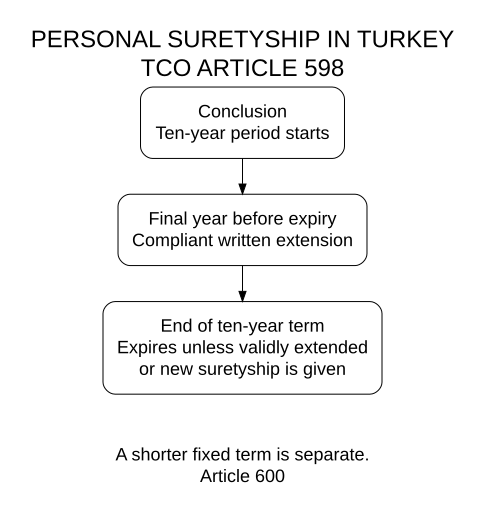
Under Article 598, suretyship given by a natural person ends automatically upon expiry of ten years from conclusion of the suretyship agreement. The provision further states that, even when a longer period was agreed, the surety can be pursued only until the ten-year period expires unless the suretyship has been extended or a new suretyship has been given. A clause calling an individual’s undertaking unlimited in time does not remove this statutory control.
The starting event is conclusion of the suretyship, not the date on which the bank most recently printed an account statement. A review therefore needs the signed original and the chronology of any later personal undertaking. Record the original agreement, each alleged extension, each replacement document and the date proceedings were commenced. Do not assume that a later transaction between lender and borrower reset the individual’s statutory period.
This is a rule on the duration and ending of suretyship, not merely the ordinary limitation period of a debt claim. A limitation defence, expiry of a fixed contractual term and statutory termination after ten years are legally different arguments. They should not be combined into the unsupported assertion that every ten-year-old debt has disappeared. The principal debtor’s obligation and any already commenced proceedings need separate treatment.
A valid extension requires the surety’s own compliant declaration
Article 598 permits an extension for a new period of no more than ten years through the surety’s written declaration conforming to the required suretyship form. The declaration cannot be made earlier than one year before the suretyship is due to end. The statute consequently regulates both the formal act and the permitted time for making it. A renewal provision included at the beginning of a long relationship is not automatically the later declaration required by this paragraph.
Read an alleged extension against those requirements. Identify who made the declaration, whether the signatory acted personally or through appropriately authorised representation, when it was made, what duration it states and which undertaking it extends. The form and any applicable spousal-consent questions must be checked rather than assumed from the existence of a signature elsewhere in the credit file.
A newly executed suretyship is a different legal possibility from extending the old one. The creditor relying on a new undertaking should identify its formation, secured obligation, amount and date. An individual disputing continuing liability should obtain the complete document rather than deny an extension solely because no paper is labelled “renewal”. Article 19 requires attention to the parties’ actual common intention when classifying contractual wording.
Fixed-term suretyship ends at the agreed expiry under Article 600
Article 600 provides that a fixed-term surety is released at the end of the agreed term. The agreed term of the suretyship must first be identified. A repayment date in the borrowing agreement is not necessarily an expiry date for the separate security, and a facility-review date is not necessarily either. Read the duration clause, the secured-debt description and any annex incorporated into the signed undertaking.
A contractual period shorter than the natural-person ten-year ceiling requires its own review; the existence of the statutory ceiling does not automatically convert a shorter undertaking into a ten-year promise. Conversely, writing a longer period into an individual’s suretyship does not remove Article 598. The two provisions should be applied to their respective questions instead of selecting whichever date produces the preferred commercial result.
The file must also show what action was taken during the relevant period. Do not treat a demand letter, an enforcement application and a pending lawsuit as interchangeable events. Their legal effects depend on the applicable rule and procedural posture. An expiry calculation without the dated enforcement record is not a complete opinion on whether a particular ongoing claim can continue.
Article 599 concerns a future debt that has not yet arisen
Withdrawal under Article 599 is not a general right to cancel an existing suretyship whenever the surety becomes uncomfortable. It concerns security for a future debt, before that debt has arisen. The article requires a significant deterioration in the debtor’s financial position after conclusion of the suretyship, or discovery that the debtor’s position was substantially worse than the surety had assumed in good faith at that time.
Where those conditions exist, the surety can withdraw by written notification to the creditor while the debt remains unborn. The decisive chronology therefore includes the suretyship, the financial deterioration or discovery, the notice and the creation of the secured debt. A notice dispatched after the relevant obligation arose cannot simply be treated as the statutory pre-debt withdrawal described by Article 599.
The provision also requires the surety to compensate the creditor for loss suffered through reliance on the suretyship. Withdrawal is therefore not presented by the statute as a cost-free right to reverse every credit decision. Preserve the evidence concerning the qualifying financial change, the notice and any reliance loss alleged by the creditor. The financial basis and the legal consequence must both be addressed.
Article 601: demanding creditor action under an indefinite suretyship
An indefinite suretyship is subject to a separate mechanism under Article 601. Once the principal debt is due, an ordinary surety can require the creditor to exercise its litigation and enforcement rights against the debtor within one month, to pursue realisation of any relevant pledge, and to continue the proceedings without interruption. A joint and several surety has this right in the circumstances prescribed by law.
The request must be based on the correct maturity and security position. It is not enough to tell the creditor informally to “sort the debt out”. Identify the undertaking, the due obligation, the statutory request, the actions demanded and the evidence of receipt. The creditor’s subsequent steps should then be recorded against the one-month requirement and the duty to continue the proceedings.
When maturity depends on a notice from the creditor to the debtor, Article 601 permits the surety, after one year from conclusion of the suretyship, to demand that the creditor give that notice. Once the debt becomes due through the notice, the creditor must use its litigation and enforcement rights in accordance with the preceding paragraph. This is a notice-and-enforcement sequence, not a declaration that every indefinite suretyship ends after one year.
The final paragraph provides release when the creditor fails to comply with the surety’s qualifying requests. Establishing that result requires the request and the creditor’s response or omission. A borrower-side promise to make future payments is not evidence that the creditor performed the statutory steps. Obtain the relevant proceeding numbers and dated records before drawing a conclusion.
Employee suretyship has a distinct termination provision
Article 602 addresses indefinite suretyship for employees. It allows the surety, every three years, to notify termination effective at the end of the following year. The provision concerns the security arrangement for the employee’s obligations, not the termination of the employee’s employment contract. Those are different agreements with different parties and consequences.
A file invoking Article 602 needs the date and scope of the employee suretyship and the termination notice. The notice cycle and its effective date must be distinguished. Do not describe an immediate release merely because a notice was sent. Nor should a rule concerning employee suretyship be extended to every commercial shareholder guarantee without establishing that the undertaking falls within the provision.
Build a release chronology rather than a single-date calculation
Prepare one chronology containing the suretyship date, the principal debt’s creation and maturity, each payment or settlement, each amendment or extension, the agreed expiry, notices and enforcement steps. Each entry should refer to its underlying document. Keep a separate statement of the amount still claimed and the security’s maximum amount. That organisation exposes whether the dispute is about duration, debt extinction, an alleged renewal or a creditor’s failure to act.
Historic undertakings require an additional transitional-law check under Law No. 6101. An agreement concluded before the Code entered into force cannot be resolved by applying a present-day summary mechanically to its old signing date. The applicable temporal rules and any later undertaking must be identified. This guide does not supply a universal historical expiry date for every pre-Code credit file.
A served payment order, summons or judgment remains an urgent procedural document even when a strong termination argument exists. Preserve the entire document and its service record. An email requesting release does not itself replace the required response in a pending proceeding. Our debt collection and enforcement guide explains why the procedure must be identified separately from the substantive defence.
Frequently asked questions
Does an individual Turkish suretyship continue forever?
No. Article 598 imposes a ten-year statutory duration from conclusion for natural-person suretyship, subject to a compliant extension or new undertaking. A fixed term can require a separate earlier-expiry analysis. Corporate and independent security instruments must not be assumed to follow the same rule.
Does the ten-year period begin with the last unpaid instalment?
Article 598 identifies conclusion of the suretyship as the starting event. The last unpaid instalment concerns the debt’s payment history, not automatically a new suretyship date. Examine any later personal undertaking and the date of proceedings separately.
Can a suretyship be extended for another ten years?
Article 598 permits a new period of no more than ten years through a written declaration complying with suretyship form, made no earlier than one year before expiry. The declaration’s timing and form must both be established.
Does repayment of the principal debt release the surety?
Article 598 provides release when the principal debt ends. The payment or discharge must concern the actual secured obligation. A partial payment or settlement of another facility does not prove complete extinction of that obligation.
Does a fixed-term suretyship last until the borrower eventually pays?
Article 600 provides release at the end of the fixed suretyship term. Identify the actual duration clause rather than equating the loan’s maturity with the security’s expiry. Existing proceedings and any valid replacement undertaking require their own review.
Can I withdraw before a future loan is advanced?
Article 599 permits written withdrawal before the future debt arises where its financial-deterioration or good-faith-discovery conditions are met. The creditor’s reliance loss remains compensable under the same article. Withdrawal is not an unrestricted cancellation right.
Can I force a creditor to take action against the debtor?
Article 601 provides a qualifying request mechanism for indefinite suretyship. It regulates maturity, action within one month and uninterrupted continuation, with a separate notice route where maturity depends on creditor notification. Non-compliance with qualifying requests results in release.
Does resigning as company director automatically cancel my suretyship?
Resignation is not one of the automatic termination events stated in Articles 598–602. Review the personal undertaking, its duration, debt discharge and any applicable release mechanism. The end of a corporate appointment and the end of a personal obligation are separate questions.
Is statutory expiry the same as limitation of the debt claim?
No. Article 598 concerns the ending of suretyship. Limitation concerns a different legal question. The principal claim, a contractual expiry and the personal-security duration must be analysed separately instead of assuming one ten-year rule decides all three.
What documents are needed for an overseas surety’s review?
Provide the complete undertaking, underlying loan, amendments, alleged extensions, repayment and discharge records, notices and all served procedural documents. Include original execution dates and delivery evidence. Arrange a suitable confidential channel before sending identity or financial records.
Official sources and scope
The statutory basis is the Turkish Code of Obligations No. 6098, particularly Articles 19 and 598–603. The official Ministry text contains the termination provisions. Transitional questions are governed by Law No. 6101. English explanations are not an official translation; the Turkish text governs.
Istanbul and Mersin offices
Our Mersin-based practice coordinates matters throughout Türkiye, with offices in Istanbul and Mersin. For an English-language review of a suretyship’s duration, state the execution date, your role and any urgent procedural deadline in the English contact section. Agree a confidential channel before sending financial or identity records.
Istanbul — Polaris Plaza
Maslak Ahi Evran Caddesi, Polaris Plaza No:21, Floor 9, 34475 Sarıyer/İstanbul. Istanbul office information.
Mersin — Profit İş Merkezi
İhsaniye Mahallesi, 4903. Sokak, Profit İş Merkezi No:23, Floor 3, Office 14, 33070 Akdeniz/Mersin.
Call +90 552 224 43 66. General legal information; an enquiry does not establish representation or suspend a deadline.
Contact regarding a legal matter
In your first message, you may briefly state the subject, your country or city, and any relevant notification or recent procedural date. Please do not send identity numbers, medical data, or personal documents. Messaging alone does not constitute legal advice or create a lawyer–client relationship.
Discover more from Bakırcı & Keskin Hukuk Bürosu
Subscribe to get the latest posts sent to your email.