Turkey Work Permit Missing-Document Requests: The Two Thirty-Day Rules
Short answer
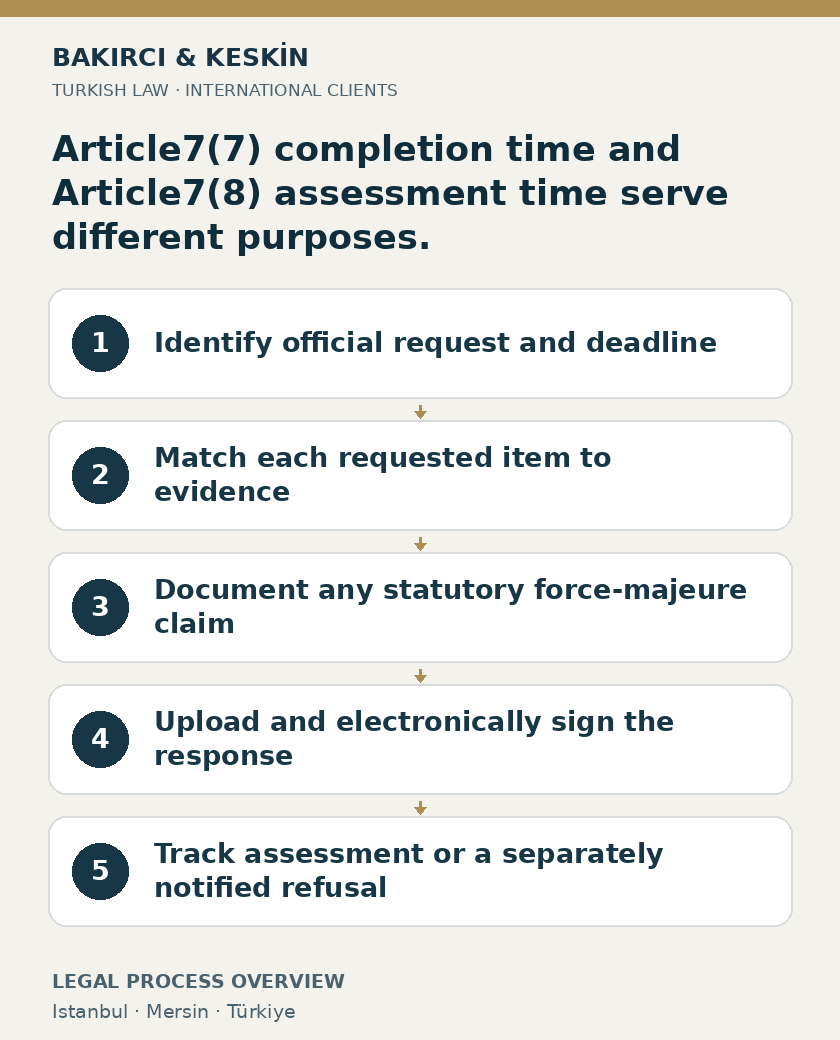
A request for missing documents in a Turkish work-permit application is a procedural stage with its own deadline. International Labour Force Law No. 6735 Article 7(7) postpones assessment until the missing information is supplied, but ordinarily limits that postponement to thirty days. The exception requires official documentation of a force majeure event delaying completion. Article 7(8)’s thirty-day assessment period is a different rule, conditional on a properly made and complete application. Identify the exact request, complete the authorised electronic response and preserve proof; a file saved without the required signature is not evidence of a completed submission.
Quick summary
| Legal issue | Turkey Work Permit Missing-Document Requests: The Two Thirty-Day Rules |
|---|---|
| Short answer | A request for missing documents in a Turkish work-permit application is a procedural stage with its own deadline. International Labour Force Law No. 6735 Article 7(7) postpones assessment until the missing information is supplied, but ordinarily limits that postponement to thirty days. The exception requires official documentation of a force majeure event delaying completion. Article 7(8)'s thirty-day assessment period is a different rule, conditional on a properly made and complete application. Identify the exact request, complete the authorised electronic response and preserve proof; a file saved without the required signature is not evidence of a completed submission. |
| Key legislation | International Labour Force Law No. 6735; Ministry of Labour current work-permit FAQ |
Identify whether the file was submitted, deferred or refused
The phrase “incomplete work permit” can describe different situations. The employer can have an unfinished electronic draft, a submitted application awaiting requested evidence, or a final refusal based on an unremedied deficiency. The legal response depends on which stage the official record actually shows. Obtain the application reference, status record and complete Ministry message before deciding what needs to be done.
The Ministry’s current work-permit FAQ explains that a saved application without the necessary electronic signature remains incomplete. It separately explains the procedure for uploading requested material to an application already under assessment. A document on the employer’s computer, a consultant’s receipt and a completed official submission therefore need to be distinguished.
This distinction is especially important for overseas applicants who cannot see the employer’s daily application handling. Ask for the actual official record rather than a general assurance that “everything is being processed.” The question is not whether someone has begun preparing the papers, but whether the legally relevant application or response has been completed and can be proved.
Article 7 contains two separate thirty-day rules
Law No. 6735 Article 7(7) deals with missing information or documents. Assessment is deferred until the omissions are completed. Except for the documented force majeure situation specified in the provision, the deferral cannot exceed thirty days. An application still incomplete at the end of that period is refused.
Article 7(8) concerns the Ministry’s assessment of a properly made application whose information and documents are complete. It requires assessment to be completed within thirty days. It does not say that approval follows automatically when thirty days have elapsed. The completeness requirement remains part of the statutory rule.
These periods should have separate entries in the case chronology. Record the deficiency request and its communicated deadline, the completed response and the subsequent decision. Do not use an estimated average processing time as a substitute for the response deadline. Equally, the document-completion stage should not be confused with Article 21’s separate thirty-day objection period following a notified adverse decision.
Turn the Ministry’s request into a document-by-document response
Read the exact wording and identify each item requested. The Ministry can require a missing record, a clearer copy, clarification of a discrepancy or evidence supporting a substantive condition. Supplying a document with a similar title does not necessarily answer the point. The response should explain which attachment addresses which item and identify any part that remains unresolved.
Keep the original Turkish message with the working translation used by the overseas employee or headquarters. Terms concerning the employer, workplace, occupation, period or issuing authority should be translated consistently. A summary that omits the reporting period or the relevant company can cause the team to obtain the wrong record while the statutory time continues to run.
Where the request is unclear, seek clarification promptly through an appropriate official channel and retain the enquiry. Clarification should be pursued alongside preparation of the material that is clearly required. A request for explanation does not itself establish an extension of the deficiency period. Preserve any actual official response granting or specifying a procedural step.
Match the evidence to the right entity, person and period
For employer records, confirm the registered legal entity, workplace identifiers, authorised signatory and reporting period. Group companies are separate persons, and a parent company’s records should not silently replace those of the Turkish applicant employer. When the request concerns a workplace-specific fact, the attachment must allow that fact to be identified.
For the employee, reconcile the passport details, contract, proposed occupation and qualification records. Explain a genuine name change or transliteration difference with the relevant supporting material. Replacing one spelling in an unofficial summary does not amend the underlying public record. The Ministry must be able to connect the evidence to the person whose authorisation is requested.
Distinguish evidence of an existing fact from a change made after the application. A later certificate can prove an earlier qualification, while a later corporate transaction can create a new fact. State the dates accurately. Article 9(1)(b) expressly addresses applications based on false or misleading information or documents, so an attempted correction should never obscure the actual chronology.
Plan for documents that must be obtained outside Turkey
An overseas employee can need records held by a university, professional body, civil authority or former employer. Identify the issuing body, the required document and the format accepted for the particular application. The response plan should distinguish obtaining the record, any authentication required and the Turkish translation required for submission. These are separate tasks with separate responsible persons.
There is no universal rule that every foreign document needs the same form of legalisation. The document’s nature, issuing state, applicable arrangements and Ministry requirement determine the appropriate treatment. An apostille, where relevant, concerns authenticity of the public act; it does not by itself establish that a professional qualification satisfies every Turkish authorisation requirement.
Keep evidence of the request to the issuing body and its response. Ordinary administrative processing time should be planned into the application. A pending document order does not automatically satisfy the missing-document request or the force majeure exception. Supply available relevant evidence accurately, explain what remains outstanding and obtain advice on the legal significance of the delay before the period expires.
A qualification document and statutory prior permission are different
Article 8 of Law No. 6735 requires prior permission for assessment of work-permit applications in health and education services requiring professional competence. The statute identifies the competent ministries for the covered professional activities and contains a separate framework for foreign academic staff through the Council of Higher Education.
A diploma demonstrates a qualification; it is not automatically the prior permission required by Article 8. When the Ministry requests that permission, uploading the diploma again does not answer the legal requirement. The file should identify the exact professional activity and the competent authority’s document rather than relying on a broad job label.
The article also addresses prior permission in extension applications. A person who previously worked lawfully should therefore examine what permission is required for the present assessment. The missing-document response must fit the statutory category actually invoked, and any claimed exception must have its own basis. Document completion cannot cure an application for a profession that remains legally unavailable to the applicant.
The force majeure exception requires official evidence
Article 7(7) creates a limited exception to the ordinary maximum deferral: a force majeure event delaying completion of the missing information or documents must be documented by an official authority. The provision does not create an unrestricted right to extra time whenever an applicant or consultant asks for it.
A request relying on this exception should identify the obstructing event, the affected document, the period during which completion was prevented and the official evidence of that event. It should explain the connection between the event and the missing item. A general assertion that the process was difficult does not establish that causal link.
The applicant should also document steps taken to obtain the material and the present position. An employer’s internal staffing difficulty, an overlooked email or an unsupported statement from a private intermediary should not be presented as official certification. Whether the statutory exception is satisfied requires a legal and administrative assessment of the actual evidence. No fixed additional extension period is promised by Article 7(7).
Complete the electronic response, including the required signature
The Ministry’s published procedure directs requested PDFs to the relevant application’s action menu under the application-tracking and assessment sections of e-İzin. It expressly requires completion of the upload transaction with an electronic signature. The final step matters because uploading or saving a file is not necessarily the same as submitting the response.
Before completion, compare the attachment index with the request. Check that the files open, contain all relevant pages and preserve seals, signatures and identification details. A technically accepted PDF can still be illegible or answer the wrong question. Keep the original record and translation together where both are needed to understand the evidence.
The person submitting must use the appropriate authority to act for the applicant or employer. Record who completed the transaction and preserve the version actually sent. The overseas worker should receive the submission confirmation and a usable copy of the response without being given another person’s authentication credentials. Accountability for the filing can be achieved through records and proper authorisation.
Treat a technical problem as an evidence issue immediately
A failed upload, unavailable signature function or system error should be recorded when it occurs. Preserve the date, application reference, exact message and relevant screenshot, together with any official support correspondence. Keep the intended final documents unchanged so that their readiness and the failed submission attempt can be assessed accurately.
A technical problem is not automatically a statutory extension. The legal significance depends on the facts, evidence and applicable procedure. Seek prompt guidance on the available official method for completing the response; do not assume that an email to a private consultant or a general helpdesk automatically performs the required legal act.
After a technical issue is resolved, verify the actual application state and completion record. Repeatedly creating new drafts can make the history harder to understand. A single chronology linking the Ministry request, the attempted transaction, the official support response and successful submission gives a later reviewer a coherent record of what happened.
Completion allows assessment to proceed; it does not decide the merits
Once the requested material has been supplied, the file still has to satisfy the substantive work-permit requirements. Article 7 authorises evaluation under international labour policy and the Ministry’s criteria, with relevant institutional opinions considered where necessary. Article 9 separately identifies refusal grounds. Document completeness and eligibility therefore remain distinct questions.
The Ministry’s FAQ explains that the assessment period runs from system completion or, when additional material is requested, from upload of the requested information and documents. Keep that completion evidence when following up a delayed application. A status enquiry should identify the application and relevant dates rather than simply count days from the employee’s first conversation with the employer.
Silence does not amount to a work permit. The legislation requires the relevant authorisation, and the application must be tracked to a recorded decision. Any further procedural step concerning administrative delay should be assessed from the complete file, including what was requested and whether the response actually removed every identified deficiency.
A refusal for uncompleted deficiencies changes the procedural route
Article 9(1)(h) identifies late applications and applications whose deficiencies are not completed among the refusal grounds. After a final refusal, the task is no longer simply to add a file to an undecided request. Obtain the full decision, its notification record and the record of the response that was submitted or attempted.
Article 21(2) allows interested persons to object to the Ministry within thirty days of notification and provides for administrative judicial review after rejection of the objection. A claimed timely completion should be supported by the submission record and the actual documents, not just a statement that a consultant was instructed to send them.
The broader routes after refusal are addressed in our work-permit refusal and objection guide. A new application based on a corrected deficiency is a separate decision. It does not by itself preserve the opportunity to challenge the earlier refusal or change the facts recorded in that application.
A pending document request does not create new work or residence rights
Article 6 prohibits work without the required permit for persons within the law’s scope, subject to the statutory exceptions. Supplying missing documents does not itself issue the permit. An initial applicant should therefore keep the proposed start of actual work separate from the expected response or assessment date.
Extension cases require review of the distinct rules governing an existing worker’s position during a properly made renewal. Article 7(3) also requires extension applications before the existing permit expires, within the specified opening window. The deficiency period should not be treated as permission to make the original extension application late.
The applicant’s place of filing and residence position must remain accurate throughout the process. Our guide to domestic and overseas work-permit applications explains those different routes. A document response should not silently convert an overseas application into a domestic one or assume that a pending first application extends an unrelated residence permission.
Give every requested item an owner and a verified completion record
A useful cross-border response plan assigns the Turkish corporate records to the employer, personal foreign records to the employee and legal classification to the authorised adviser. One coordinator should compare the completed set with the Ministry request. This prevents both duplicate uploads and gaps caused by each person assuming that someone else has answered an item.
Finish with a record of the exact attachments, the signed submission and the next notification to monitor. Where an item remains unavailable, identify that fact explicitly and preserve any legally supported request concerning the obstacle. The result should be a file that proves what was requested, what was supplied, when it was submitted and which legal stage the application has reached.
Frequently asked questions
Is a missing-document request the same as a refusal?
No. Article 7(7) provides a deferral stage for completing omissions. A final refusal is a separate decision and brings the Article 21 objection framework into consideration. Obtain the actual status and message before selecting the response.
What is the ordinary maximum period for completing missing documents?
Article 7(7) limits the deferral to thirty days unless the specified officially documented force majeure exception applies. Check the request and communicated deadline immediately; do not substitute an average processing estimate.
Does the Ministry have to approve the permit after thirty days?
No automatic approval follows. Article 7(8) concerns completion of assessment of a properly made application with complete information and documents. Substantive eligibility and the recorded decision remain necessary.
Can I obtain more time because a foreign document is delayed?
The statutory exception requires force majeure delaying completion, documented by an official authority. Ordinary delay does not automatically qualify. The event, affected document, causal connection and official evidence must be examined.
Is uploading a PDF enough?
The Ministry’s current FAQ also requires completion of the response transaction by electronic signature. Preserve the final submission record and verify the application status. A local file or saved upload alone is insufficient proof of completion.
What if the system fails before the deadline?
Record the error, date, application reference and support correspondence, and seek immediate guidance on an available official submission method. A technical error does not automatically establish an extension.
Can a diploma replace professional prior permission?
Not where Article 8 requires prior permission for the relevant activity. The qualification record and the competent authority’s permission are different documents. Determine the applicable profession and application category.
Can I start work while supplying missing documents?
An initial pending application does not itself authorise work. Existing-permit renewal cases have separate rules that require review. Article 6’s permit requirement should be checked against the applicant’s actual status.
What can I do after refusal for an uncompleted deficiency?
Obtain the decision and notification evidence. Article 21 provides a thirty-day Ministry objection period from notification. Any new application or court route must be assessed separately with the complete submission history.
What should an applicant abroad ask the Turkish employer to provide?
Ask for the application reference, complete deficiency request, response deadline, exact submitted attachments, signature/completion record and later status messages. These records allow the applicant and adviser to verify the process without sharing authentication credentials.
Official legal sources
- International Labour Force Law No. 6735 — Articles 6, 7(3), 7(7), 7(8), 8, 9(1)(b), 9(1)(h), 21
- Ministry of Labour current work-permit FAQ — Questions 11–14 and 54–56
Legal review: 28 October 2026. The official Turkish legislation controls. Application requirements and individual deadlines must be checked against the current official record.
Contact information
Do not include confidential documents or identity numbers in an initial message. An enquiry does not establish representation or suspend any legal deadline.
Istanbul and Mersin contact details
Bakırcı & Keskin Law Office is Mersin-based. Turkish matters are handled under the applicable jurisdiction and agreed mandate. The competent court and the scope of representation are assessed for each matter.
Istanbul — Polaris Plaza
Maslak Ahi Evran Caddesi, Polaris Plaza No:21, Floor 9, 34475 Sarıyer/İstanbul, Türkiye.Mersin — Profit İş Merkezi
İhsaniye Mahallesi, 4903. Sokak, Profit İş Merkezi No:23, Floor 3, Office 14, 33070 Akdeniz/Mersin, Türkiye.+90 552 224 43 66 · Contact details in English. An enquiry does not establish representation or suspend a legal deadline.
Istanbul Office – Polaris Plaza, Maslak / Sarıyer
Bakırcı & Keskin Hukuk Bürosu
Maslak Ahi Evran Caddesi, Polaris Plaza No:21, Kat:9, 34475 Sarıyer/İstanbul
Our physical offices in Istanbul and Mersin coordinate matters throughout Turkey, subject to jurisdiction and the local steps required for each case. Please specify your preferred office when arranging an in-person appointment.
Open the Istanbul office on Google Maps · Contact and appointments
Contact regarding a legal matter
In your first message, you may briefly state the subject, your country or city, and any relevant notification or recent procedural date. Please do not send identity numbers, medical data, or personal documents. Messaging alone does not constitute legal advice or create a lawyer–client relationship.
Discover more from Bakırcı & Keskin Hukuk Bürosu
Subscribe to get the latest posts sent to your email.