Transferring a Business Lease in Turkey: Landlord Consent and the Outgoing Tenant’s Liability
Buying the equipment or goodwill of a Turkish business does not, by itself, establish that its premises lease has been transferred to the buyer. Article 323 of the Turkish Code of Obligations requires the landlord’s written consent to transfer the rental relationship. For a workplace lease, the landlord cannot refuse that consent without just cause. The incoming tenant then takes the tenant’s place, but the outgoing workplace tenant remains jointly and severally responsible until the lease ends, for a maximum of two years. The transaction documents must therefore address consent, the effective substitution and continuing liability, not merely keys and a payment between the two businesses.
Have a general question about this article? Ask anonymously
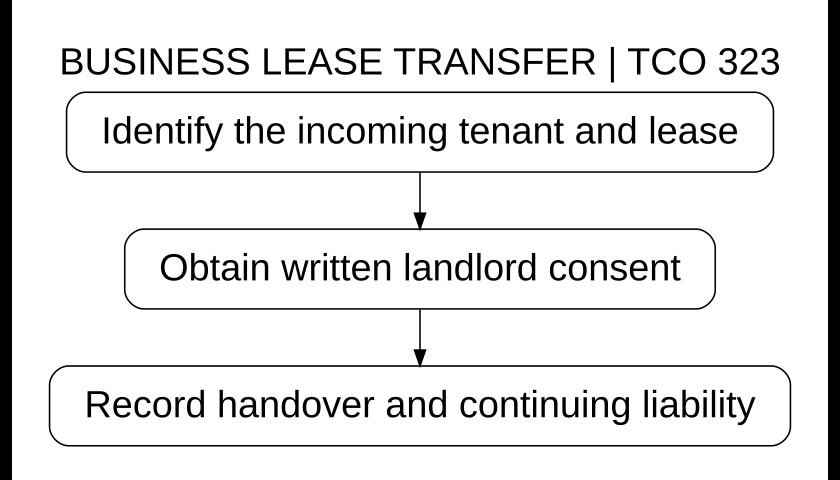
Establish which legal person holds the existing tenancy
Read the executed lease, amendments and any earlier transfer. Identify the tenant’s registered name, the premises and the current contractual position. A shop sign, franchise brand and the entity paying an invoice are not necessarily the tenant named in the legally relevant arrangement.
Record the incoming person with the same precision. A company owned by the proposed buyer is distinct from the buyer personally. The landlord’s consent to one identified entity should not silently be treated as consent to a different company selected after the business acquisition closes.
The governing special rule is Law No. 6098, Article 323. The broader contract-transfer guide explains Article 205’s general framework. That general framework expressly preserves special provisions and does not remove the lease-specific written-consent requirement.
The business acquisition and the rental relationship need separate completion conditions
A transaction may cover stock, equipment, a trading name, customer relationships and the seller’s lease. Identify which assets and contracts are included rather than assume that the word business transfers everything through the same legal mechanism.
Before paying an amount attributed to the location or tenancy, establish what happens if the necessary landlord consent is not obtained. The parties can record consent as a completion condition and allocate the consequences of its absence. Their agreement allocates risk between them; it does not itself supply the landlord’s consent.
A change in shareholders also differs from replacing the company that is the tenant. Where the same legal entity remains the contractual tenant, do not describe a share transaction as a tenant substitution solely because ownership of that company changed. Other contractual or corporate issues may require review, but they should not be confused with the Article 323 transaction being proposed.
Article 323 requires the landlord’s consent in writing
The statute states that the tenant cannot transfer the rental relationship without obtaining the landlord’s written consent. Preserve the actual consent and the lease it concerns. A broker saying that the owner is comfortable with the deal is not the same record as an authorised landlord’s written approval.
The writing should identify the relevant substitution rather than merely acknowledge a visit or receipt of papers. Permission to inspect the shop, negotiate a purchase or occupy temporarily does not necessarily approve transfer of the whole tenancy. Read the operative words and incorporated schedules.
The written-form and signature guide addresses the applicable execution questions. Article 323 does not itself prescribe one universal notarised form for every lease transfer. Nor should ordinary silence or the existence of a bank payment be treated as automatic proof that the statutory writing requirement has been satisfied.
Confirm who can sign for the landlord
The consenting party must be the landlord or a person with the relevant authority. A building manager, letting agent and property owner’s relative can have different mandates. Authority to receive rent or arrange repairs does not necessarily include authority to approve a tenant substitution or release the outgoing tenant.
If the landlord is a company, examine the applicable signing arrangement and the capacity in which the declaration is made. Where several persons hold the landlord position, identify the participation or representation required. A single signature should not be described as binding everyone without that review.
The commercial signing-authority guide explains the distinction between a person’s commercial role and legally sufficient authority. Keep consent and authority documents together so the transfer file does not depend on a later recollection of who was said to have approved it.
A workplace landlord cannot refuse without just cause
Article 323 qualifies the consent requirement for workplace leases: the landlord cannot withhold consent without just cause. The rule is neither an unrestricted landlord veto nor permission for the tenant to disregard the need for a legally effective transfer.
The provision does not publish an exhaustive list of reasons automatically sufficient in every case. A review must examine the reason actually given and its relation to the proposed tenancy. Information about the incoming entity, payment ability, intended use and compliance with the existing lease can make the factual issues intelligible; no one item should be represented as deciding every dispute.
Present a concrete request and ask for the landlord’s stated response. A proposal that does not identify the incoming tenant or the premises creates an avoidable evidential problem. The contemporaneous documents should show what the landlord was asked to approve and why consent was refused.
An unjustified refusal should not be answered by a concealed handover
A disputed refusal calls for the appropriate legal assessment and remedy. Do not assume that labelling the refusal unreasonable creates the missing written consent by itself. The legal basis for proceeding without the landlord’s signed approval must be established through the proper route, not a unilateral assertion in the business sale contract.
Preserve the request, supporting information, communication dates and reasons. Separate a request for clarification from an unequivocal rejection. If the landlord proposes different terms, identify whether that is a proposal for a new bargain, a conditional consent or a refusal of the requested transfer.
Commercial pressure to open the shop does not cure an incomplete tenancy file. A proposed operating date, supplier booking or fit-out payment should be coordinated with the legal completion conditions. Otherwise, the incoming business can obtain equipment while remaining in dispute about its right to use the location.
The incoming tenant takes the existing tenant’s contractual place
Article 323 states that the transferee, with the landlord’s written consent, takes the tenant’s place in the lease. The starting point is substitution in an existing rental relationship, not necessarily a completely new lease with a new beginning date and unrelated terms.
Identify the effective date, rent, use clause, duration and existing amendments. A document intended only to record substitution should not accidentally contain an unexamined new rent obligation, waiver or surrender provision. Where the parties genuinely agree other changes, identify and review them as changes.
Check whether the lease is still legally continuing. In roofed-workplace leases, Article 347 contains continuation rules that differ from assuming every printed fixed-term expiry ends the tenancy automatically. The remaining contract and applicable renewal position must be established before the handover account uses an assumed end date.
The lease transfer does not supply unrelated operating permissions
The landlord’s consent concerns the rental relationship. It does not by itself establish that the incoming business has every public licence, professional authorisation or other approval required for its proposed activity. Separate those requirements from the private permission to become tenant.
The intended use must also be compared with the existing lease. Continuing the same activity and proposing a materially different use present different questions. A transfer should not be described as giving the incoming tenant unlimited freedom to change the premises simply because the outgoing business has left.
Keep any proposed works separately identified. Written approval of tenant substitution is not necessarily written approval of alterations under Article 321. The completion file should state which acts are authorised and which remain subject to a separate decision.
The workplace exception prevents an automatic complete release
Article 323 first states the outgoing tenant’s release from obligations towards the landlord following the qualifying transfer. It then supplies a specific workplace exception: the outgoing tenant remains jointly and severally responsible with the incoming tenant until the lease ends, for no more than two years.
Both limits matter. The provision should not be shortened into a statement that the outgoing tenant always owes precisely two further years’ rent. The legally relevant end of the lease and the maximum period of continuing responsibility must be identified from the actual chronology.
Joint and several responsibility also differs from an equal split. The landlord-facing position and the two tenants’ internal allocation require separate analysis. The joint-debtor guide explains why an internal promise that the buyer will pay everything does not, by itself, remove the landlord’s statutory claim.
A two-year responsibility period is not a universal claim-filing deadline
The period in Article 323 defines the outgoing workplace tenant’s continuing responsibility. It should not be presented as though every claim must invariably be sued upon within two years of the transfer or disappears regardless of when the relevant obligation arose.
For each demand, identify the obligation, when it arose or became due, the period covered by the statutory responsibility and the limitation rule governing that claim. A chronology is more reliable than applying a single calendar date to all rent, damage and reimbursement issues.
The limitation-interruption guide addresses the separate effect of acknowledgments, payments and proceedings. The transfer document should not purport to decide every future limitation question through an unexplained two-year reference.
Internal reimbursement and an external release are different documents
The outgoing and incoming tenants can allocate financial responsibilities between themselves. Record how a demand from the landlord will be notified, who will respond and how a payment will be reimbursed under the agreed arrangement. That is useful even where the statutory external responsibility remains.
An outgoing tenant relying on an additional release by the landlord must identify the actual agreement and its scope. A receipt for one month’s rent or consent to the substitution is not automatically a release from every separate obligation. The wording should make clear which claims are discharged and on what conditions.
Keep historical claims visible. Existing arrears, an already alleged breach and future obligations should not be mixed into a general statement that all accounts are clean. The legal allocation must be assessed, and any agreed settlement should identify the debts and payments it actually covers.
Subletting does not substitute the contractual tenant
Article 322 concerns subletting and transfer of use. In residential and roofed-workplace leases, it requires the landlord’s written consent. An arrangement allowing another operator to use the premises is not necessarily an Article 323 substitution of the tenant’s whole contractual position.
Read who remains responsible to the landlord and who owes rent to whom. A subtenant paying the original tenant and an incoming tenant replacing that person are different legal structures. The label takeover in a commercial advertisement does not establish which one was agreed.
Do not use a sublease document to promise the outgoing tenant an Article 323 release. Conversely, a landlord’s permission for a particular subtenant should not be represented as consent to replace the contractual tenant without checking the declaration’s scope.
Finding a replacement after early return is another distinct route
Article 325 addresses a tenant returning the premises before the relevant contractual or termination endpoint. It deals with a reasonable reletting period and earlier release where a suitable, financially capable replacement is ready to take over. That framework is not identical to an agreed Article 323 transfer while the rental relationship is being handed over.
The early-return and replacement-tenant guide examines that separate account. Identify whether the outgoing business is transferring a live lease or returning possession and relying on the replacement mechanism.
A file should not alternate between the two descriptions merely to select the most favourable financial consequence. The proposed transaction, landlord response and actual handover determine which legal analysis is needed.
Deposits and third-party security need an express schedule
Record the deposit’s amount, currency, holder and any previous application. Distinguish an adjustment paid between the two tenants from the landlord’s obligations concerning the security. Payment by the incoming tenant to the outgoing tenant does not itself prove that every landlord-facing deposit arrangement has changed as intended.
For roofed-workplace leases, Article 342 regulates contractual security, including the monetary ceiling and bank-holding mechanism. The deposit guide explains those general requirements. Check the actual security rather than assume that the acquisition price includes a freely withdrawable cash deposit.
List sureties, guarantees and other security separately. Their coverage, duration and any required consent must be reviewed under their own rules. A lease-transfer signature does not itself certify that every third-party undertaking continues unchanged for a different tenant.
Complete the operational handover without obscuring legal disputes
| Completion item | Point to document |
|---|---|
| Existing lease | Parties, premises, effective amendments and continuation status. |
| Landlord consent | Written approval of the identified incoming tenant and signatory authority. |
| Effective substitution | The transfer date and any conditions that must first occur. |
| Financial account | Rent periods, arrears, advances, security and agreed credits. |
| Continuing responsibility | The statutory workplace position and any separately agreed release or reimbursement. |
| Physical and commercial items | Keys, condition, fixtures, stock, third-party goods and operating approvals. |
Article 18/B(1)(a) of Mediation Law No. 6325 generally requires mediation before a rental-relationship lawsuit, subject to its specified enforcement-eviction exception. Classify any dispute over consent, payment or possession before assuming the same procedure resolves all of them.
For an international buyer or outgoing operator, retain the original documents beside translations and verify every signatory’s role. A local representative’s ability to receive keys is not automatically authority to settle liability. Provide any served court or enforcement document with its service date; negotiations over consent do not themselves suspend a required response.
Frequently asked questions
Does buying a shop’s equipment automatically transfer its lease?
No. Identify the separate rental relationship and the legally effective transfer. Article 323 requires the landlord’s written consent.
Can a workplace landlord refuse consent for any reason?
Article 323 prohibits withholding consent without just cause for workplace leases. The actual proposed tenant, request and reason for refusal must be examined.
Does an unjustified refusal automatically amount to written consent?
Do not assume that consequence. The disputed refusal and the appropriate legal route require assessment before treating the transfer as effective.
Must every lease transfer use a notarised form?
Article 323 itself requires written landlord consent, not a universal notarised instrument. The applicable form and authority requirements must be checked for the particular transaction.
Is the outgoing business tenant immediately free of all responsibility?
Article 323 preserves joint and several responsibility with the incoming workplace tenant until the lease ends, for a maximum of two years. Any additional release requires its own basis.
Does the rule always impose exactly two further years of rent?
No. The lease-end limit and the two-year maximum must both be considered. The actual obligation and legal chronology determine the supported claim.
Is that two-year period the limitation period for every claim?
No. Continuing responsibility and limitation answer different questions. Identify when the relevant obligation arose and the limitation rule governing it.
Is a sublease the same as transferring the tenant’s position?
No. Article 322 concerns subletting or transfer of use; Article 323 concerns substitution in the rental relationship. The actual parties and obligations must be identified.
Does landlord consent automatically approve a new business activity or renovation?
Not by itself. Read the consent and lease-use provisions and assess any separate operating or alteration approvals required.
What should a buyer abroad provide before paying for the tenancy?
Provide the lease, business-sale terms, incoming entity details, proposed consent, authority documents and a schedule of rent, security and handover obligations.
Official legal sources
Turkish Code of Obligations No. 6098, Articles 205, 321–325, 342 and 347; Mediation Law No. 6325, Article 18/B. This is an English explanation, not an official translation or certification that a particular business can lawfully operate at the premises.
Ask about a business lease transfer
Identify the existing and proposed tenants, the premises and the landlord’s response. Arrange a confidential channel before sending the lease, acquisition agreement or financial records.
Istanbul and Mersin offices
Bakırcı & Keskin Law Office is Mersin-based and works throughout Türkiye with an Istanbul and Mersin focus.
Istanbul — Polaris Plaza
Maslak Ahi Evran Caddesi, Polaris Plaza No:21, Floor 9, 34475 Sarıyer/İstanbul.
Mersin — Profit İş Merkezi
İhsaniye Mahallesi, 4903. Sokak, Profit İş Merkezi No:23, Floor 3, Office 14, 33070 Akdeniz/Mersin.
Call +90 552 224 43 66. An enquiry does not establish representation or suspend a legal deadline.
Contact regarding a legal matter
In your first message, you may briefly state the subject, your country or city, and any relevant notification or recent procedural date. Please do not send identity numbers, medical data, or personal documents. Messaging alone does not constitute legal advice or create a lawyer–client relationship.
Discover more from Bakırcı & Keskin Hukuk Bürosu
Subscribe to get the latest posts sent to your email.