Revoking a Gift in Turkey: Completed Gifts, Promises and the One-Year Rule
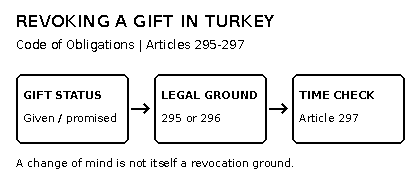
A donor cannot take back a completed Turkish gift merely because the relationship has deteriorated or the donor has changed their mind. Article 295 of the Turkish Code of Obligations identifies grounds for revoking a delivered gift or a performed gift promise. Article 296 separately permits withdrawal from an unperformed promise in specified circumstances, including serious changes in the donor’s finances or family obligations. Article 297 ordinarily requires the donor to act within one year after learning of the revocation ground. The correct assessment begins with what was actually given, whether the gift was completed, the ground relied on and the date it became known.
Have a general question about this article? Ask anonymously
First establish that the transaction was a gift
Article 285 of Law No. 6098 defines a gift as a contract by which the donor undertakes to provide an uncompensated benefit from the donor’s assets to the recipient, effective between living persons. The legal character matters. A repayable loan, payment of a debt and an investment contribution do not become gifts simply because money moved between relatives.
The same article excludes fulfilment of a moral duty from the gift category. It also distinguishes disclaiming an inheritance or abandoning a right not yet acquired. A dispute should therefore identify the original purpose and agreed legal effect of the transfer before selecting the revocation provisions. A bank receipt records movement of funds, not necessarily every term of the underlying relationship.
Keep the agreement, payment description, correspondence and asset-transfer records together. Where the parties disagree about repayment, our private-loan repayment guide addresses that separate classification. The fact that a gift cannot be revoked on the proposed ground does not establish that a disputed transfer was a gift in the first place.
Completed gift, gift promise and an unaccepted offer
The distinctions within the gift rules are equally important. Article 288 requires a gift promise to be in writing and requires official form for a promise concerning immovable property or a real right over it. Article 289 addresses a hand-to-hand gift of movable property established by delivery. A file should specify which legal act occurred and whether the promised transfer was actually performed.
Article 288 also addresses performance of a promise defective for lack of form: performance gives it the effect of a delivered gift, but that rule does not apply to gifts whose validity requires official form. It is therefore unsafe to state that every defective property-gift promise becomes valid merely because the intended recipient was given possession or keys.
Before acceptance, Article 293 allows a gift offer to be withdrawn even where the donor has physically separated the proposed item from other property. That is a different stage from revocation of an accepted and completed gift. Record offer, acceptance and performance dates separately; describing all three events as the gift date can conceal the applicable rule.
The three statutory grounds for revoking a completed gift
Article 295 permits revocation where the recipient committed a serious offence against the donor or someone close to the donor; materially breached legal obligations towards the donor or a member of the donor’s family; or, without a justified reason, failed to discharge a burden attached to the gift. The provision addresses particular conduct, not an unrestricted assessment of whether the recipient behaved gratefully.
The claim should identify the ground and its facts directly. A family disagreement, a change in affection or a recipient’s decision to live elsewhere does not by itself state one of the statutory conditions. Equally, a serious allegation should not be dismissed simply because the gift agreement did not repeat Article 295: the legal assessment concerns the statutory framework and the supported facts.
Separate contemporaneous evidence from later impressions. Record what happened, who was affected, how it relates to the chosen ground and when the donor learned of it. The purpose of this chronology is to establish the legal case and time position, not to accumulate unrelated complaints about the relationship.
A serious offence requires a supported account of the conduct
The first ground concerns a serious offence against the donor or one of the donor’s close persons. Identify the alleged conduct and the person affected. Provide any complaint, investigation records, judgment or other lawfully obtained evidence relevant to the event. The statute should not be paraphrased as a right to revoke whenever someone makes an accusation.
Article 295 itself does not state a universal requirement that a final criminal conviction must first be obtained in every case. Nor does filing a criminal complaint automatically prove the civil revocation ground. The relationship between proceedings, evidence and the civil claim must be assessed for the actual file instead of inventing either categorical rule.
Do not assume that an investigation suspends the Article 297 period. The discovery chronology and the act required to exercise the civil right need independent attention. Waiting for another process without examining those issues can leave the donor’s contractual position unprotected.
A breach of legal family obligations is not merely a broken expectation
The second ground requires a significant breach of obligations arising by law towards the donor or a family member. Identify the legal duty relied on and the conduct said to breach it. A donor’s private expectation of more frequent visits is not automatically the same thing as a legally imposed obligation.
The seriousness requirement must also be addressed. Explain the duration, circumstances and consequences of the alleged breach using records relevant to the duty. A list of unpleasant communications cannot replace identification of the obligation whose substantial violation is asserted.
Where the intended arrangement involved reciprocal lifetime care rather than an uncompensated gift, classification again comes first. The court-facing position should not alternate between a gratuitous transfer and an onerous exchange without explaining the evidence. Different legal relationships have different termination and recovery rules.
A burden attached to the gift must be established
Article 291 allows the donor to impose burdens and to demand performance of those accepted by the recipient under the agreement. For a public-interest burden, the power to demand performance passes to the relevant public institution after the donor’s death. The burden should therefore be identified from the actual agreement, not added later because the donor considers it reasonable.
Article 295 permits revocation for non-performance of such a burden without a justified reason. Read that requirement alongside Article 291’s protection where the gift’s value does not meet the cost of performing the burden and the excess is not paid. In that situation, the recipient can refrain from performing the burden. An explanation omitting this qualification risks treating every unperformed condition as unjustified.
Obtain the burden clause, evidence of acceptance, performance demands, expenditure information and the recipient’s response. Distinguish disagreement over what was promised from a refusal to fulfil an established obligation. The appropriate claim can involve performance of the burden, revocation or another supported remedy; its basis must be stated accurately.
The recoverable benefit is measured at the request date
Article 295 links return to the recipient’s enrichment at the time of the request. It does not simply promise recovery of the original headline value in every case. The gift, its subsequent treatment and the enrichment relevant at the statutory date need to be documented.
For money, identify the transfer and the evidence concerning the benefit retained. For an asset, obtain its transfer history and current legal position. An assertion that the recipient still owns everything received is a fact to verify, not an assumption to make from the original agreement alone.
A revocation declaration is also different from practical recovery. It does not itself debit a bank account or amend a land-register entry. The relief sought and any protective or recovery procedure must match the property and parties concerned. Avoid promising automatic restoration without reviewing the actual ownership and enforcement position.
Unperformed gift promises: the broader Article 296 framework
Article 296 allows the person who promised a gift to withdraw and refuse performance where a ground exists that would support recovery of a delivered gift. It adds two further situations: the donor’s finances later change so substantially that performance becomes extraordinarily burdensome, or new family obligations arise after the promise or existing obligations become materially heavier.
These additional grounds concern the promise and refusal to perform it. They should not be imported wholesale into Article 295 as automatic grounds for recovering a gift already completed. A donor facing financial difficulty must establish both the relevant change and the legal stage of the transaction.
The final paragraph provides that the duty to perform ends if the promisor’s inability to pay debts is established or bankruptcy is ordered. Distinguish the evidence of that status from a general statement that cash is tight. The precise ground and its proof remain necessary even where the intended donation now appears commercially unwise.
The donor’s one-year period under Article 297
Article 297 allows the donor to revoke within one year from learning of the ground. The ordinary starting point is knowledge of the revocation reason, not automatically the date the gift was made. An older gift and a newly discovered ground therefore require separate dates in the analysis.
Record when the donor learned the relevant facts and how that knowledge is shown. A later legal consultation does not necessarily create a new discovery date. Earlier letters, messages or proceedings can establish that the underlying conduct was known before advice was sought.
The notice should identify the gift, the supported ground and the legal consequence asserted, with reliable evidence of its content and delivery. Article 297 should not be reduced to a statement that any complaint to any authority necessarily exercises the gift-revocation right. Any court action required for the practical recovery must also be considered.
Heirs do not invariably receive a fresh year
If the donor dies before the one-year period has expired, Article 297 passes the right to the heirs for the remainder of that period. This is not automatically a new full year beginning at death. Preserve the donor’s discovery date as well as the death date.
Where the donor did not learn of the ground during life, the article allows the heirs to exercise revocation within one year from death. It also expressly addresses a recipient who intentionally and unlawfully kills the donor or prevents the donor from exercising the right. Those provisions must be read on their own terms rather than replaced with a single simplified deadline for every estate.
Heirship and the authority to act for the estate require their own documents. A family member’s interest in the dispute does not necessarily establish that person’s capacity to exercise the inherited right. Obtain the relevant succession records and identify the complete party structure before presenting the claim.
Return conditions, periodic gifts and inheritance claims are different routes
Article 292 permits a donor to stipulate return of the gift if the recipient dies first. For immovable property or a real right over it, that return condition can be annotated in the land register. It is a contractual return mechanism distinct from revocation for misconduct under Article 295.
Article 298 provides that a gift involving periodic performances ends on the donor’s death unless otherwise agreed. Again, the text addresses that particular arrangement; it does not say that every gift ever made is reversed on death. The agreement and the type of performance must be identified.
Inheritance equalisation and protection of reserved shares are separate questions. The guides on lifetime gifts and equalisation and reduction for reserved shares explain those mechanisms. A disappointed heir cannot substitute a donor-revocation ground for the requirements of the inheritance claim actually available.
Reviewing a Turkish gift from abroad
Provide the original agreement, all language versions, asset or payment records, burden or return clauses and a dated account of the revocation ground. For an inherited right, add the donor’s knowledge history and succession documents. Keep the original records intact and obtain private communications only through lawful means.
An international transaction also requires an applicable-law analysis before applying this Turkish framework. Residence abroad does not by itself remove or create the right. Where proceedings or a registry application already exist, include the complete documents and service dates. The practical goal is a correctly classified claim, exercised by the right person within the relevant period.
Frequently asked questions
Can a donor revoke a gift simply after changing their mind?
Not under Article 295 merely for that reason. A completed gift requires one of its statutory revocation grounds. An unaccepted offer and an unperformed promise have separate rules.
What are the Article 295 grounds?
They concern a serious offence against the donor or a close person, significant breach of legal obligations towards the donor or a family member, and unjustified failure to perform an accepted gift burden.
Does financial hardship automatically recover a completed gift?
No. Article 296’s financial-change ground concerns withdrawal from a gift promise and refusal to perform. It must not be treated as an automatic Article 295 recovery ground for an already completed gift.
When does the donor’s one-year period begin?
Article 297 starts it when the donor learns of the revocation ground. Identify that discovery date separately from the date of the original gift.
Do heirs always obtain a fresh year after death?
No. If the donor dies during an already running year, heirs receive the remaining period. Article 297 provides a different rule where the donor did not learn of the ground during life.
Is the original value always the amount returned?
Article 295 refers to the recipient’s enrichment at the time of the request. The asset and enrichment position require evidence; the original value is not a universal automatic award.
Can a gift carry an enforceable burden?
Article 291 allows accepted burdens and provides for demanding their performance, with its cost-related qualification. Article 295 requires unjustified non-performance for that revocation ground.
Can return be agreed if the recipient dies before the donor?
Yes. Article 292 permits that condition and allows annotation where the gift concerns immovable property or a real right over it.
Does a criminal complaint automatically reverse the gift?
No. Evidence of the statutory ground, timely exercise of the civil right and the steps needed to recover the property remain separate questions.
Is donor revocation the same as an heir’s reduction action?
No. Gift revocation, inheritance equalisation and reduction to protect reserved shares have different legal requirements and must be classified separately.
Official sources
Turkish Code of Obligations No. 6098, Articles 285–298; official Ministry text, pages 57–59. English explanations are not an official translation; the Turkish text governs.
Ask about a gift dispute
State whether the gift was completed, the relevant event and when it became known. Do not include identity numbers or private evidence in the initial enquiry.
Istanbul and Mersin offices
Bakırcı & Keskin Law Office is Mersin-based and works throughout Türkiye with an Istanbul and Mersin focus. Agree a confidential channel before transmitting gift or succession documents.
Istanbul — Polaris Plaza
Maslak Ahi Evran Caddesi, Polaris Plaza No:21, Floor 9, 34475 Sarıyer/İstanbul. Istanbul office directions.
Mersin — Profit İş Merkezi
İhsaniye Mahallesi, 4903. Sokak, Profit İş Merkezi No:23, Floor 3, Office 14, 33070 Akdeniz/Mersin. Mersin office directions.
Call +90 552 224 43 66. An enquiry does not create representation or suspend a legal deadline.
Contact regarding a legal matter
In your first message, you may briefly state the subject, your country or city, and any relevant notification or recent procedural date. Please do not send identity numbers, medical data, or personal documents. Messaging alone does not constitute legal advice or create a lawyer–client relationship.
Discover more from Bakırcı & Keskin Hukuk Bürosu
Subscribe to get the latest posts sent to your email.