Third-Party Clauses in Turkish Contracts: Beneficiary Rights and TCO 128–129
A contract mentioning somebody who did not sign it can create very different legal positions under Turkish law. Article 129 of the Turkish Code of Obligations concerns an agreed performance for a third-party beneficiary. Article 128 concerns a contracting person’s undertaking that somebody else will perform an act. In the first arrangement, the central question is who can demand the promised benefit. In the second, the question is who answers for the loss when the promised third-party act does not occur. Naming a family member, affiliate or other recipient does not alone answer either question.
Have a general question about this article? Ask anonymously
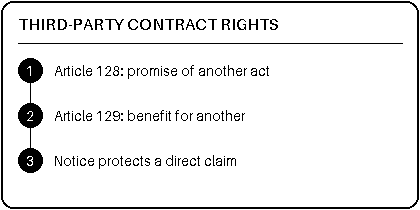
Map the three roles before interpreting the clause
The person making the contract, the person owing performance and the intended recipient are not necessarily the same people. Article 129 expressly begins with a person contracting in their own name and stipulating performance for another. A review must therefore distinguish a contractual party from a beneficiary and from a representative who signs in somebody else’s name.
Use the full legal name for each company or individual. A trading group can include several separate companies, and a payment instruction can identify a bank-account holder without explaining that holder’s substantive entitlement. The contract should establish who promised what, to whom it must be supplied and who has the right to demand it. An organisation chart cannot replace that contractual analysis.
| Provision | Central arrangement | Question requiring proof |
|---|---|---|
| Article 128 | A person undertakes another person’s act. | What act was promised, and what loss followed its non-occurrence? |
| Article 129, first paragraph | A contracting party stipulates performance for a beneficiary. | What performance can that contracting party demand for the beneficiary? |
| Article 129, second paragraph | The beneficiary has a qualifying direct claim. | Does direct enforcement accord with the parties’ purpose or custom? |
The stipulating party can demand performance for the beneficiary
Under Article 129 of Law No. 6098, the person who contracts in their own name and includes a performance obligation for a third party can demand that performance be made to the third party. The promise is not legally meaningless simply because the recipient did not execute the underlying agreement. The first paragraph identifies an enforcement right belonging to the contracting person.
The destination of performance remains important. The provision speaks of performance to the beneficiary; it should not be paraphrased as an automatic right for the stipulating person to collect the same benefit personally. The wording of the demand must correspond to the contractual arrangement. Payment, delivery and the supply of a service must each identify the correct recipient.
Establish the content of the benefit from the executed agreement and its incorporated schedules. A general reference to supporting another person does not specify an amount, delivery obligation or service standard by itself. The entitlement being demanded must be capable of identification from the contract rather than reconstructed solely from a later account of what the recipient hoped to obtain.
A direct claim by the beneficiary is not presumed from every mention
Article 129’s second paragraph permits the third party, or those succeeding to that party’s position, to demand performance where this accords with the parties’ purpose or custom. The text therefore distinguishes a benefit intended for someone from a qualifying right for that person to enforce performance directly. A recipient’s name on a schedule is relevant but does not end the interpretation exercise.
Look for wording dealing with enforcement, the recipient’s entitlement and communications with the obligor. Read exclusions and qualifications as part of the same agreement. A clause stating that payment is to be routed through a particular account may concern payment administration rather than a direct substantive right for its holder. The legal effect must be established instead of inferred from banking details alone.
A person relying on custom must identify the practice said to support direct enforcement and its relevance to this relationship. The statutory reference is not satisfied merely by asserting that businesses often use beneficiaries. The agreement’s purpose and the applicable practice need their own evidence. This makes the distinction usable without inventing a universal rule for all payment or delivery instructions.
Notification protects the direct claim against later release or alteration
Where the qualifying direct right exists, Article 129 provides a further protection. Once the beneficiary or successor tells the debtor that it wishes to exercise that right, the creditor can no longer release the debtor or change the obligation’s nature and scope. The communication is therefore legally significant beyond an ordinary request for transaction information.
Document the identity of the sender, the contractual entitlement identified and the communication to the person owing performance. Preserve the complete notice and delivery record. A message sent only to the stipulating party is not the notification to the debtor described by the provision. Where a representative sends it, that person’s authority should also be established.
The rule must be applied to the actual protected obligation. It does not state that notification makes every clause in the entire commercial relationship permanently unchangeable. Nor should a later agreement between the original signatories be assumed effective against the beneficiary without checking the notification chronology. Compare the original promise, the notice and the proposed release or amendment in that order.
The benefit’s scope still comes from the relevant agreement
A direct beneficiary claim does not transform the recipient into the owner of every right held by the stipulating party. Identify the particular performance promised for its benefit, its due date and any conditions. A claim for a fixed payment is not automatically a right to receive confidential commercial records or direct the supplier’s unrelated operations.
Conditions governing the benefit must be distinguished from later attempts to remove it. The conditional-contract guide explains the separate rules governing events that begin or end contractual effects. Article 129 notification should not be presented as proof that an independently required condition has occurred.
The file should also account for performance already made. A supplier facing communications from both the stipulating party and beneficiary needs a consistent record showing what has been delivered or paid for the same obligation. Two people being entitled to seek performance for the beneficiary is not a justification for collecting the same performance twice.
Article 128 concerns responsibility for another person’s act
Under Article 128, a person who undertakes a third person’s act towards another person must compensate the loss caused by that act not occurring. The undertaking concerns the conduct of the third person, but the statutory compensation responsibility attaches to the person who gave the undertaking. The third person does not become a signatory merely because its anticipated conduct is described.
Identify the precise act undertaken and the scope of the promise. A contractual undertaking that an event will occur must be distinguished from a statement of expectation, a description of negotiations or an obligation to make efforts. Article 19’s real-common-intention rule governs interpretation. The complete language, not a single reassuring expression removed from context, is the proper starting point.
The claim should connect the missing act to the loss asserted. Article 128 refers to compensation for loss resulting from non-occurrence; it does not prescribe a standard refund, a fixed penalty or a universal percentage. Establish the promised act, the failure relied on, the causal connection and the calculation. Any separately agreed penalty requires its own contractual and statutory examination.
A fixed period does not automatically create a written-demand cut-off
Article 128’s second paragraph allows the parties, for an undertaking made for a specified period, to agree that responsibility ends if no written request for performance is made to the undertaking party before that period expires. The wording creates an option for agreement. It should not be described as a compulsory expiry mechanism automatically governing every promise of third-party conduct.
The document review therefore needs both the agreed period and the clause attaching the stated consequence to failure to make a written request. A date appearing in a commercial schedule does not necessarily establish that additional agreement. Read the relevant definitions and notice provisions to identify what the date governs and whom the request must reach.
Where the clause applies, retain the written request and evidence of its timing and communication. Do not assume that a complaint addressed only to the third person satisfies a demand directed to the undertaking party. A timely demand under this clause and compliance with any separate litigation or enforcement requirement remain different matters.
Personal-security safeguards cannot be avoided by changing a heading
An undertaking involving a natural person can require examination under Article 603. That provision extends the rules concerning suretyship form, capacity to become a surety and spousal consent to other contracts by which individuals give personal security under a different name. The presence of the words third-party undertaking does not itself resolve that classification.
The inquiry concerns the undertaking’s substance and the safeguards actually made applicable by the statute. It should not be expanded into a claim that Article 603 automatically imports every suretyship rule into every agreement mentioning a third party. The personal-guarantee form guide addresses those specified protections in detail.
Corporate authority is a separate issue. A person signing for a company needs authority for the transaction, while a person undertaking personal security signs in a different capacity. Keep those signatures and declarations distinguishable. An undertaking cannot be accurately reviewed when a corporate signature block and a proposed personal obligation are treated as the same act.
Beneficiary rights are different from assignment and contract transfer
Assignment transfers an existing claim under Articles 183–194. A contract for a third party under Article 129 is a different arrangement, based on a performance stipulated for that beneficiary. The receivables-assignment guide explains the transfer mechanism. A beneficiary should not be told to prove an assignment that is not the legal source actually relied on.
Equally, beneficiary status does not automatically substitute the recipient for a contracting party. Articles 205–206 regulate transfer of and accession to a contractual position. Those mechanisms concern a different package of rights and obligations. A direction to deliver a benefit to another person should not be treated as that person’s agreement to take over every duty in the underlying contract.
The distinction matters when a transaction changes after signing. Identify whether the intended step alters the recipient, assigns a claim or substitutes a party. The contract-transfer guide addresses consent and form for the latter. A payment-routing amendment cannot safely be used as a substitute for all three mechanisms.
Signing for a principal is a separate representation question
Article 40 concerns an authorised representative acting in another person’s name and on that person’s account. In that situation the transaction’s effects arise directly for the represented person. By contrast, Article 129 expressly describes a person contracting in their own name for a third person’s benefit. The identity of the contracting party is therefore not interchangeable with the identity of the beneficiary.
Read the signature block with the operative promises. A person can be authorised to negotiate for a company without agreeing personally to compensate another party if that company later fails to act. Conversely, an own-name undertaking under Article 128 is not proof of authority to bind the third person itself. The separate guide to unauthorised representation and ratification addresses the consequences of an absent authority, not the beneficiary’s direct claim.
The supporting documents must match the argument. An authority instrument supports a representation position; the benefit clause supports an Article 129 entitlement; the undertaking supports an Article 128 compensation claim. Keeping these sources separate prevents an otherwise complete-looking file from omitting the document that establishes the right actually asserted.
Article 130 provides a particular employee-insurance rule
Article 130 states that where a person employing another obtains insurance to secure civil liability towards that worker, the rights arising from the insurance belong directly to the worker. It also requires the insurance compensation paid to the worker to be deducted from compensation payable under the general provisions. Other liability-insurance legislation is expressly reserved.
This provision is a defined statutory arrangement, not evidence that every insurance policy automatically gives every interested person identical rights. Identify the insured liability, the person protected and the policy documents. Keep the direct entitlement and the deduction against the corresponding compensation claim visible so that the same harm is not presented as independently payable twice.
Prepare the claim around entitlement, notice and performance
A focused dossier should contain the contract establishing the third-party arrangement, documents identifying each participant, the exact benefit or act, relevant deadlines and conditions, and all notifications. For an Article 128 damages demand, add the loss calculation. For an Article 129 direct claim, identify the contractual purpose or custom supporting it and the notice preserving the beneficiary’s position.
Keep the original language beside any translation. Translate the roles consistently rather than using creditor, beneficiary, guarantor and representative interchangeably. A foreign affiliate’s involvement also requires the relevant governing-law and authority review; the mere use of an English form does not determine those questions.
A served claim or payment order must be assessed separately from commercial correspondence. Identify whose right is being asserted and who has been named in proceedings. Notification under Article 129 and a written demand under Article 128 do not themselves file a procedural response. The practical objective is a claim made by the correct person, against the correct obligor, for the performance or compensation the actual arrangement supports.
Frequently asked questions
Can a person who did not sign enforce a Turkish contract?
Article 129 permits a beneficiary or successor to demand the promised performance when direct enforcement accords with the parties’ purpose or custom. A mere mention in the agreement does not resolve that test.
What right does the person stipulating the benefit retain?
Under Article 129, a person contracting in their own name can demand that the agreed performance be supplied to the third-party beneficiary. The demand must match the promised benefit and recipient.
Why should a direct beneficiary notify the debtor?
After the qualifying beneficiary or successor notifies the debtor that it wishes to exercise the right, Article 129 prevents the creditor from releasing the debtor or changing the obligation’s nature and scope.
Does naming another bank account necessarily create a beneficiary right?
No. Payment-routing instructions and substantive direct entitlements are different questions. The contract must establish the legal role of the account holder and the performance concerned.
What does Article 128 require from a person promising another person’s act?
The undertaking party must compensate the loss resulting from the promised act not occurring. Identify the act, the scope of the undertaking and the loss caused by its non-occurrence.
Does every time-limited undertaking automatically expire without a written demand?
Article 128 permits the parties to agree that consequence for a specified-period undertaking. The period and the actual written-demand cut-off agreement must both be identified.
Can an individual avoid personal-security safeguards through a different title?
Article 603 extends specified suretyship form, capacity and spousal-consent protections to other personal-security contracts given by natural persons under different names. Substance and the applicable safeguards require review.
Is beneficiary status the same as an assignment?
No. An assignment transfers a claim under Articles 183–194. Article 129 concerns an obligation stipulated for another person. Identify the legal source actually supporting the claimant’s entitlement.
Does beneficiary notice prove an approval condition occurred?
No. Notice preserving the direct claim and fulfilment of a contractual condition are separate events. Both the condition and the relevant notification must be established.
Which documents matter most in a third-party clause dispute?
Provide the agreement, role and authority documents, the exact promised act or benefit, the notification record and the performance history. For an Article 128 claim, include the supported loss calculation.
Official legal sources
Turkish Code of Obligations No. 6098, Articles 19, 40, 128–130 and 603; official Ministry text, page 25, containing the third-party provisions. This explanatory English text does not replace the Turkish statute.
Ask about a third-party contract clause
State whether you are the contracting party, intended beneficiary or person who gave an undertaking. Mention any deadline, but do not attach confidential records to the initial message.
Istanbul and Mersin offices
An English-language review starts with the exact clause and the legal role of each participant. Bakırcı & Keskin Law Office coordinates Turkish matters from its Mersin and Istanbul offices. Agree a confidential document channel before sending the executed agreement.
Istanbul — Polaris Plaza
Maslak Ahi Evran Caddesi, Polaris Plaza No:21, Floor 9, 34475 Sarıyer/İstanbul. Istanbul office directions.
Mersin — Profit İş Merkezi
İhsaniye Mahallesi, 4903. Sokak, Profit İş Merkezi No:23, Floor 3, Office 14, 33070 Akdeniz/Mersin. Mersin office directions.
Call +90 552 224 43 66. An enquiry does not establish representation or suspend a legal deadline.
Contact regarding a legal matter
In your first message, you may briefly state the subject, your country or city, and any relevant notification or recent procedural date. Please do not send identity numbers, medical data, or personal documents. Messaging alone does not constitute legal advice or create a lawyer–client relationship.
Discover more from Bakırcı & Keskin Hukuk Bürosu
Subscribe to get the latest posts sent to your email.