Is a Promise to Give Money or Property Binding in Turkey? Gift Form and Acceptance
A promise to make a gift is not governed by the same form rule as a completed gift of movable property. Article 288 of the Turkish Code of Obligations requires a gift promise to be in writing and requires official form where the promise concerns immovable property or a real right over it. Performance can give a promise invalid for lack of ordinary form the effect of a delivered gift, but that cure expressly excludes gifts requiring official form. Article 289 separately addresses a movable gift constituted by delivery. Before demanding a promised payment or relying on a property transfer, establish the gift’s stage, acceptance, capacity and required form.
Have a general question about this article? Ask anonymously
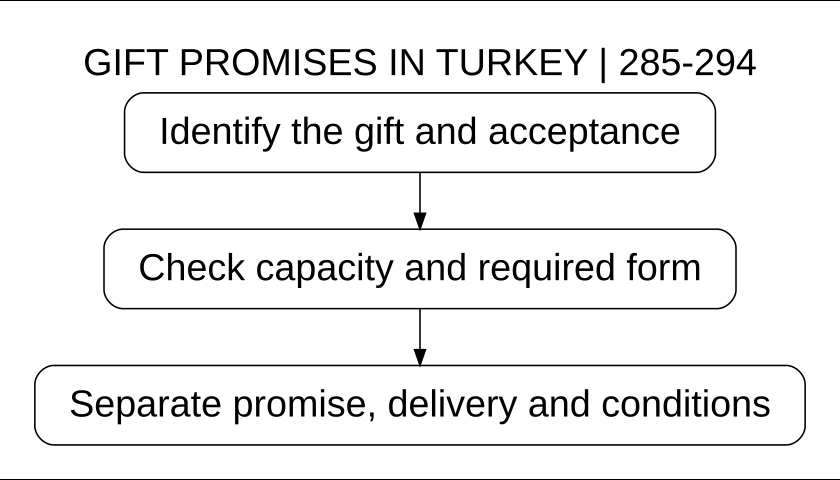
Article 285 requires a gratuitous benefit effective between living persons
The statutory gift is a contract by which the donor undertakes to provide the recipient with a benefit from the donor’s assets without consideration, effective between living persons. The original purpose matters. A family transfer can instead repay a debt, fund an investment, advance a loan or perform a different obligation.
Article 285 expressly excludes fulfilment of a moral duty, rejection of an inheritance and renunciation of a right not yet acquired from the gift category. Those exclusions should not be ignored merely because a transfer was generous or occurred between close relatives.
The primary source is Law No. 6098, Articles 285–294. The file should identify the benefit, donor, recipient and intended legal effect. A bank receipt establishes a movement of funds but does not necessarily establish the entire agreement behind it. The private-loan guide addresses a different relationship where repayment was undertaken.
An unaccepted offer is not the same as an enforceable gift promise
Article 293 permits a person to withdraw a gift offer before the intended recipient accepts, even if the proposed item has already been physically separated from the donor’s other property. Setting an item aside therefore does not alone establish that the recipient acquired a contractual right to demand it.
Keep the offer, acceptance and performance dates distinct. A statement expressing a future intention, a completed agreement and an actual transfer answer different questions. The evidence should show which stage was reached rather than refer to every event as the date of the gift.
Acceptance does not dispense with the applicable form requirement. A recipient’s enthusiastic reply to an informal promise concerning land does not, merely by showing assent, prove the official act required by Article 288. Formation, form and transfer must each be assessed.
An ordinary gift promise must satisfy written form
Article 288 makes writing a condition of validity for a gift promise. Identify the actual written undertaking and the property or amount promised. A later recollection of a conversation is evidence of what someone says occurred, not automatically a contract made in the required form.
Articles 14–15 govern the signatures and recognised methods relevant to written form. The person undertaking the obligation and the text adopted by that person must be identifiable. A copied signature image, a typed message and a legally qualifying secure electronic signature should not be treated as identical objects.
The written-form and signature guide explains that separate framework. Preserve the signed instrument and its attachments rather than rely only on a cropped screen image. A promise to give an unspecified benefit should also be distinguished from an identified obligation whose performance can be assessed.
Immovable gifts require the more demanding official form
A promise to give immovable property or a real right over it is valid only in official form under Article 288. Ordinary writing is not enough merely because the parties used a detailed agreement or obtained signatures from witnesses. The legal nature of the executed act must match the required form.
Giving possession, handing over keys or allowing the recipient to occupy premises does not invoke the ordinary-form cure for a gift requiring official form. Article 288 expressly excludes that category. The intended gift, the permission to use the property and the actual property-right position should therefore be examined separately.
The undertaking to transfer and completion of the property transfer are also distinct questions. Obtain the official instrument and relevant registry records instead of describing a private promise as completed ownership. Eligibility, restrictions and any other rules applying to the particular property require their own review.
Performance cures one kind of form defect, not every defect
Under Article 288, a promise invalid because ordinary form was not observed has the effect of a delivered gift when the donor performs it. The statutory distinction prevents an explanation that treats every completed movable gift as invalid solely because no earlier written promise existed.
The cure is expressly unavailable for gifts whose validity requires official form. It also addresses the stated form defect, not a universal cure for incapacity, lack of authority or a different defect in the transaction. Identify exactly which problem is said to have been cured before relying on the rule.
Performance must itself be established. A transfer instruction, an intended future payment and a completed transfer are different events. Record the asset or amount actually supplied and the purpose established by the agreement. Where only part was performed, do not describe the entire unperformed promise as completed without a separate legal assessment.
Article 289 concerns delivery of the donor’s movable property
The Code constitutes a hand-to-hand gift through delivery of the donor’s movable property to the recipient. The emphasis is on the legally relevant delivery, not merely the donor announcing an intention. Identify the item, the parties and the actual change in possession relied on.
The delivery record should distinguish outright giving from temporary custody, lending for use or holding an item for another person. A recipient keeping a valuable object does not necessarily prove that ownership was gifted. The surrounding agreement and communications explain the legal purpose of possession.
The safekeeping guide and free-use loan guide address those separate arrangements. They should not be replaced by a gift assumption merely because no rent or fee was charged.
The donor’s capacity and family-law restrictions remain relevant
Article 286 allows a person with legal capacity to make gifts while preserving restrictions arising from the spouses’ property regime and inheritance law. The ability to sign a document should not be presented as a guarantee that every gift is immune from those separate restrictions.
The article also addresses a court restriction for prodigality resulting from proceedings started within one year following the gift. In that situation, the court may annul the gift. The text concerns when the proceedings began; it does not simply say that every restriction decision made at any later time automatically reverses the transaction.
Preserve the actual capacity-related records and the transaction date. Age, illness, residence abroad or a family member’s disagreement should not be treated as a substitute for the relevant legal facts. A person’s capacity to make this act and the property restrictions affecting it require their own analysis.
The recipient’s ability to accept has a separate statutory rule
Article 287 allows a person lacking legal capacity to accept a gift if that person has discernment. It also provides that the gift ceases if the recipient’s legal representative prohibits acceptance or orders return of the donated item. Both parts of the rule must be retained in the explanation.
Identify whether the proposed transaction is a straightforward benefit or also requires the recipient to undertake obligations. A provision allowing acceptance of a gift should not be expanded into an unrestricted power to assume every accompanying liability. The actual terms and applicable representation rules still need review.
Keep the representative’s identity and authority separate from a relative’s informal opinion. The statute refers to the legal representative, not automatically anyone who knows or cares for the recipient. The document file should establish the role relied on before treating a request for return as exercising Article 287.
Conditions and accepted burdens are not interchangeable
Article 290 allows a gift to be conditional. The agreement should identify the condition and its effect on the promised benefit. A donor’s uncommunicated expectation is not automatically a condition that can later be inserted into a completed transfer.
Article 291 separately permits burdens accepted by the recipient under the agreement and allows the donor to demand their performance. Distinguish the event controlling the gift’s effect from an obligation the recipient undertakes to carry out. The wording determines what must happen and which remedy requires examination.
The conditional-contract guide explains the general distinction between conditions governing commencement and ending of contractual effects. The specific gift provisions must also be applied; using a label such as conditional donation does not eliminate their requirements.
A burden’s cost can limit the recipient’s duty to perform it
Article 291 allows the recipient to refuse the burden where the value of the gift does not cover its performance costs and the excess is not paid. A donor should not therefore assume that every accepted burden must be performed regardless of cost and the statutory qualification.
Identify the accepted task, value of the donated subject and the expenditure required. A dispute about whether the burden existed is different from a dispute about the cost of fulfilling an established burden. The evidence should make clear which issue is being raised.
For a public-interest burden, the right to demand performance passes to the relevant public institution after the donor’s death. This concerns the stated enforcement right, not an automatic transfer of the donated property to that institution. Keep the beneficiary, burden and person entitled to require its performance distinct.
A gift linked to the donor’s death engages testamentary rules
Article 290 states that a gift whose performance depends on the donor’s death is subject to the rules on wills. It should not be treated as an ordinary lifetime promise merely because a private document calls it a gift. The event making performance due and the intended legal effect are decisive.
This is different from Article 292’s return condition if the recipient dies before the donor. That provision permits the donor to stipulate return of the donated subject in that event and permits annotation in the land register where the subject is immovable property or a real right over it.
The two directions of the death condition must not be reversed in drafting or translation. One concerns performance following the donor’s death; the other concerns return when the recipient dies first. Record whose death triggers which consequence and obtain the form and registry review required for that arrangement.
An agent needs specific authority to make the gift
Article 504 states that an agent cannot make a gift without special authorisation. A general mandate to manage assets or carry out transactions should therefore not be assumed to include gratuitous disposal of those assets. Obtain the actual authority document and the instruction for the proposed gift.
The representative’s power is separate from the gift’s form and the donor’s capacity. A document establishing authority does not itself complete the promised gift, and a formally executed gift document does not automatically prove the representative had the required power.
The unauthorised-representation guide addresses the distinct approval and liability framework. For a donor abroad, confirm the instrument, permitted act, asset and recipient before relying on a local representative to perform it.
A donor’s liability is not automatically the same as a seller’s warranty
Article 294 makes the donor responsible for damage arising from the gift where the donor caused it through gross fault. It separately binds the donor to an additional guarantee promise made about the donated item or claim. Those rules should not be replaced with the full ordinary sale-warranty framework without identifying a supporting legal basis.
Preserve any express guarantee and the representation actually made about the subject of the gift. A factual description, a separate guarantee and the recipient’s assumption can have different significance. The existence of a defect or disputed right does not itself establish what additional undertaking the donor gave.
Any damages demand should identify the conduct, the applicable responsibility rule and the resulting loss. Equally, the gratuitous character of the transaction is not a universal exemption from every express promise or every harmful act. The precise statutory and contractual basis must be stated.
Binding formation does not mean a gift can never later be challenged
Articles 295–297 address the different questions of revoking a completed gift and withdrawing from an unperformed promise in specified circumstances. The gift-revocation guide explains those grounds and periods. A mere change of mind should not be substituted for a statutory ground after the relevant agreement or transfer exists.
Inheritance equalisation, reserved-share protection and taxation are also separate inquiries. A valid lifetime gift is not automatically exempt from every later estate adjustment or reporting obligation. This guide does not supply an assumed tax rate or declare a particular family transfer free of tax without examining the relevant law and facts.
For an international transaction, determine the applicable law and formal-validity rules before applying this domestic framework. The governing-law guide explains that preliminary inquiry for contractual issues. Property, succession and formal-validity questions can require their own conflict rules.
Prepare a gift file that shows exactly what occurred
| Question | Record to obtain |
|---|---|
| Was it gratuitous? | The agreement and communications explaining the benefit’s purpose. |
| Was the offer accepted? | The actual offer, response and relevant dates. |
| Was the required form used? | The complete signed or official instrument. |
| Was performance completed? | Delivery, payment or relevant property-transfer records. |
| Were conditions or burdens agreed? | The accepted wording, intended trigger and performance evidence. |
| Who had capacity and authority? | The applicable personal and representative records. |
Keep originals beside translations, particularly where words such as promise, condition, burden and return are material. Any pending court or registry matter needs its own procedural assessment. A family discussion or request for the gift document does not itself suspend a legal deadline.
Frequently asked questions
Must a Turkish gift promise be written?
Article 288 requires writing for an ordinary gift promise. A promise concerning immovable property or a real right requires official form.
Does handing over keys cure an informal promise to give land?
Not under Article 288’s performance cure, which expressly excludes gifts requiring official form. Permission to occupy and a valid property gift are different questions.
Can performing an unwritten promise have legal effect?
Article 288 gives a promise invalid for ordinary lack of form the effect of a delivered gift when performed. It does not cure every other defect or apply to official-form gifts.
Can an unaccepted gift offer be withdrawn after the item was set aside?
Yes. Article 293 permits withdrawal until acceptance even if the donor physically separated the proposed item from other property.
Does every family payment count as a gift?
No. Establish the gratuitous purpose under Article 285 and distinguish loans, debt payment, investment and the statutory exclusions, including fulfilment of a moral duty.
Can a recipient lacking legal capacity accept a gift?
Article 287 permits acceptance where the recipient has discernment, subject to the legal representative’s prohibition or order to return. Accompanying obligations need separate review.
Must an accepted burden be performed regardless of cost?
Article 291 permits refusal where the gift’s value does not cover the performance cost and the excess is not paid. Establish the accepted burden and the figures.
Is a gift performed only after the donor’s death an ordinary lifetime promise?
Article 290 applies testamentary rules where performance depends on the donor’s death. It must be distinguished from a return condition if the recipient dies first.
Does a general asset-management mandate automatically permit gifts?
Article 504 requires special authority for an agent to make a gift. Check the actual instrument separately from the gift’s own form and capacity requirements.
Does this formation guide decide every revocation or inheritance dispute?
No. Formation, later gift revocation, estate adjustment and taxation have separate requirements. Identify the claim and governing rules before selecting a remedy.
Official legal sources
Turkish Code of Obligations No. 6098, Articles 14–15, 285–294 and 504; official Ministry text, pages 57–58, containing gift formation, capacity and conditions. This English explanation is not an official translation or a tax or estate assessment of an unidentified transfer.
Ask about a promised or completed gift
State the asset, whether a document was signed, whether it was delivered and any agreed condition. Arrange a confidential channel before sending personal or financial records.
Istanbul and Mersin offices
Bakırcı & Keskin Law Office is Mersin-based and works throughout Türkiye with an Istanbul and Mersin focus.
Istanbul — Polaris Plaza
Maslak Ahi Evran Caddesi, Polaris Plaza No:21, Floor 9, 34475 Sarıyer/İstanbul.
Mersin — Profit İş Merkezi
İhsaniye Mahallesi, 4903. Sokak, Profit İş Merkezi No:23, Floor 3, Office 14, 33070 Akdeniz/Mersin.
Call +90 552 224 43 66. An enquiry does not establish representation or suspend a legal deadline.
Contact regarding a legal matter
In your first message, you may briefly state the subject, your country or city, and any relevant notification or recent procedural date. Please do not send identity numbers, medical data, or personal documents. Messaging alone does not constitute legal advice or create a lawyer–client relationship.
Discover more from Bakırcı & Keskin Hukuk Bürosu
Subscribe to get the latest posts sent to your email.