Must a Tenant Buy Extra Services in Turkey? Linked Contracts Under TCO 340
A landlord cannot avoid Turkish tenant protections merely by placing an unrelated obligation in a separate agreement. Article 340 of the Turkish Code of Obligations invalidates a linked contract where establishing or continuing a residential or roofed-workplace lease is made conditional on the tenant undertaking an obligation without benefit to the tenant and without a direct connection to using the premises. The statutory conditions must be established together. Not every service package, furniture arrangement or expense is invalid, but calling an obligation optional or putting it on another company’s invoice does not settle the issue.
Have a general question about this article? Ask anonymously
Start with the protected rental category
Article 340 belongs to the residential and roofed-workplace provisions. Article 339 also applies that section to items supplied for use with the premises. Establish the character of the tenancy before applying the linked-contract rule: a home, a qualifying workplace and an entirely different commercial arrangement do not become identical merely because a document mentions rent.
Article 339’s exception for property inherently allocated to temporary use and rented for six months or less requires attention to both features. A brief contractual duration alone is not proof that an ordinary home is outside the section. Likewise, the tenant’s foreign nationality or corporate status does not itself answer the property classification.
The source is Law No. 6098, Articles 339–340. Keep the premises description, actual use, lease and any occupancy terms. A statement that the contract is a membership agreement should be checked against its real content rather than accepted as conclusive classification.
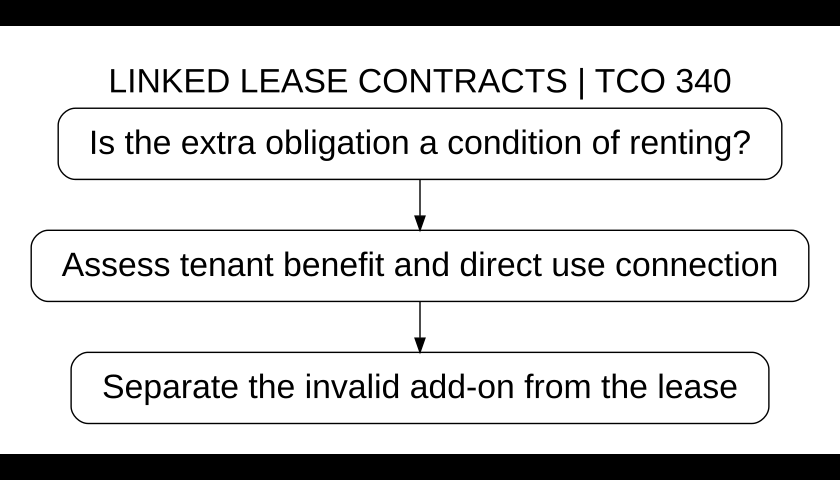
The Article 340 conditions are cumulative
The rule concerns the lease’s formation or continuation being tied to another obligation. That obligation must lack benefit to the tenant and lack a direct relationship with use of the rented premises. The article then identifies the linked contract as invalid. An analysis that proves only that two documents were signed on the same day leaves the remaining conditions unanswered.
Set out each element separately. Identify the rental condition, the additional obligation, its asserted benefit and its connection with use. This prevents a dispute from being reduced to a vague claim that an add-on is unfair or expensive. Price can be evidence in the wider assessment, but Article 340 is not simply a universal price-control formula for every service supplied near a rented building.
The tenant and landlord should work from the same document set. Keep advertisements, draft offers, final agreements and messages explaining which items were compulsory. Where the parties disagree about what was offered, preserve the different versions instead of silently replacing the original proposal with the current sales brochure.
Was the additional undertaking truly a condition of the tenancy?
The relevant question is whether the tenant could establish or continue the lease without undertaking the extra obligation. A genuinely independent service purchased voluntarily presents a different case from an obligation imposed as the price of obtaining or keeping the premises. The description optional is not enough if the communications show that refusal would prevent the letting.
Identify the person making that condition and the stage at which it was imposed. A clause in the signed lease is one kind of evidence; a written refusal to hand over keys until another agreement is signed is another. The record should connect the demand with the tenancy rather than assume every supplier recommendation from a letting agent is mandatory.
Keep evidence of any request to decline or remove the add-on and the response. A tenant need not invent a refusal that never occurred. Existing documents may explain the arrangement, while an absence of evidence should be identified honestly instead of filled with a reconstructed conversation presented as an original record.
The rule also addresses conditions imposed to continue an existing lease
Article 340 expressly covers continuation, not only initial formation. An obligation introduced after the tenant has moved in therefore still needs the statutory assessment. The date of the lease does not make every later service or purchase requirement immune from examination.
Article 343 separately prohibits changes against the tenant other than determination of rent within the residential and roofed-workplace framework. A proposed renewal package should therefore be reviewed for both the tied obligation and the effect of any new lease terms. Raising an Article 340 issue does not itself decide whether a claimed rent increase complies with the different rent rules.
The contract-amendment guide addresses consent and execution. Receipt of a renewal email is not automatically acceptance of every attachment, and signing one document should not be reported as signing another document that was not included.
Assess the tenant’s benefit, not merely the supplier’s description
Article 340 includes the absence of tenant benefit as part of its test. Identify what the additional obligation actually provides, whether the tenant can use it and what obligations the supposed benefit carries. An advertised package and a service genuinely available under enforceable terms are not the same evidence.
Do not assume that a service lacks benefit solely because the tenant later decides not to use it. Equally, the supplier’s assertion that the arrangement is convenient does not establish benefit in the actual transaction. Examine the contractual entitlement, restrictions and connection with the tenant’s use rather than substituting either party’s preference for the legal analysis.
A benefit schedule can record the promised deliverable, provider, availability, price and termination conditions. This is a practical way to make the disputed facts testable. It should not conceal an additional debt or long-term commitment inside a general description of assistance.
A direct connection to using the premises is a separate requirement
The second substantive inquiry concerns the obligation’s direct relationship with use of the rented property. Being promoted by the same group of companies or offered at the same reception desk does not itself prove that connection. The agreement should identify what the tenant must buy or undertake and why it relates to the actual premises.
Utility and genuine operating-cost arrangements need a different analysis from an unrelated purchase. Article 341 ordinarily addresses expenses such as heating, lighting and water and requires copies of supporting documents on request. That express framework should not be ignored by describing every payment outside the stated base rent as an invalid linked contract.
Conversely, a label such as building services does not prove that the whole charge represents use expenses. Obtain the underlying scope and account. The late-rent charges guide explains the separate Article 346 restrictions on additional payment obligations and default penalties.
Furniture, deposits and optional services require classification, not blanket answers
Article 339 expressly recognises items supplied with the rented premises. Record which furniture or equipment is included in the letting and what the tenant is required to return. A furniture inventory and a compulsory purchase agreement do not create the same obligations merely because they concern the same objects.
Article 342 separately regulates security, including the three-month-rent ceiling and its bank-holding arrangements. A qualifying deposit is not made invalid simply by calling it an additional obligation. The deposit guide addresses its own validity and release conditions.
A genuine optional service should have a clear choice, scope and price. The file should show whether rejecting it affects the tenancy. These distinctions prevent both overstatement by the tenant and attempts to present an unrelated mandatory purchase as routine rental administration.
A third-party payee does not resolve the linkage question
The landlord, letting intermediary and provider of an additional service may be different legal persons. Map their roles and the obligation each claims. The fact that the extra payment goes to a separate supplier is not, on its own, an answer to whether the lease was made conditional on the tenant undertaking it.
Equally, a separate company should not be treated as responsible for every promise made by a landlord without evidence of its role or authority. For a refund, identify who received the money and on what basis. For continuation of the tenancy, identify who holds the landlord position and who can make the relevant declaration.
Keep invoices and bank details linked with the agreement they purport to perform. A transfer to an agent’s account can raise authority and receipt issues in addition to the validity of the linked obligation. Do not resolve those issues simply by selecting the party with the most recognisable trading name.
Standard terms can require scrutiny even where Article 340 is not established
Articles 20–25 regulate pre-written standard terms. They address incorporation, unexpected terms, interpretation, unilateral changes and provisions contrary to good faith that disadvantage the other party. Failure to establish every Article 340 condition does not itself certify every clause in a template as enforceable.
Determine whether the disputed wording was prepared for repeated use and what information and opportunity to review it were provided. Article 20 states that a printed acknowledgement that each clause was discussed is not alone sufficient to remove terms from the standard-conditions category. Preserve the actual formation record rather than rely only on that acknowledgement.
The standard-contract-terms guide addresses the broader framework. State which legal ground applies to each challenge rather than using the terms unfair, hidden and linked as interchangeable conclusions.
Article 340 identifies the linked contract as invalid
The provision’s stated consequence concerns the linked contract. It should not be converted into an automatic declaration that the tenant no longer owes any rent or can abandon the premises without considering the tenancy. The additional obligation and the underlying rental relationship must be kept distinct.
Identify exactly which contract or undertaking is challenged and which obligations remain undisputed. The parties may have several lawful and unlawful arrangements in the same transaction. The response should not erase every independent obligation merely because one tied agreement fails the statutory test.
Where the documents combine several undertakings into one text, assess the effect on the individual provisions and the relevant rules on invalidity. A heading saying entire package is non-severable is not a substitute for that legal analysis. Nor does a landlord’s refusal to recognise the objection establish that invalidity has been cured.
Refusing the add-on and ending the lease are different acts
A tenant seeking to continue the tenancy should say so clearly when contesting an additional obligation. An ambiguous message cancelling everything can create a separate dispute about the tenant’s intention. Identify the challenged add-on, the Article 340 basis and the continuing performance of valid rental duties.
A landlord’s threat to end the lease because the tenant rejects the add-on requires assessment under the applicable termination rules. Article 347 does not permit a protected landlord to end a fixed-term lease merely because its printed term expired. The particular claim and any notice must be reviewed rather than assume that an invalid linked obligation supplies an independent eviction ground.
Physical access and lawful recovery of possession remain separate matters. The landlord-access guide explains why an ownership claim or contractual disagreement is not unrestricted permission to enter an occupied home.
Recovering money already paid requires the full payment record
Articles 77 and following address unjust enrichment and performance based on a legally insufficient ground. A person seeking return of an add-on payment must establish the amount, recipient and basis of the transfer. The Article 340 assessment identifies invalidity; it does not replace every separate restitution condition or defence.
Article 78 contains the rule for voluntarily performing a debt that did not exist, including its stated mistake condition. Article 82 provides limitation rules for unjust-enrichment claims. Keep the demand, explanation, payment reference and knowledge chronology rather than assume every disputed payment can be recovered through an identical procedure.
Do not automatically deduct the disputed payment from later rent. A refund claim, an agreed credit and a legally effective set-off are different routes. The set-off guide explains the general requirements; the existence of an asserted counterclaim does not alone establish that a rent instalment has been discharged.
Preserve the connection between the documents and the rental condition
| Evidence | What it helps establish |
|---|---|
| Lease and occupancy terms | The protected rental category and the underlying obligations. |
| Add-on agreement | The exact additional debt or service commitment. |
| Offer and continuation messages | Whether renting depended on undertaking the add-on. |
| Service specification | The claimed tenant benefit and direct connection with use. |
| Invoices and transfers | The actual recipient, amount, purpose and dates of payment. |
| Notice or proceeding | The remedy demanded, relevant parties and service timetable. |
Retain complete electronic records and attachments. A screenshot of a price without the surrounding rental condition may omit the fact central to Article 340. The electronic-evidence guide explains why original and contextual records matter. Obtain evidence lawfully and do not enter another person’s accounts to reconstruct a missing conversation.
Identify the claim and parties before choosing a procedural route
Article 18/B(1)(a) of Law No. 6325 generally requires mediation before a rental-relationship lawsuit, with its stated enforcement-eviction exception. A dispute involving a separate supplier and several contracts requires classification of the actual claim and parties; the rental label does not automatically settle every procedural issue.
For an overseas tenant or landlord, provide the signed versions in every language and identify any representative who approved the arrangement. An agent authorised to find accommodation is not automatically authorised to settle all refund and possession claims. A settlement should state the obligations ended, sums returned and continuing lease terms.
Any served lawsuit or enforcement document needs its own timely response. Asking the landlord to explain an add-on or commencing negotiations is not a substitute for that procedural act. The objective is a precise conclusion about the tied obligation while protecting the lawful rental position.
Frequently asked questions
Does every extra service in a Turkish lease violate Article 340?
No. Establish the rental condition, absence of tenant benefit and absence of a direct connection with use within the protected lease category.
Can the rule apply when an add-on is imposed at renewal?
Yes. Article 340 expressly addresses both establishing and continuing the lease. Record when and how the additional condition was imposed.
Does putting the obligation in a separate contract solve the problem?
No. The provision addresses linked contracts. Their actual relationship to the tenancy matters more than whether they use separate signature pages.
Is a third-party supplier automatically outside the analysis?
The payee’s identity alone does not decide linkage. Establish the obligation, rental condition and each party’s role before deciding validity or repayment responsibility.
Are heating and water charges automatically invalid add-ons?
No. Article 341 separately addresses use expenses and supporting documents. Classify genuine expenses apart from an unrelated mandatory obligation.
Does invalidity of the linked contract erase all rent?
No automatic result of that kind follows. Article 340 identifies the linked contract as invalid; the rental duties require a separate account.
Must the tenant have refused before any legal assessment is possible?
Use the actual evidence of the arrangement. A documented condition can be relevant without inventing a refusal or conversation that never occurred.
Does failure to prove Article 340 validate every standard term?
No. Standard-terms control, additional-payment restrictions and other applicable rules have their own conditions and may require separate examination.
Can a disputed add-on payment simply be offset against rent?
Not automatically. Establish the recovery claim and a valid credit or set-off mechanism before treating a rental instalment as paid.
What records should an international client provide?
Provide the lease, add-on terms, messages linking the two, service scope, payment evidence and any notices or served papers, with all signed language versions.
Official sources and scope
Turkish Code of Obligations No. 6098, Articles 19–25, 77–82 and 339–347; Mediation Law No. 6325, Article 18/B. This English explanation is not an official translation or a determination of an unidentified mixed transaction.
Ask about a compulsory rental add-on
State the premises, the extra obligation and how it was connected to renting or renewal. Use an agreed confidential channel for contracts and payment records.
Istanbul and Mersin offices
Bakırcı & Keskin Law Office is Mersin-based and works throughout Türkiye with an Istanbul and Mersin focus.
Istanbul — Polaris Plaza
Maslak Ahi Evran Caddesi, Polaris Plaza No:21, Floor 9, 34475 Sarıyer/İstanbul.
Mersin — Profit İş Merkezi
İhsaniye Mahallesi, 4903. Sokak, Profit İş Merkezi No:23, Floor 3, Office 14, 33070 Akdeniz/Mersin.
Call +90 552 224 43 66. An enquiry does not establish representation or suspend a legal deadline.
Contact regarding a legal matter
In your first message, you may briefly state the subject, your country or city, and any relevant notification or recent procedural date. Please do not send identity numbers, medical data, or personal documents. Messaging alone does not constitute legal advice or create a lawyer–client relationship.
Discover more from Bakırcı & Keskin Hukuk Bürosu
Subscribe to get the latest posts sent to your email.